
Introduction: The Two Universes We Live In
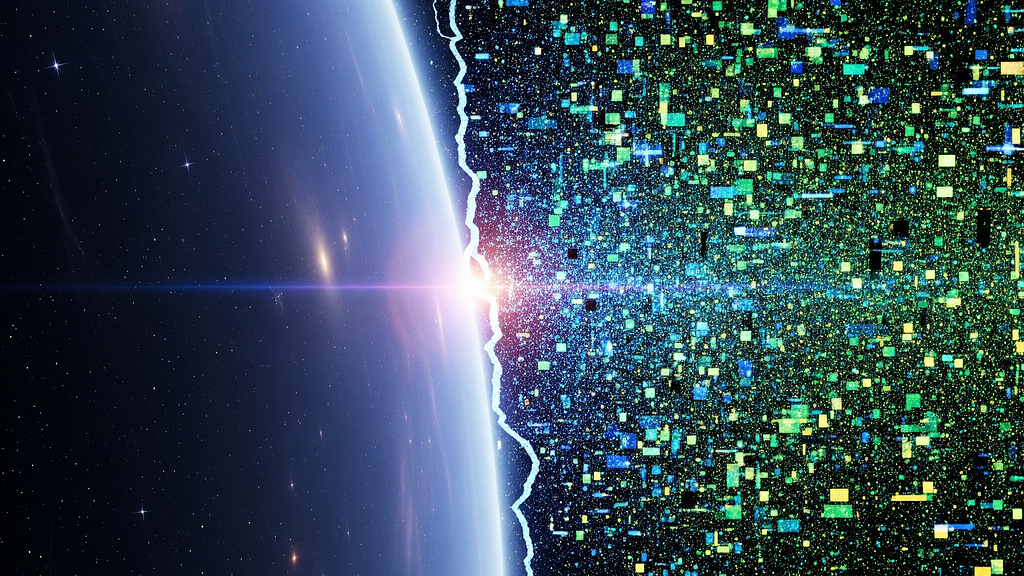
What if the smooth, continuous flow of time is an illusion? What if the space you move through is not an empty void, but a seething, pixelated gridwork of unimaginable energy? These are not questions from science fiction, but from the very heart of modern physics, where a century-long crisis has forced scientists to question the fundamental nature of reality itself.
Our understanding of the universe is built upon two magnificent theoretical pillars. The first is Albert Einstein’s General Relativity, an epic poem about the grand, sweeping waltz of planets, stars, and galaxies. It describes a cosmos where space and time are interwoven into a smooth, flexible fabric, warped and curved by the presence of mass and energy. The second pillar is Quantum Mechanics, a chaotic, punk-rock saga of the subatomic world. It governs a bizarre realm of uncertainty and probability, where particles can be in multiple places at once and can pop into existence from nothing.
Individually, these theories are spectacularly successful, underpinning everything from GPS navigation to the computer you are using now. But there is a profound, irreconcilable problem: they absolutely refuse to work together. This is not merely a mathematical quirk; it is a deep philosophical chasm. The conflict represents the ultimate clash between the deterministic, predictable world of our everyday experience and the probabilistic, uncertain nature of fundamental reality. Einstein’s theory reflects a universe that is, at its core, understandable and predictable. Quantum mechanics suggests the opposite — that at the smallest scales, reality is fundamentally random. The quest to resolve this dissonance, to find a single, unified language that can describe both the cosmic and the quantum, is the search for a theory of Quantum Gravity.
Part I: A Cosmic Divorce
Einstein’s Masterpiece: The Smooth, Bending Universe
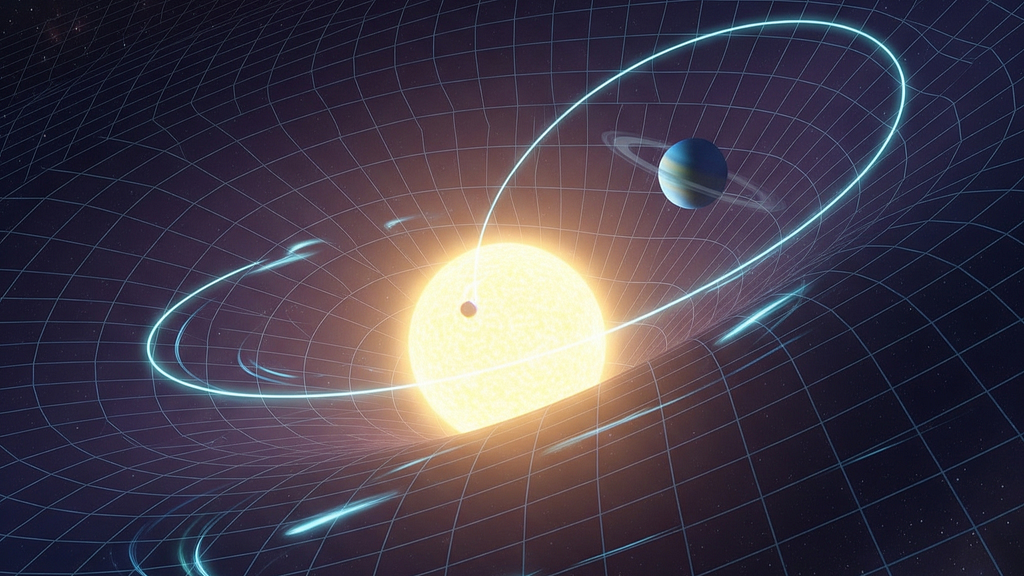
To grasp the conflict, one must first appreciate the elegance of Einstein’s creation. General Relativity reimagines gravity not as a mysterious force pulling objects together, but as a feature of the universe’s geometry. Imagine space and time not as a rigid stage, but as a dynamic, four-dimensional fabric, like a giant trampoline or a cosmic gel. When a massive object like the Sun is placed on this fabric, it creates a deep curve. A smaller object, like the Earth, rolling nearby, follows this curvature, creating what we perceive as an orbit.
The success of this idea is staggering. It explains with perfect precision why the coffee stays in your cup, how light bends around stars, and how black holes can trap everything, including light itself. Its predictions have been confirmed time and again, most spectacularly in 2015 with the detection of gravitational waves — ripples in the spacetime fabric itself, generated by the collision of two black holes over a billion light-years away. The core assumption, the very soul of this theory, is that spacetime is perfectly smooth and continuous, like an unbroken sheet of silk.
Down the Rabbit Hole: The Bizarre, Chunky Quantum Realm
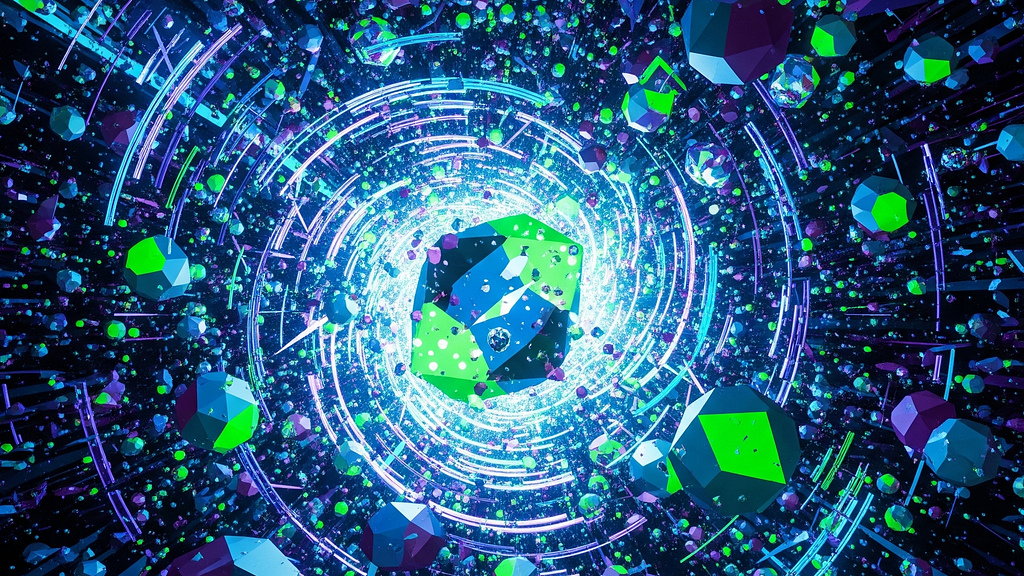
Now, descend into the quantum world, where all notions of classical smoothness are violently discarded. At the smallest scales, reality becomes fundamentally bizarre and granular. Particles do not have definite positions until they are measured; instead, they exist as clouds of probability. Energy is not a continuous flow but comes in discrete packets called “quanta.” It is like discovering that a beautiful, smooth photograph is, upon extreme magnification, composed of individual pixels. The quantum world suggests that everything, at its most basic level, is pixelated.
This “chunky” description has been used to successfully explain three of the four fundamental forces of nature. Electromagnetism is carried by discrete photons. The strong nuclear force, which binds atomic nuclei, is carried by gluons. The weak nuclear force, responsible for radioactive decay, is mediated by W and Z bosons. Each force has its own quantum messenger particle. The one stubborn outlier, the one force that has resisted all attempts at quantization, is gravity.
The Incompatibility Crisis: When the Math Breaks Down
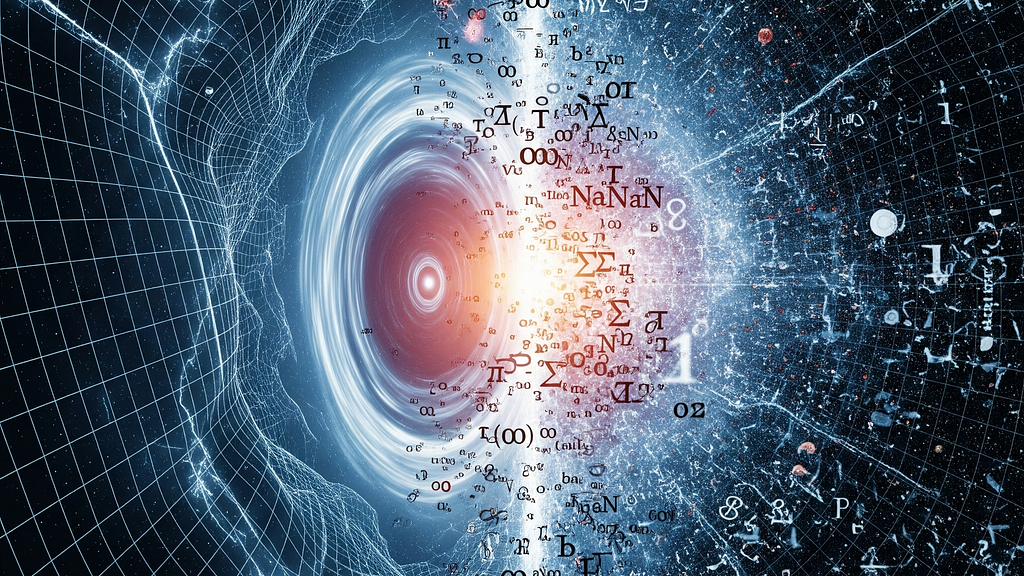
Here lies the heart of the crisis. General Relativity’s smooth, geometric stage is fundamentally incompatible with the quantum mechanical requirement that all forces be mediated by discrete particles on a grainy, probabilistic backdrop. When physicists attempt to combine the two — to calculate the gravitational effects at quantum scales — the mathematics literally breaks down. The equations, which should yield sensible, finite numbers, instead spit out nonsensical infinities. It is the mathematical equivalent of a system crash, a clear signal that a fundamental piece of the puzzle is missing. The script’s analogy is perfect: it is like having a perfect recipe for chocolate and another for vanilla, but when you mix them, the result is chaos.
This is not some abstract academic exercise. This breakdown of physics becomes a stark reality in the most extreme environments in the universe. At the singularity at the heart of a black hole, gravity becomes infinitely strong in an infinitesimally small space. In the first moments after the Big Bang, the entire observable universe was smaller than an atom. In these places, the very large and the very small collide, and both theories must apply. Yet they contradict each other, leaving us blind at the very moments of creation and cosmic extremity. However, these points of failure are not just dead ends; they are powerful signposts. Historically, the failure of an established theory is what paves the way for a revolution. These singularities are nature’s way of screaming that our understanding is incomplete, providing the most fertile ground for discovering the new physics of quantum gravity.
Part II: The Search for a Common Language
Pixelating Reality: The Radical Idea of a Quantum Spacetime
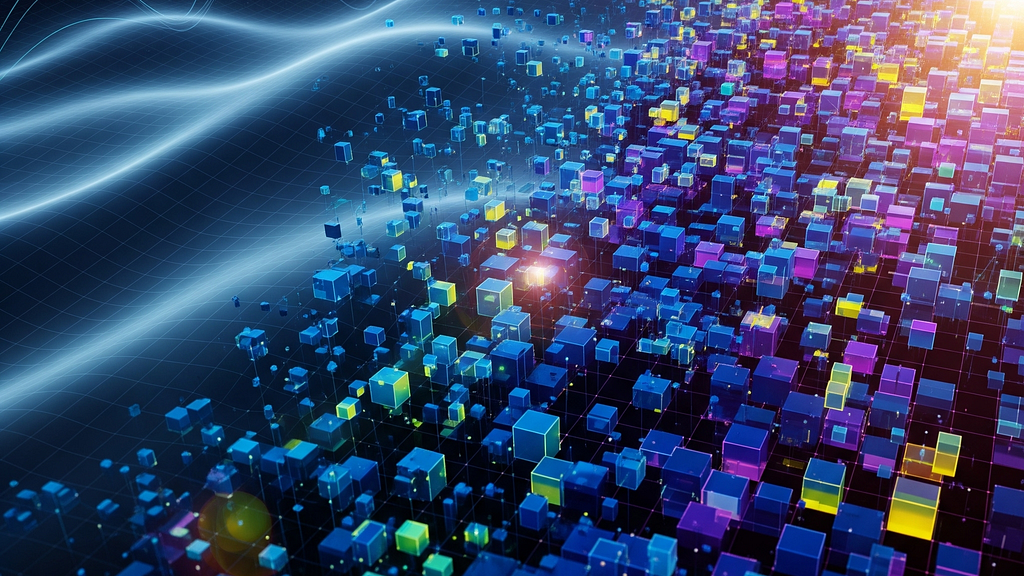
The proposed solution is as radical as it is elegant: what if space and time themselves are not fundamental, but are quantized? Imagine zooming into the fabric of reality, far past the scale of atoms and their nuclei. As you approach the smallest possible scale, known as the Planck scale — an absurdly tiny 10^-35 meters — the smooth, continuous fabric of Einstein’s universe might dissolve into a grid of discrete, indivisible units.
This is the central idea behind quantum gravity. Just as a seemingly smooth phone screen is made of individual pixels, the universe might be built from fundamental “chunks” of space and “ticks” of time. This concept immediately tames the infinities that plague the current theories. If there is a minimum possible distance, a fundamental pixel size for the universe, then it is impossible to calculate what happens at zero distance, preventing the equations from breaking down. Reality, in this view, has a finite resolution.
The Graviton: Hunting for Gravity’s Ghostly Messenger
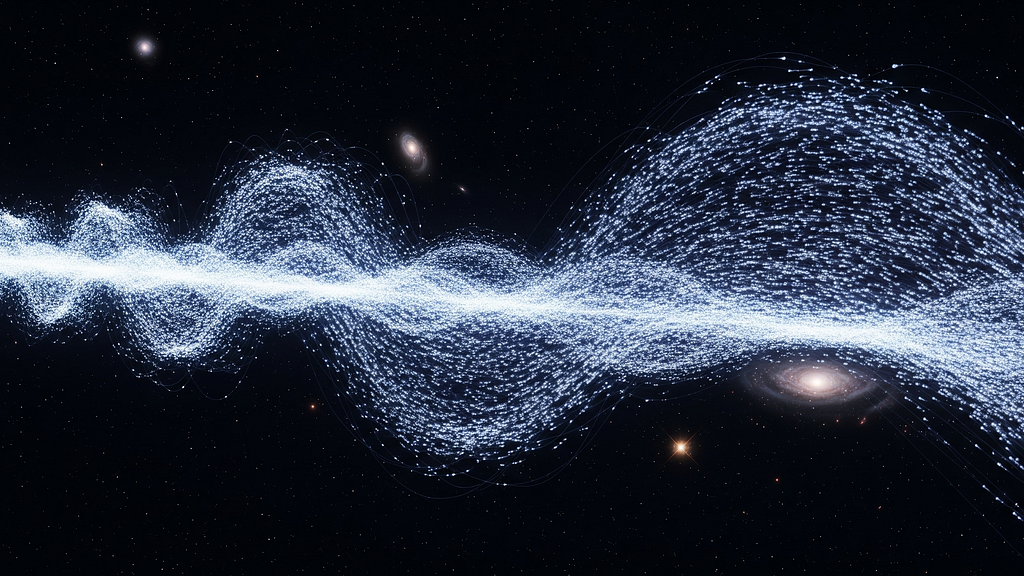
If gravity is a quantum force, it must have a messenger particle. This hypothetical particle is called the graviton. In this picture, a gravitational wave is not a smooth ripple in spacetime, but a vast, coordinated flock of gravitons traveling together. Based on the known properties of gravity, the graviton must have specific characteristics. It must be massless, because gravity has an infinite range, stretching between galaxies billions of light-years apart. It must also have a quantum property called “spin-2,” which, in simple terms, is what allows it to interact universally with all forms of matter and energy — everything feels gravity.
However, finding this particle is a near-impossible task. Gravity is astonishingly weak, about 10,000 billion, billion, billion, billion times weaker than electromagnetism. This means gravitons interact with matter so feebly that they are essentially ghosts. It has been calculated that a detector with the mass of Jupiter, placed in orbit around a dense neutron star, would be lucky to detect a single graviton in a time longer than the current age of the universe. This incredible weakness is not just a practical obstacle; it is the very reason the universe appears classical and smooth to us. The individual quantum “pixels” of spacetime are hidden because their effects are so minuscule. Gravity’s weakness is thus both the source of the problem — making its quantum nature hard to probe — and the reason the problem is so well hidden in our everyday lives.
Part III: The Leading Contenders
Two major theoretical frameworks have emerged as the leading candidates for a theory of quantum gravity, each offering a radically different vision of reality.
String Theory: A Cosmic Orchestra in Ten Dimensions

Perhaps the most famous and ambitious approach is String Theory. It proposes a profound shift in our understanding of fundamental particles. Instead of being zero-dimensional points, all particles — electrons, photons, quarks — are actually unimaginably tiny, one-dimensional vibrating strings of energy.
The theory’s beauty lies in its unifying power. Using the metaphor of a cosmic orchestra, different vibrational patterns, or “notes,” of these strings give rise to all the different particles we observe. One note produces an electron, another a photon. In a stunning mathematical result, one particular vibration produces a particle with the exact properties of the graviton. In String Theory, gravity is not an afterthought; it is a necessary consequence of the theory. The catch, however, is a big one: for the mathematics to work, these strings must vibrate in a universe with 10 or 11 spacetime dimensions. The theory elegantly explains that the extra six or seven dimensions could be “compactified” — curled up into tiny, complex shapes at every point in our familiar 4-dimensional space, too small for us to ever perceive directly.
Loop Quantum Gravity: Weaving the Very Fabric of Spacetime
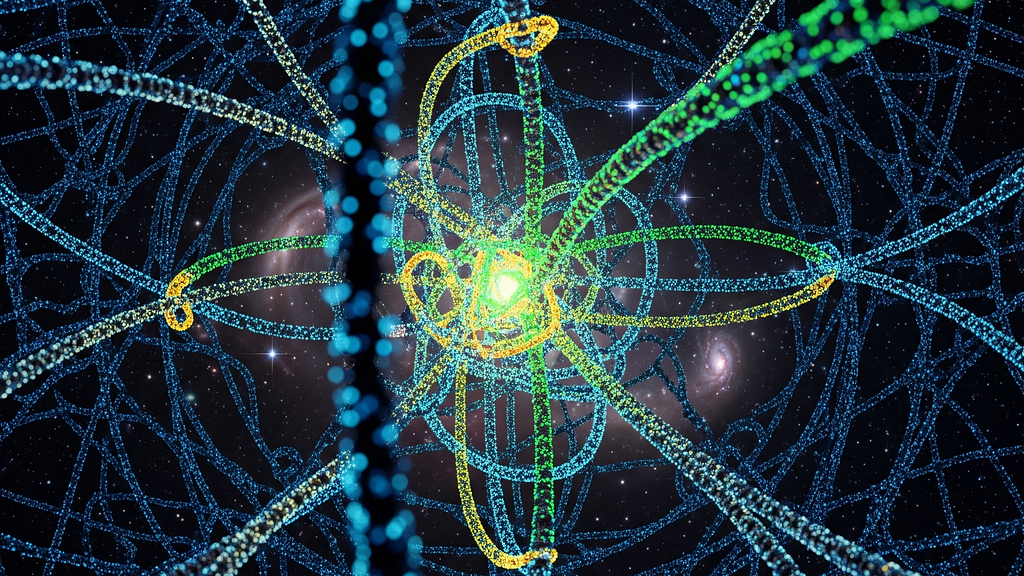
The main rival, Loop Quantum Gravity (LQG), takes a more conservative and direct approach. It does not try to unify all forces into a single theory of everything. Instead, it asks a more focused question: what is spacetime itself made of?.
LQG suggests that the fabric of spacetime is a network, a “cosmic web” woven from fundamental, indivisible loops. Space is not an empty container but is built from these quantum “atoms” of space. This inherently means there is a smallest possible length, a smallest possible area, and a smallest possible volume in the universe. Unlike String Theory, which describes strings moving within a pre-existing spacetime background, LQG is background-independent — the network of loops
is spacetime. It is a direct attempt to build the pixelated universe from the ground up, using only the principles of General Relativity and Quantum Mechanics in the familiar four dimensions.
Part IV: At the Edge of Imagination
Welcome to the Spacetime Foam
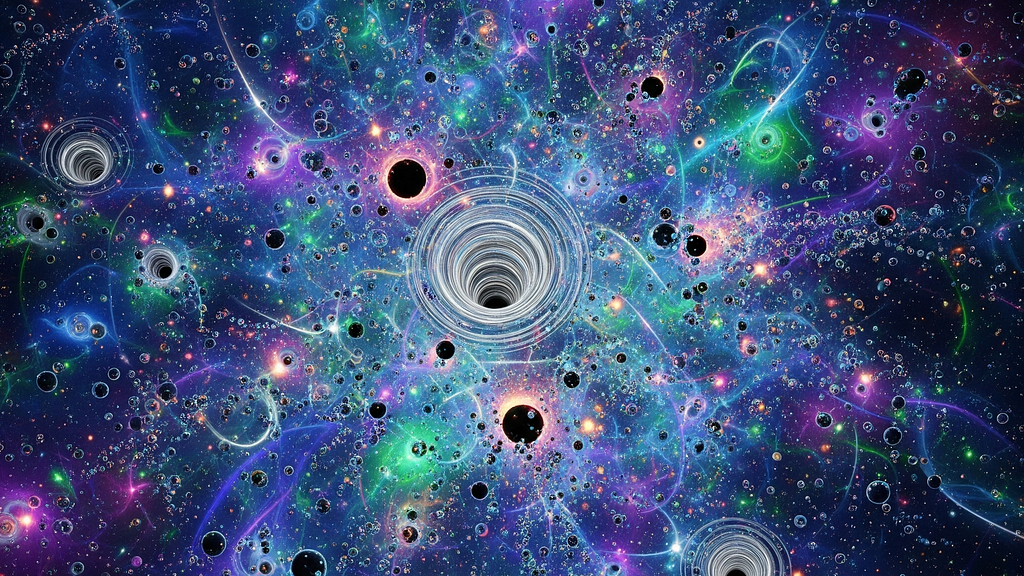
Perhaps the most mind-bending prediction arising from these theories is the concept of “spacetime foam.” Coined by the physicist John Wheeler, it describes the nature of reality at the Planck scale. If one could zoom in to this unfathomable level, spacetime would cease to be a calm, static stage. Instead, it would be a bubbling, frothing, chaotic foam of quantum uncertainty.
Wheeler envisioned this foam as a turbulent quantum soup where tiny wormholes, mini black holes, and virtual particles constantly pop in and out of existence in a ceaseless dance. It is like looking at the surface of a lake: from a distance, it appears perfectly smooth, but up close, it is a dynamic surface of constant ripples, bubbles, and activity. This roiling foam may be the true, fundamental foundation of our reality. Every action, every moment, unfolds atop this invisibly turbulent sea of quantum flux.
Cosmic Detective Work: How to Test the Impossible
With the Planck scale so far beyond the reach of any conceivable experiment, how can scientists ever hope to test these ideas? Direct detection is impossible, but physicists are clever. They have become “cosmic detectives,” searching for subtle, indirect fingerprints that quantum gravity might leave on the universe. This challenge has forced a paradigm shift in what it means to conduct an experiment, moving from smashing particles in colliders to using the entire cosmos as a laboratory.
This new era of scientific investigation involves ingenious methods:
- Light from Distant Quasars: Scientists study light that has traveled for billions of years from distant cosmic beacons. If spacetime is a “fuzzy” foam, it might cause photons of different energies to travel at infinitesimally different speeds. Over cosmic distances, this tiny effect could become measurable.
- Gravitational Waves: The ripples from merging black holes and neutron stars are being analyzed with incredible precision. Scientists are looking for subtle quantum signatures or echoes in these waves that might betray the pixelated nature of spacetime.
- Laboratory Analogues: In university labs, researchers are creating exotic states of matter, like superfluids and Bose-Einstein condensates, whose collective behaviors can be described by mathematics strikingly similar to that of gravitons or black hole event horizons. These systems act as “analogue” universes for testing the theories’ predictions.
Conclusion: Reading the Source Code of Reality
The quest for quantum gravity is far more than an abstract puzzle for physicists. It is the key to answering the most fundamental questions about our existence. Cracking this code would allow us to finally understand what happened in the first moments of the Big Bang, what truly lies at the heart of a black hole, and whether our universe is ultimately a smooth continuum or a discrete quantum tapestry.
The most profound implication may be that space and time are not fundamental at all. They could be emergent properties — illusions that arise from a deeper, more complex reality, much as the sensation of “wetness” emerges from the collective interactions of countless individual H2O molecules. We may discover hidden extra dimensions, or learn that reality itself is a kind of quantum computer processing information on a substrate of spacetime foam.
This grand endeavor is humanity’s attempt to read the universe’s source code — to understand the fundamental programming language in which all of reality is written. The answers remain elusive, hidden at the edge of imagination and experiment. But every theoretical breakthrough and every clever observation brings us one step closer. Is the universe a smooth canvas, as Einstein believed, or a pointillist masterpiece of quantum pixels? The journey to find out is the greatest scientific adventure of all.

