
Physics stands at a precipice, staring into the abyss between its two greatest theories. The key to bridging it might be a particle so ghostly, we may never prove it exists.
The Whisper We Can’t Yet Hear
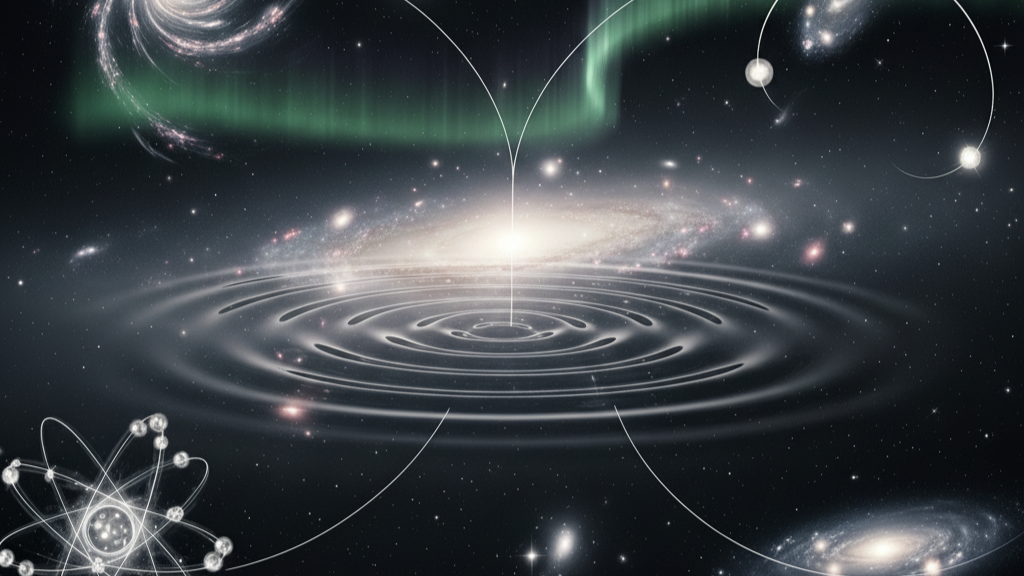
Imagine if the entire universe is speaking to us in whispers, but we still don’t know the language. We’ve managed to decipher some of its dialects. We know that light, the radiant messenger that paints our world, comes in discrete little packets of energy called photons. We’ve learned that the powerful forces holding the nuclei of atoms together, and the more subtle ones governing radioactive decay, also have their own couriers—particles named gluons and W/Z bosons. A beautiful, coherent pattern emerges from this understanding: the fundamental forces of nature seem to communicate through the exchange of specific messenger particles. It’s a kind of cosmic grammar, a set of rules that appears to govern everything we can see and touch.
But then there is gravity.
It is the silent, omnipresent force that holds planets in their majestic orbits, that keeps our feet firmly on the Earth, and that, in its most extreme form, bends the very fabric of spacetime itself. Yet, it remains the glaring exception to the universe’s grammatical rules. If every other force has a particle to carry its message, where is the particle for gravity? Physicists have a name for this hypothetical ghost: the graviton. But after nearly a century of searching, a profound question hangs over all of modern science: Is the graviton a real, undiscovered piece of the cosmos, or is it just a mathematical dream?
The search for this particle is far more than a technical exercise in physics. It is a deeply philosophical quest to determine if the universe is, at its most fundamental level, a unified and elegant whole. The existence of a messenger for every other force implies a universal principle. Gravity’s apparent refusal to play by these rules challenges this very notion, forcing us to confront two possibilities: either our understanding of the cosmos is critically incomplete, or reality itself is a patchwork of different laws that just happen to coexist. The hunt for the graviton, therefore, is a hunt for the soul of the universe.
A Clash of Titans: Einstein’s Universe vs. the Quantum Realm
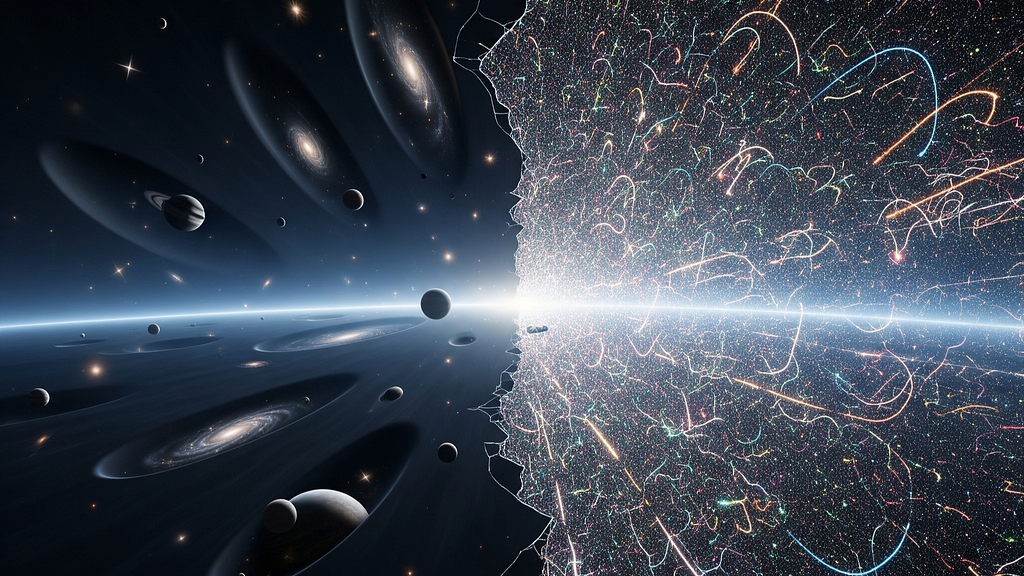
The mystery of the graviton was born from the 20th century’s greatest intellectual schism: the deep and persistent incompatibility between its two crowning achievements, General Relativity and Quantum Mechanics. These are not just two theories; they are two fundamentally different ways of describing reality, and they have been locked in a cold war for nearly a century.
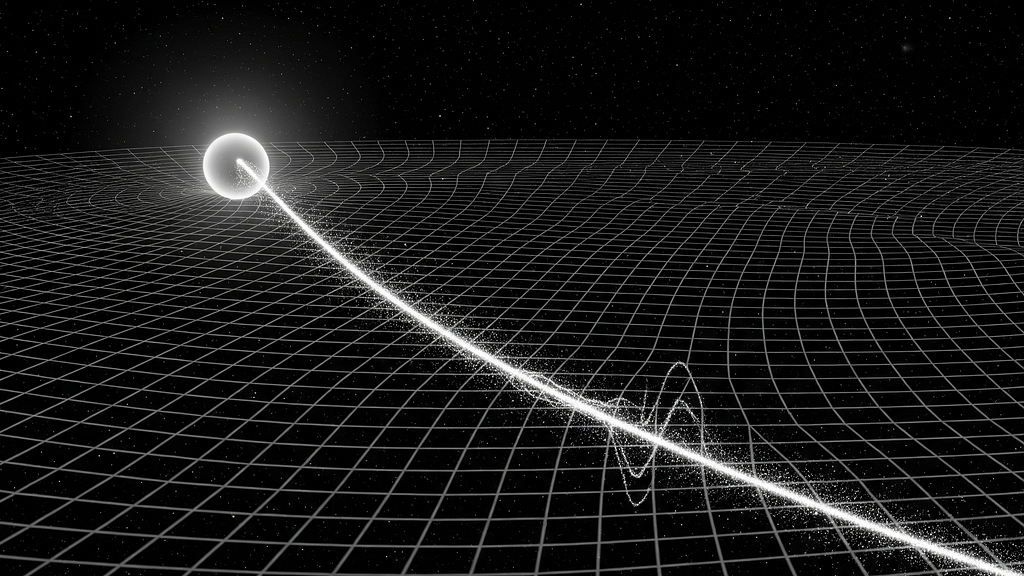
On one side stands Albert Einstein’s majestic theory of General Relativity. In this picture, gravity is not a force in the conventional sense at all. It is the consequence of mass and energy warping the four-dimensional fabric of spacetime. Imagine a heavy bowling ball placed on a stretched rubber sheet; it creates a deep well that causes any smaller marbles rolling nearby to curve inward. For Einstein, this is gravity: a smooth, deterministic, and geometric phenomenon. Planets orbit the Sun not because they are being pulled by an invisible rope, but because they are following the straightest possible path through the curved spacetime created by the Sun’s immense mass.
On the other side stands the strange and chaotic world of quantum mechanics. This theory governs the universe at the smallest scales and insists that energy and forces are not smooth and continuous, but “quantized”—chopped up into discrete little packets. It is a world of probabilities and uncertainties, where particles can be in multiple places at once and forces are carried by messenger particles. From the quantum perspective, if electromagnetism has its photon, gravity must have its graviton. There is no other way for the force to operate in a quantum world.
This fundamental disagreement came to a head in the 1930s, as physicists first attempted to “quantize” gravity, to rewrite Einstein’s elegant geometric equations in the messy language of quantum particles. They immediately ran into mathematical disasters. The conflict is a battle over the very texture of the universe. Is reality ultimately continuous and smooth, as Einstein’s theory implies? Or, if you could zoom in infinitely on a patch of empty space, would you eventually hit a fundamental “pixel” of spacetime, a grainy, indivisible unit as quantum theory would demand? The graviton is the proposed particle of that pixel. Until this clash is resolved, physics is left with two heavyweight champions in the ring, each undefeated in its own domain, leaving the graviton a theoretical hope, not a scientific fact.
The Profile of a Ghost: What a Graviton Would Be
While the graviton remains hypothetical, the laws of physics place incredibly tight constraints on what it must be like if it exists. Its properties are not wild guesses; they are direct consequences of the known behavior of gravity. This transforms the graviton from a vague “what if” into a highly specific, falsifiable prediction.
First, the graviton must be massless. We know that gravity has an effectively infinite range; its influence stretches across the entire cosmos. In quantum field theory, the range of a force is inversely related to the mass of its carrier particle. A massive particle can only travel a finite distance before its energy is spent, resulting in a short-range force (like the nuclear forces). For a force to have infinite range, its messenger particle must have zero mass, just like the photon that carries the electromagnetic force.
Second, and for the same reason, the graviton must travel at the speed of light. When the LIGO observatory first detected gravitational waves in 2015, it was from the collision of two black holes 1.3 billion light-years away. The light from that event arrived at virtually the same moment as the gravitational waves, confirming Einstein’s prediction that gravity propagates at the ultimate cosmic speed limit, c. A massless particle would naturally travel at this speed.
Third, and most uniquely, the graviton must have a spin of 2. In the quantum world, “spin” is an intrinsic property of a particle, analogous to electric charge. It’s not a literal spinning motion, but a fundamental quantum number that determines how the particle behaves.
Force-carrying particles like the photon have a spin of one (1). This allows them to create both attraction (opposite charges) and repulsion (like charges). But gravity is different. It is a universal force of attraction; there is no such thing as gravitational repulsion. The mathematics of quantum field theory are unequivocal on this point: a force that is purely attractive and couples to the energy and momentum of matter must be mediated by a particle with a spin of two (2). This property is a direct translation of Einstein’s complex spacetime curvature equations into the language of quantum particles. The graviton, if it exists, is the quantum embodiment of warped spacetime.
Building a Trap for a Whisper: The Impossible Experiment
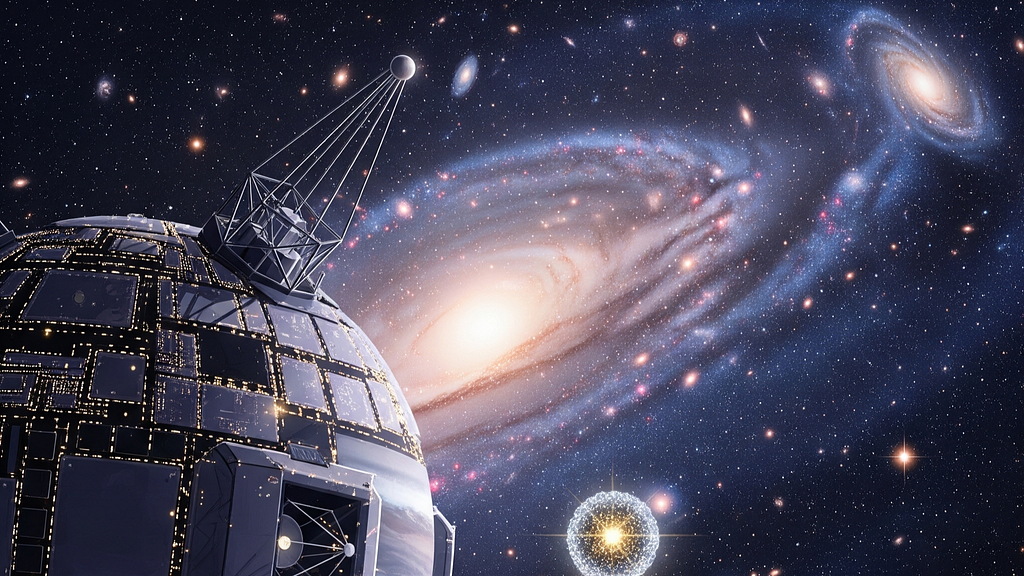
If physicists have such a clear profile of their target, why haven’t they found it? The answer lies in the single most defining characteristic of gravity: it is ridiculously, almost comically, weak compared to the other fundamental forces of nature. A single photon striking your retina is enough for your brain to register a flash of light. A simple refrigerator magnet can overcome the gravitational pull of the entire Earth to hold up a piece of paper.
This extreme weakness makes detecting a single graviton an exercise in impossibility. The playful dialogue between science communicators captures the scale of the challenge perfectly. Is it as hard as finding your socks in the dryer? No. Calculations suggest that to be reasonably sure of detecting just one graviton from a source like the Sun, you would need a detector the size of the planet Jupiter, placed in close orbit. And even then, you would have to wait for a period longer than the entire age of the universe for a single interaction to occur. This isn’t a mere technological hurdle; it’s a fundamental barrier imposed by nature itself. The graviton is so faint, it might as well be a ghost.
To put this weakness into perspective, consider how the four fundamental forces stack up against each other.
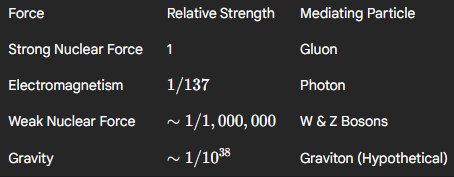
That number for gravity — a 1 followed by 38 zeros — is so vanishingly small that it illustrates why direct detection is beyond our wildest dreams. However, this very weakness that makes the graviton a ghost is also the reason we are here to search for it.
If gravity were even a fraction as strong as electromagnetism, the universe would have been a very different place. Stars would have burned out in an instant, and matter would have collapsed into an endless sea of black holes moments after the Big Bang, long before planets, life, or consciousness could ever form. We are faced with a beautiful paradox: we exist in a stable, structured universe precisely because gravity is gentle, and that same gentleness makes its fundamental particle all but invisible to us.
Echoes in Spacetime: The Clue from Gravitational Waves
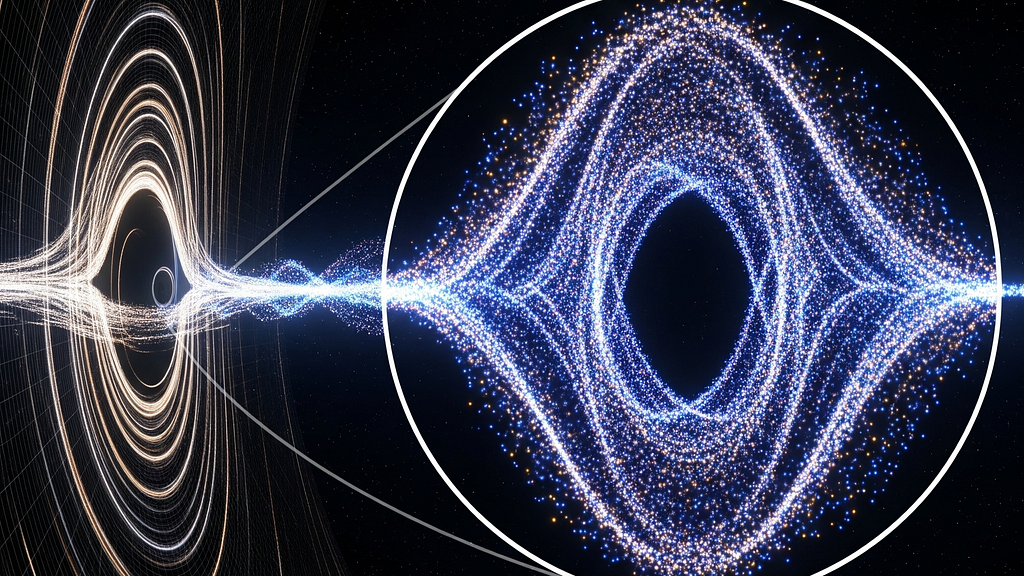
Frustrated by the impossibility of direct detection, scientists have turned to looking for indirect signs of the graviton’s existence. The breakthrough came on September 14, 2015, when the Laser Interferometer Gravitational-Wave Observatory (LIGO) detected faint ripples in the fabric of spacetime for the first time. The waves were the echo of two massive black holes spiraling into each other over a billion years ago. That detection was more than just a confirmation of Einstein’s century-old prediction; it gave humanity a new way to sense the cosmos. We could now listen to the vibrations of spacetime itself.
This discovery fundamentally changed the graviton debate. It provided the first piece of observational evidence that is perfectly consistent with the graviton’s existence. The logic is analogous to how we understand ocean waves. While you cannot see an individual H2O molecule in a wave, you know the wave itself is the collective motion of countless molecules. Similarly, physicists theorize that a gravitational wave might be the macroscopic effect of a coherent flood of countless gravitons traveling together. The smooth wave detected by LIGO could be composed of innumerable “tiny graviton dots”.
This remains indirect evidence, not definitive proof. We can listen to gravity’s grand symphony, but we cannot yet isolate a single note. The situation is both clever and deeply frustrating for physicists. Before LIGO, the graviton was a purely theoretical necessity. After LIGO, it moved into the realm of being strongly suggested by observation. We now know that gravitational energy propagates through the void in a wave-like manner at the speed of light. Any future theory of quantum gravity, whether it includes gravitons or not, must be able to account for this observed reality.
The Great Debate: A Particle, a String, or Something Else Entirely?

Today, the scientific community is split into several camps, each with a compelling idea about the true nature of gravity. This debate is not a sign of confusion, but of a vibrant and healthy science pushing at its absolute limits.
One of the most prominent pro-graviton camps is led by proponents of String Theory. This elegant and ambitious framework proposes that all fundamental particles — electrons, photons, and everything else — are not point-like dots, but unimaginably tiny, vibrating strings of energy. Different vibrations of the same fundamental string give rise to different particles. In a stunning theoretical result, mathematicians found that one specific vibrational mode of these strings has the exact properties of the hypothetical graviton: it is massless, travels at light speed, and has a spin of 2. For string theorists, the graviton isn’t an add-on; it emerges naturally and necessarily from the theory’s core mathematics.
However, other physicists push back, arguing that perhaps we have it all wrong. Maybe gravity doesn’t need a particle at all. In this view, Einstein’s picture of a smooth, continuous spacetime is the fundamental reality, and it is quantum mechanics that must be modified to accommodate it. These ideas fall under the umbrella of
emergent gravity. They propose that gravity isn’t a fundamental force but a collective, statistical phenomenon, much like temperature or pressure. A single water molecule doesn’t have a temperature; temperature is an emergent property of the average motion of many molecules. Similarly, these theories suggest that gravity and spacetime itself might emerge from a deeper level of quantum information or thermodynamics.
This debate represents more than just a disagreement over equations; it reflects a deeper philosophical divide about how the universe is built. Is reality reductionist, where everything can be explained by one fundamental building block, like a string? Or is it holistic, where some of its most profound features, like gravity, are emergent properties that don’t exist at the lowest level? Until we have a complete, testable theory of quantum gravity, the graviton remains a tantalizing “maybe”.
The Day We Catch the Ghost: A Revolution in Human Thought
But imagine, for a moment, that one day we do it. Imagine a future generation of scientists announces irrefutable proof that gravitons exist. What then?
The consequences would be nothing short of a revolution, shaking the foundations of science and, eventually, all of human civilization. The first and most immediate impact would be the unification of physics. For the first time, we would have a single framework — a “Theory of Everything” — that could describe all four fundamental forces, from the quantum dance inside an atom to the gravitational waltz of galaxies. The deepest mysteries of the cosmos might finally surrender their secrets. The physics inside a black hole’s singularity and the conditions at the instant of the Big Bang would no longer be realms of pure speculation.
And then there would be the technology. It is easy to get carried away with science-fiction dreams of gravity-powered spaceships, floating cities, or devices that could manipulate spacetime. While these remain speculative, we should not underestimate the transformative power of fundamental discovery. This is the crucial lesson of history. When physicists in the early 20th century were developing quantum mechanics, they were driven by pure curiosity about the nature of light and matter. They could never have dreamed that their bizarre equations would one day lead to lasers, GPS, microchips, and the internet — the very technologies that define our modern world. Understanding the photon, the particle of light, gave us the digital revolution. What might understanding the graviton, the particle of spacetime itself, unlock for humanity?
The true impact, however, might be more philosophical. For millennia, gravity was a mystery, an act of gods. Newton tamed it into a predictable law. Einstein revealed it to be the very geometry of the cosmos. To finally capture its quantum particle would be the final step in this epic intellectual journey. It would affirm that the universe, from its smallest constituent to its grandest structure, is governed by a single, knowable set of rules. It would be the ultimate triumph of human curiosity.
Closing: The Beauty of the Search
In the end, the graviton remains one of science’s greatest unsolved mysteries, an idea perched on the jagged edge of known physics. It is either one of the quietest, most subtle whispers of the universe, or it is a beautiful mirage our minds invented in our quest for a unified picture of reality.
Either way, the search continues. Physicists will continue to build ever more sensitive detectors, to scan the skies for cosmic clues, and to fill blackboards with equations, all in the hope that one day, we might finally hear gravity’s faintest voice. It is a testament to the relentless nature of human inquiry that we spend so much effort chasing a ghost. But perhaps the true value is not in the destination, but in the journey itself. Until the day an answer is found, the mystery keeps science beautiful.

