
A Comprehensive Analysis of Exotic Resolutions to the Fermi Paradox

The Fermi Paradox remains one of the most enduring and unsettling queries in modern astrophysics. Formulated informally by Enrico Fermi in 1950 and rigorously categorized by researchers like Carl Sagan and Frank Drake, the paradox highlights the stark contradiction between the high statistical probability of extraterrestrial intelligence (ETI) and the complete absence of observational evidence. With an estimated 200–400 billion stars in the Milky Way alone, and potentially 70 sextillion in the observable universe, the Copernican Principle suggests that Earth should not be unique. Yet, after decades of radio astronomy and the search for extraterrestrial intelligence (SETI), the cosmos remains eerily silent.
Historically, attempts to resolve this have centered on the “Great Filter”—a hypothetical probability barrier that prevents life from becoming an expanding, space-faring civilization. This filter could lie in our past (making life rare) or in our future (implying civilizations inevitably destroy themselves). However, a new class of “Beyond the Filter” models has emerged that do not rely on the rarity of life, but rather on selection effects, thermodynamic strategies, or dimensional limitations.
The Grabby Aliens Model: Why We are “Early”

The “Grabby Aliens” model, developed by economist Robin Hanson and his colleagues, addresses a fundamental riddle: Why has humanity appeared so early in the universe’s history?
The Riddle of Earliness
Standard cosmological models suggest the universe will remain habitable for trillions of years. Red dwarf stars have stable lifetimes extending up to 10 trillion years. If life relies on a sequence of “hard steps” (improbable evolutionary transitions), the mathematical expectation is that the vast majority of civilizations should arise in the distant future. Specifically, if there are roughly six hard steps to reach our level of intelligence, over 99% of advanced life should appear after the present day.
Hanson proposes that “Grabby Aliens” provide the truncation to this timeline. Late-arriving civilizations never evolve because the universe is pre-emptively colonized by the “early risers.”
Model Parameters
The model distinguishes between “Quiet” civilizations (which do not expand and cannot explain our earliness) and “Loud” (Grabby) civilizations. Grabby civilizations expand rapidly, visibly change the volumes they control, and last a long time.
| Parameter | Symbol | Description | Estimation Basis |
| Expansion Speed | \(s\) | Radial velocity of the civilization’s influence. | Estimated at 0.5c to 0.8c; if it were lower, we would see older neighbors. |
| Power Law | \(n\) | Number of “hard steps” in evolution. | Derived from Earth’s major evolutionary events. |
| Origin Constant | \(k\) | Calibration of appearance rate. | Assumes humanity’s current date is a random sample of pre-grabby dates. |
The “Deadline”
A counter-intuitive result is that Grabby Aliens likely control 40% to 50% of the universe’s volume right now. We see an empty sky because these civilizations are at vast distances; their expansion fronts move at near-light speeds, but the light from their “grabby” phase has not yet reached Earth. We are effectively looking at their galaxies as they were in the distant past. This suggests humanity exists in a rapidly shrinking “bubble” of uncolonized space and will encounter a Grabby civilization in 200 million to 2 billion years.
The Aestivation Hypothesis: Thermodynamics as Destiny
While Grabby Aliens maximize spatial volume, the Aestivation Hypothesis assumes they maximize computation. Proposed by researchers at the Future of Humanity Institute, it suggests aliens are not dead—they are simply hibernating.
The Logic of Information Processing
Advanced civilizations likely transition to digital substrates. For a digital civilization, the ultimate resource is computational capacity, which is limited by thermodynamics. Landauer’s Principle defines the minimum heat energy E released when erasing a bit of information:
\(E \ge k_B T \ln(2)\)
The energy cost is directly proportional to the temperature (T) of the environment. Computing in a cold environment is vastly more efficient than in a hot one.
The Cosmic “Discount Rate”
The universe is currently “hot” due to the Cosmic Microwave Background (CMB) at 2.7 Kelvin. By waiting for the universe to expand and cool, a civilization could increase its total computational potential by a factor of 10^{30}. This “Rational Aestivation” suggests they are “sleeping” through the warm era to wake up in a future where their energy produces more “happiness” or “knowledge.”
The Early Waker Problem
To a sleeper, expanding humanity is a pest burning down the “library” (stars) to stay warm. This implies aestivating civilizations should leave behind “Berserker probes” to suppress new civilizations before they consume the resource stock. The fact that we have not been destroyed suggests we are either not yet a threat or the hypothesis is false.
The Bulk Beings Hypothesis: Orthogonal Existence
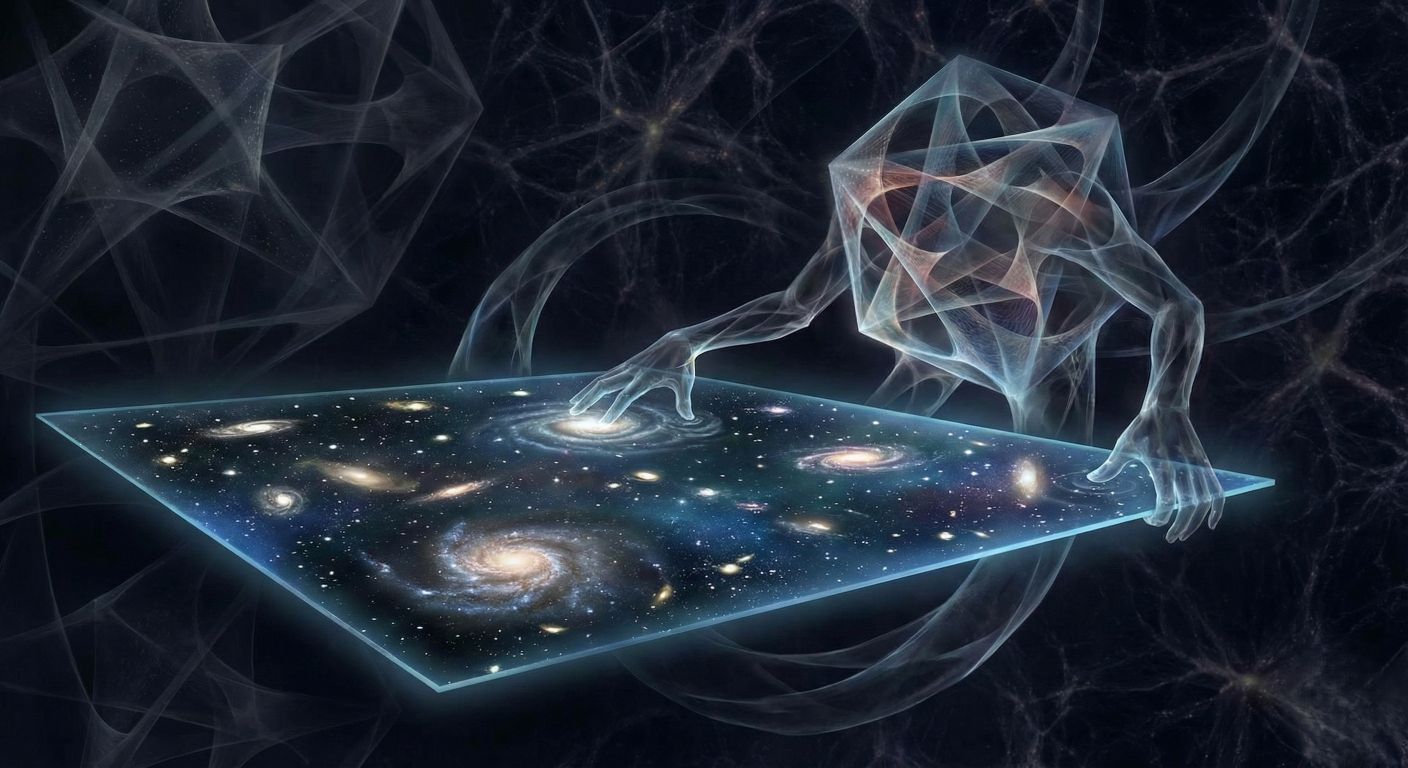
The third model questions the very space we are searching. It posits that advanced life exists in higher dimensions (the “Bulk”) or is composed of Dark Matter.
Theoretical Context: String Theory
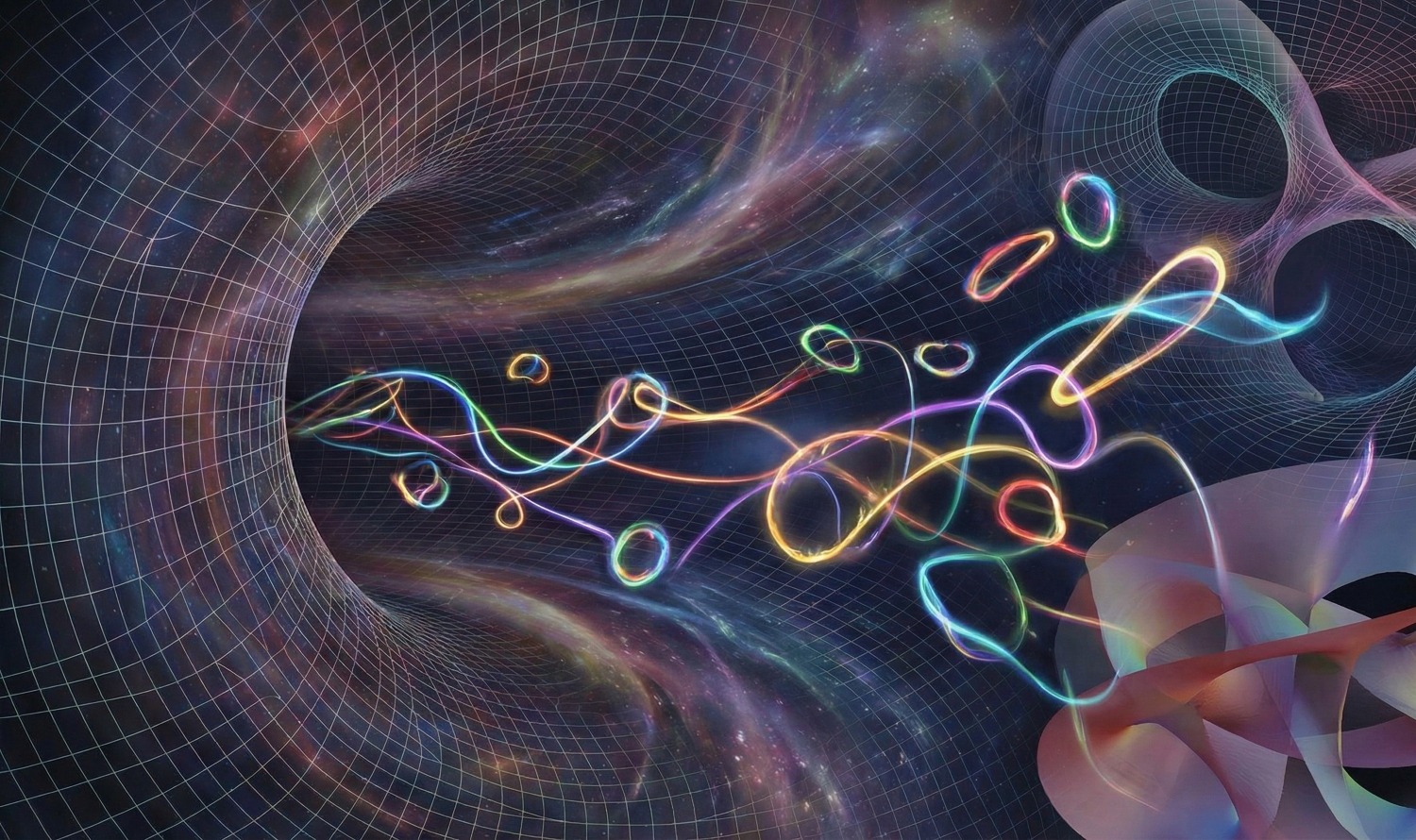
String and M-Theory require 10 or 11 dimensions to unify gravity with quantum mechanics. In these models, our universe is a 3D “brane” floating in a higher-dimensional Bulk.
- The Confinement of Light: Photons (light/radio) are “open strings” stuck to our brane; they cannot travel into the Bulk, making anything there invisible to our telescopes.
- The Leakage of Gravity: Gravity is composed of “closed strings” that propagate freely into the Bulk, which may explain why it is so much weaker than other forces.
Life in the Bulk and the Shadow Biosphere
A being in the Bulk would view our 3D universe like a 2D sheet of paper. Advanced civilizations might transcend “upward” into this larger reality rather than expanding across our 3D galaxy.
A related idea involves Dark Matter, which makes up 85% of the matter in the universe but only interacts via gravity. Physicists Lisa Randall and Caleb Scharf suggest dark matter might have its own “Dark Electromagnetism” or “Dark Chemistry,” leading to a “Shadow Biosphere” of dark organisms co-habiting the Milky Way, completely invisible to us. Advanced alien engineering might even appear to us as laws of physics—for instance, “Dark Energy” could be waste heat from a hyper-advanced intelligence.
Synthesis: The Future of the Paradox
| Feature | Grabby Aliens | Aestivation | Bulk Beings / Higher Dimensions |
| Explanation for Silence | We are early; the expansion wave hasn’t hit us yet. | They are dormant to save energy; we are effectively “pests.” | They exist in dimensions or substrates (Dark Matter) we cannot perceive. |
| Primary Motivation | Expansion: Maximizing spatial control. | Efficiency: Maximizing computation/happiness per joule. | Transcendence: Utilizing full physical reality. |
| Observational Prediction | Long Arcs in CMB/Galaxy maps. | Cold spots or missing stars (Dyson spheres). | Anomalous gravity or variation in constants. |
| Existential Risk | High: Contact implies assimilation or extinction. | Moderate: Automated “pest control” systems. | Unknown: We may be too primitive to interact. |
The Conflict of Strategies
These models are not always compatible. A single Grabby civilization destabilizes Aestivation by consuming the resources the sleepers are saving. Alternatively, Grabby behavior might be a “larval stage”—a species expands territorially until it discovers how to access the Bulk, at which point it disappears from our 3D view.
Conclusion
The Grabby Aliens hypothesis is perhaps the most robust, relying on the fewest assumptions about alien psychology. It suggests the silence of the sky is not an indication of emptiness, but a clue to a deep, hidden order. Whether we are the first to wake, the last to sleep, or the blind living in a hall of mirrors, we are standing on the edge of a cosmic phase transition.
References & Further Reading
- Fermi Paradox – Wikipedia
- The Fermi Paradox – SETI Institute
- Brian Cox Explains The Fermi Paradox – YouTube
- Grabby Aliens – A Simple Model by Robin Hanson
- Robin Hanson’s Grabby Aliens Model Explained – LessWrong
- Beyond “Fermi’s Paradox” V: What is the Aestivation Hypothesis? – Universe Today
- Aestivation Hypothesis – Wikipedia
- Does Dark Matter Harbor Life? – Nautilus Magazine
- Dark Forest Hypothesis – Wikipedia
- That is Not Dead Which Can Eternal Lie: The Aestivation Hypothesis – arXiv
- Lisa Randall — Dark Matter, Dinosaurs, and Extra Dimensions – On Being
- The Physics of Extraterrestrial Civilizations – Dr. Michio Kaku
- An Astrophysicist Says We Might Not Be Able to Distinguish Aliens From Physics – Science Alert
- Is Physical Law an Alien Intelligence? – Nautilus Magazine

