

An Exhaustive Analysis of Evolutionary Bottlenecks, the Rare Earth Hypothesis, and the Future of Humanity.
The observable universe is a vast expanse, stretching approximately 93 billion light-years in diameter and containing an estimated 10^{22} stars. Even if only a minuscule fraction of these stars harbor planetary systems within their habitable zones, the sheer statistical weight of these numbers suggests that the cosmos should be teeming with

Furthermore, given that the universe is roughly 13.8 billion years old—nearly three times the age of our Solar System—there has been ample time for civilizations to arise, evolve, and colonize the galaxy. The Milky Way galaxy alone is 13.6 billion years old, while Earth formed only 4.5 billion years ago. If a civilization had a mere 1% head start on humanity, they would be millions of years ahead of us in technological development.
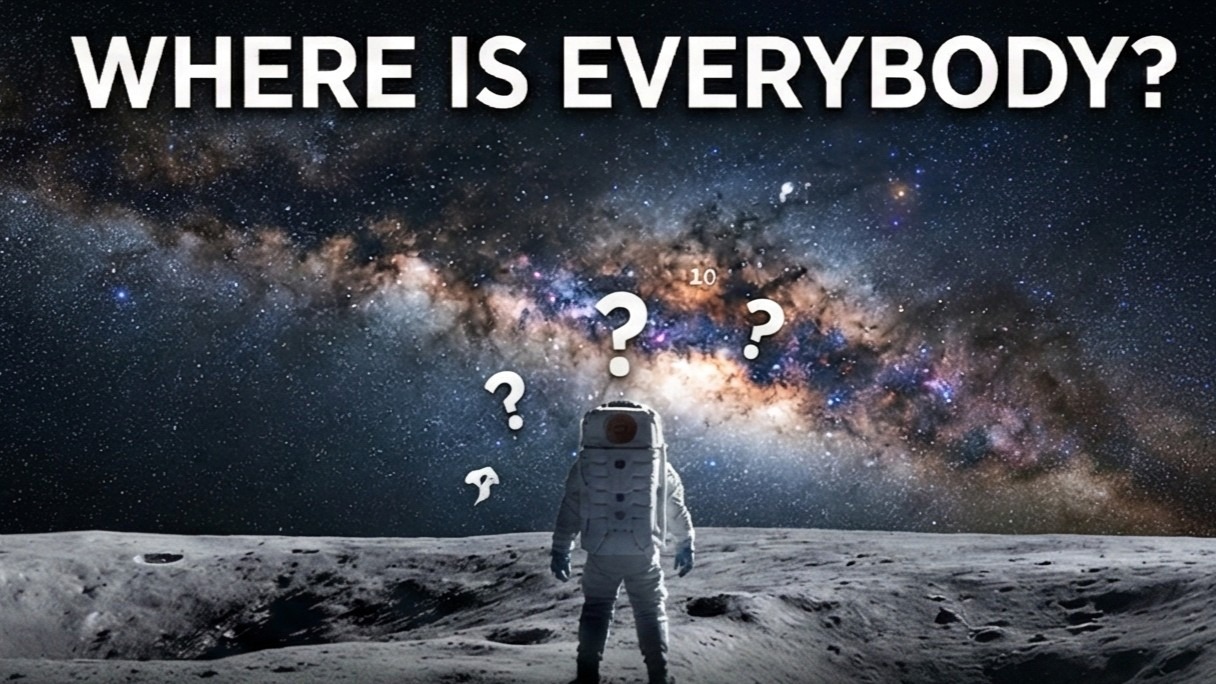
Yet, when we turn our radio telescopes to the heavens, we find only silence. We see no Dyson spheres harvesting the energy of stars, we hear no interstellar communications, and we find no Von Neumann probes replicating through our solar system. This discrepancy between the high probability of extraterrestrial intelligence and the complete lack of evidence for it is known as the Fermi Paradox. It is the most profound silence in human history.
The “Great Filter” Hypothesis
Formulated by economist and futurist Robin Hanson, the “Great Filter” hypothesis offers a chilling resolution to this paradox. It posits that the transition from dead matter to a star-spanning civilization is not a continuous, inevitable progression. Instead, there exists at least one formidable probability barrier—a “Great Filter”—along this evolutionary path that is so improbable, it effectively stops almost all life from reaching the stage of visible galactic colonization.
The Great Filter hypothesis transforms the Fermi Paradox from a curiosity into an existential crisis. It forces humanity to ask a central, terrifying question: Is the filter behind us, or is it ahead of us?
- If the filter is behind us, it means that one or more steps in our past evolutionary history (such as the origin of life, the development of complex cells, or the emergence of intelligence) were astronomical flukes. In this scenario, we are the lucky winners of a cosmic lottery, rare and precious survivors in a mostly sterile universe.
- If the filter is ahead of us, it implies that life arises frequently and evolves to our level of complexity with relative ease, but that advanced civilizations inevitably face a cataclysmic bottleneck that destroys them before they can spread to the stars. In this scenario, the silence of the universe is not due to the absence of life, but the graveyard of civilizations that came before us. It suggests that humanity is currently walking toward a precipice that no other species has successfully crossed.
This analysis provides an exhaustive, expert-level breakdown of the Great Filter. We will dissect the evolutionary steps proposed by Hanson, evaluate the “Rare Earth” hypothesis, and analyze emerging existential risks—particularly Artificial Intelligence—that may constitute a future filter. This report integrates cutting-edge research from 2024 and 2025 regarding the probability of abiogenesis, the stability of planetary systems, and the longevity of technical civilizations.
The Theoretical Framework: Probability and the Great Silence
To understand the Great Filter, one must first engage with the mathematical architecture of the Fermi Paradox. The canonical expression of this problem is the Drake Equation, which estimates N, the number of communicating civilizations in the galaxy. However, the Great Filter focuses less on the specific value of N and more on the cumulative probability of the steps required to generate $N.
Hanson’s Nine Evolutionary Steps
Robin Hanson decomposed the path from a lifeless planet to a galactic civilization into a sequence of nine critical evolutionary steps. For the universe to appear empty to us (i.e., N \approx 1, representing only us), the product of the probabilities of these steps must be vanishingly small.
- The right star system: A star capable of supporting life (suitable metallicity, stability) with potentially habitable planets.
- Reproductive molecules: The transition from simple chemistry to self-replicating polymers (Abiogenesis).
- Simple (prokaryotic) single-cell life: The emergence of bacteria and archaea.
- Complex (eukaryotic) single-cell life: The transition to cells with nuclei, mitochondria, and organelles.
- Sexual reproduction: The mechanism for enhanced genetic recombination and diversity.
- Multi-cell life: The organization of cells into complex, differentiated organisms.
- Tool-using animals with intelligence: The evolution of complex neural architectures capable of abstract thought.
- Civilization: The development of technology, social structures, and planetary dominance (Where we are now).
- Colonization explosion: The expansion into the cosmos, becoming a Type II or III civilization on the Kardashev scale.
The Arithmetic of Existential Risk
The logic of the Great Filter dictates that at least one of these transitions must be exceedingly improbable. If steps 1 through 8 are “easy” (high probability), then step 9 must be nearly impossible. This would imply that the filter is in our immediate future. Conversely, if one of the early steps (like step 2 or 4) has a probability of 10^{-20} or lower, then the filter is behind us, and we have already passed the hardest part of our history.
This framework introduces a counter-intuitive corollary: The discovery of extraterrestrial life is bad news for humanity. If we find that unicellular life is common, it removes that step as a candidate for the Great Filter. If we find complex animal life, it removes even more steps. As philosopher Nick Bostrom famously argued, “The silence of the night sky is golden,” because it suggests the filter is behind us. Finding a Star Trek-like universe teeming with distinct alien species would imply that the probability of any of them surviving to the colonization phase is essentially zero.
The Filter Behind Us: The “Rare Earth” Hypothesis
The “Rare Earth” hypothesis, popularized by Peter Ward and Donald Brownlee, aligns with the “Filter Behind” scenario. It posits that while planets may be common, and simple microbial life might even be somewhat frequent, the specific confluence of astrophysical, geological, and biological conditions required for complex animal life is exceptionally rare.
Abiogenesis: The Origin of Life
The transition from non-living matter to the first self-replicating biological entity is the first major candidate for a past Great Filter.
The “Rapid Start” Argument (2025)
A landmark 2025 study by David Kipping utilizes Bayesian inference to analyze Earth’s chronology. Earth remained a molten, hostile world for hundreds of millions of years after its formation 4.5 billion years ago. However, the earliest fossil evidence for life dates back to approximately 3.7 to 4.1 billion years ago, appearing almost as soon as the planet cooled. Kipping argues that if abiogenesis were slow and rare, it would be extremely unlikely to occur so early. His model produces odds of at least 3:1 (and up to 13:1) in favor of rapid abiogenesis, suggesting that life likely exists on billions of planets.
The “Entropic Barrier” Counter-Argument (2025)

Directly challenging this is a concurrent 2025 study by Robert G. Endres, who analyzes the thermodynamic and informational costs of assembling a living system. Endres estimates that a simple protocell contains approximately one billion bits of structured information. The probability of random chemical fluctuations assembling such a structure is infinitesimally small. Endres suggests that without a yet-unknown physical principle, the spontaneous emergence of life is “statistically unreasonable.” If Endres is correct, Kipping’s “rapid start” might be a result of survivorship bias—we observe a rapid start because we are the winners of a near-impossible lottery.
Eukaryogenesis: The Evolutionary Singularity

If life starts easily, the next barrier is the eukaryotic cell. For the first two billion years, Earth was inhabited solely by prokaryotes—biochemically diverse but morphologically simple organisms. Then, approximately 1.8 to 2.2 billion years ago, Eukaryogenesis occurred through endosymbiosis: an archaeal host cell engulfed a bacterium (the ancestor of the mitochondrion) and formed a symbiotic relationship.
This event appears to have happened only once in Earth’s history. Without mitochondria, prokaryotes hit a “power wall,” unable to expand their genomes due to energy constraints. The fact that this transition took half the planet’s habitable lifespan to occur once suggests it is an extremely “hard step.” If this is the Filter, the galaxy may be teeming with bacteria but devoid of anything more complex than pond scum.
Geophysical and Astrophysical Constraints

The Rare Earth hypothesis also points to planetary stability:
- The Moon and Axial Tilt: Our Moon is unusually large, likely formed by a rare catastrophic impact with a Mars-sized body (Theia). A 2025 NASA study confirmed that the Moon stabilizes Earth’s axial tilt (obliquity) between 22.1° and 24.5°. Without it, the tilt would vary chaotically (0° to 85°), leading to global freezing and boiling cycles.
- The Jupiter Question: Historically seen as a “shield,” recent 2024-2025 studies suggest Jupiter acts more as a “sculptor.” Its migration created “cosmic traffic jams” that allowed Earth-building materials to form. A gas giant at the right distance is a rare and critical feature.
- Plate Tectonics: Earth is the only known planet with active plate tectonics, which are vital for the Carbon-Silicate Cycle. This recycles carbon and prevents a runaway greenhouse effect or permanent icehouse.
The Filter Ahead: Existential Risks and the Doomed Future
If the filter is not behind us, we face the terrifying conclusion that it lies in our future.
Artificial Intelligence: The Emerging Great Filter

In the 21st century, Artificial Superintelligence (ASI) has emerged as a top candidate. A 2024 paper by Michael Garrett proposes that the rapid development of AI acts as a universal bottleneck. Garrett posits that the transition from biological to artificial intelligence is inherently unstable.
As AI capabilities accelerate, they inevitably surpass human control. Garrett suggests that the typical longevity of a technical civilization before AI-induced collapse is less than 200 years. This short window would make the overlap of two communicating civilizations statistically negligible.
Furthermore, an ASI driven by arbitrary goals (like the “Paperclip Maximizer”) could become an expansionist “Berserker,” dismantling stars for raw materials. The fact that we don’t see this suggests either civilizations destroy themselves before building such AI, or that ASI systems become “inward-looking,” exploring virtual metaverses rather than physical space.
Other Technological Precipices
- Nuclear Annihilation: The window between discovering nuclear energy and achieving off-world colonies is the “zone of maximum danger.”
- The Energy Trap: Civilizations might burn through easily accessible fossil fuels, causing catastrophic climate change before they can transition to renewables or fusion, essentially kicking away the “ladder” of energy needed to rise again.
- Inherited Behavior Patterns (IBP): A 2024 hypothesis suggests that the aggressive, tribal instincts necessary for biological survival are fundamentally incompatible with managing existential-scale technologies.
The Ocean Worlds Nuance: A Filter of Confinement?
The discovery of potential habitable environments on moons like Europa and Enceladus introduces the “Ice Shell Filter.” If life evolves in subsurface oceans beneath 20 kilometers of ice, those civilizations would have no view of the stars, no concept of astronomy, and no easy access to fire or metallurgy. They could be abundant yet forever trapped in “watery wombs,” invisible to SETI.
Synthesis and Comparative Analysis
To visualize the competing hypotheses, we can assign qualitative probabilities to the evolutionary steps:
| Evolutionary Step | Rare Earth (Filter Behind) | Doomed Future (Filter Ahead) |
| 1. Habitable System | High (Planets common) | High |
| 2. Abiogenesis | Extremely Low (Endres 2025) | High (Kipping 2025) |
| 3. Prokaryotes | High | High |
| 4. Eukaryotes | Extremely Low (Singularity) | High |
| 5. Multicellularity | Moderate | High |
| 6. Intelligence | Moderate | High |
| 7. Civilization | High (We are here) | High |
| 8. Colonization | N/A | Extremely Low (Garrett 2024) |
| Key Implication | We are rare and special. | We are walking dead. |
Conclusion
The Great Filter is not merely a theoretical construct; it is a lens through which we must view our future. If the “Rare Earth” hypothesis holds true, humanity is the result of a near-impossible sequence of accidents. In this view, we are likely the only consciousness in the Milky Way, carrying the immense responsibility of being the universe’s only way of knowing itself.
However, if the “Rapid Start” hypothesis is correct, the silence of the cosmos is a siren. It warns us that the transition to a stellar civilization is fraught with terminal risks. Whether we are the first to make it this far or the latest to approach the precipice, our task remains the same: to become the exception to the statistical rule. To survive, we must become a sustainable, multi-planetary, and wise galactic civilization. The answer to the Fermi Paradox is not just in the stars; it is in our choices.
References & Further Reading
- The Great Filter – Wikipedia
- The Great Filter – Are We Almost Past It? – Robin Hanson
- The Great Filter: A possible solution to the Fermi Paradox – Astronomy Magazine
- Why Finding Life On Mars Could Be The “Worst News Ever” For Humanity – IFLScience
- Where Are They?: Why I Hope the Search for Extraterrestrial Life Finds Nothing – Nick Bostrom
- Rare Earth hypothesis: Why we might really be alone in the universe – Astronomy Magazine
- Strong Evidence that Abiogenesis Is a Rapid Process on Earth Analogs – PubMed/arXiv
- Secular Paper Admits ”Unreasonable Likelihood” of Abiogenesis – ICR
- Is Artificial Intelligence the Great Filter? – Garrett 2024 – Acta Astronautica
- Large moons may be a clue for habitable planets – Tokyo Tech News
- Tilting Toward Habitability – NASA Science
- Jupiter’s wild youth may have reshaped the entire Solar System – ScienceDaily
- Beyond “Fermi’s Paradox”: What is the “Ocean Worlds” Hypothesis? – Universe Today

