For a century, physics has been torn between two “Competitors”—Gravity and Quantum Mechanics. The resolution to their conflict suggests that the universe you see is just a user interface.

For over a century, theoretical physics has been defined by a quiet but brutal conflict between its two deepest laws. On one side sits General Relativity, Albert Einstein’s masterpiece, which describes a universe of smooth, curving spacetime where gravity determines the motion of stars and galaxies. On the other side sits Quantum Mechanics, the rulebook for the subatomic world, describing a reality that is pixelated, probabilistic, and jittery.
Separately, these theories are incredibly successful. General Relativity guides our GPS satellites; Quantum Mechanics gave us the transistor and the laser. But when you try to combine them—to describe the center of a black hole or the moment of the Big Bang—the mathematics collapses. They are fundamentally incompatible. One demands a smooth geometry; the other demands a violent quantum foam.
However, a radical consensus is emerging among high-energy physicists: the war is over. The resolution, though, is not a peace treaty where one side wins. It is a revelation that the battlefield itself—spacetime—may not be fundamental. This is the Holographic Principle, the suggestion that the three-dimensional universe we experience is merely a projection of a lower-dimensional reality, much like a 2D hologram projects a 3D image.
The Problem of Information
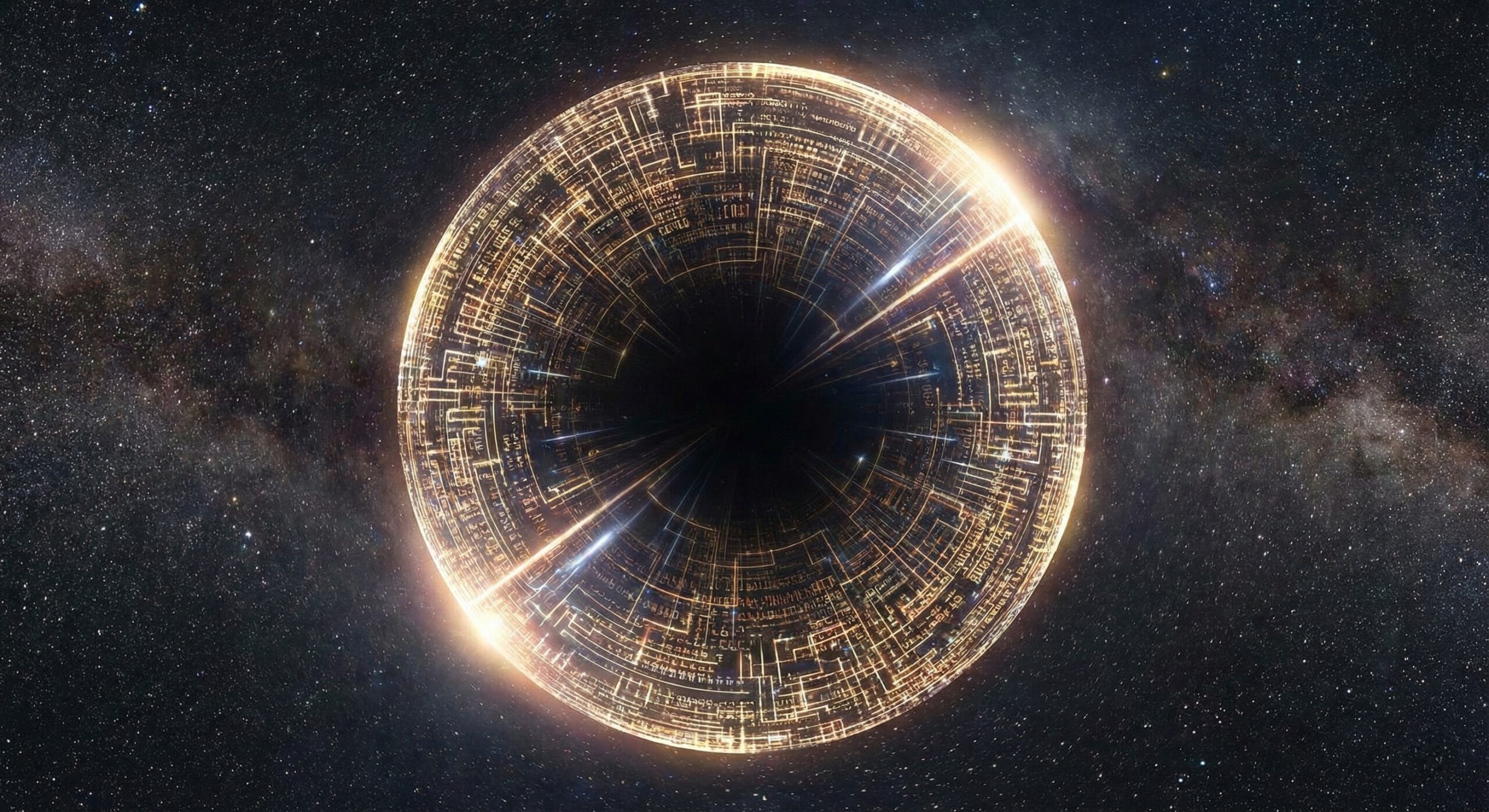
The first crack in the facade of classical spacetime appeared with black holes. According to General Relativity, black holes are simple objects defined only by mass, charge, and spin. If you throw a dictionary into a black hole, the information inside it seems to vanish. But Quantum Mechanics relies on a principle called “unitarity,” which dictates that information is never destroyed, only scrambled.
In the 1970s, Jacob Bekenstein and Stephen Hawking discovered something profound: the amount of information (entropy) a black hole can hold is not proportional to its volume, as common sense would suggest, but to its surface area. This was the first hint that the “inside” of the universe might be redundant. If the maximum information of a 3D object can be fully encoded on its 2D surface, then the third dimension—depth—might be an illusion.
The Soup Can Universe: AdS/CFT
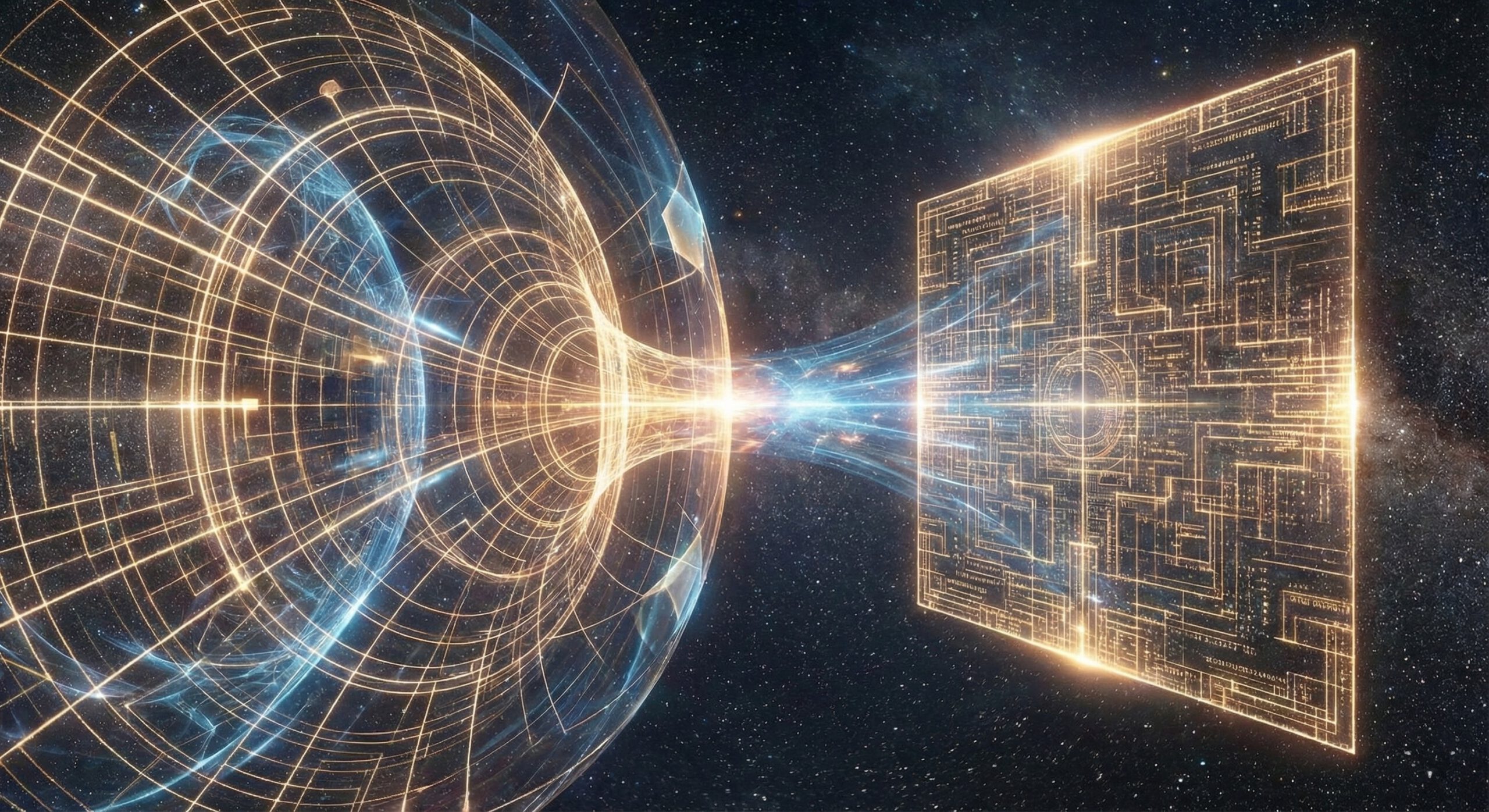
In 1997, physicist Juan Maldacena formalized this idea with the AdS/CFT Correspondence, often called the “Soup Can” analogy.
Imagine a universe contained entirely inside a tin can.
- The Bulk (The Soup): The interior of the can represents Anti-de Sitter (AdS) space. This is a world with gravity, volume, and three dimensions.
- The Boundary (The Label): The surface of the can represents a Conformal Field Theory (CFT). This is a quantum world with no gravity, living on a flat, two-dimensional surface.
Maldacena proved that these are not two different universes. They are the same universe described in two different languages. A black hole forming in the “soup” is mathematically identical to a hot, chaotic cloud of particles on the “label.” This duality saved quantum mechanics: information falling into a black hole isn’t lost; it is simply smeared out across the boundary of the universe.
Spacetime is “Made” of Entanglement

If the 3D world is a projection, what is the mechanism of the projector? How do flat, quantum correlations on a boundary turn into the voluminous fabric of space we walk through? The answer appears to be Quantum Entanglement.
For decades, entanglement was viewed as a “spooky” phenomenon happening inside space. New research suggests entanglement is what constructs space.
This relationship is encapsulated in the Ryu-Takayanagi Formula. It calculates the “entanglement entropy” of a region on the boundary and finds it is directly proportional to the area of a surface dipping into the bulk. In simple terms: the amount of quantum entanglement on the surface determines the amount of physical geometry inside.
Theoretical calculations have shown that if you were to “turn off” the entanglement between two regions of the boundary, the space inside would physically tear apart. Spacetime is a web of quantum correlations. This has led to the slogan “It from Qubit”—the idea that the physical “it” (geometry) emerges from the “qubit” (quantum information).
This connection is further strengthened by the ER=EPR conjecture, proposed by Maldacena and Leonard Susskind. It suggests that a pair of entangled particles (EPR) is connected by a microscopic wormhole (Einstein-Rosen bridge). In this view, quantum entanglement is literally the thread stitching the fabric of spacetime together.
The Glitch: We Don’t Live in a Soup Can
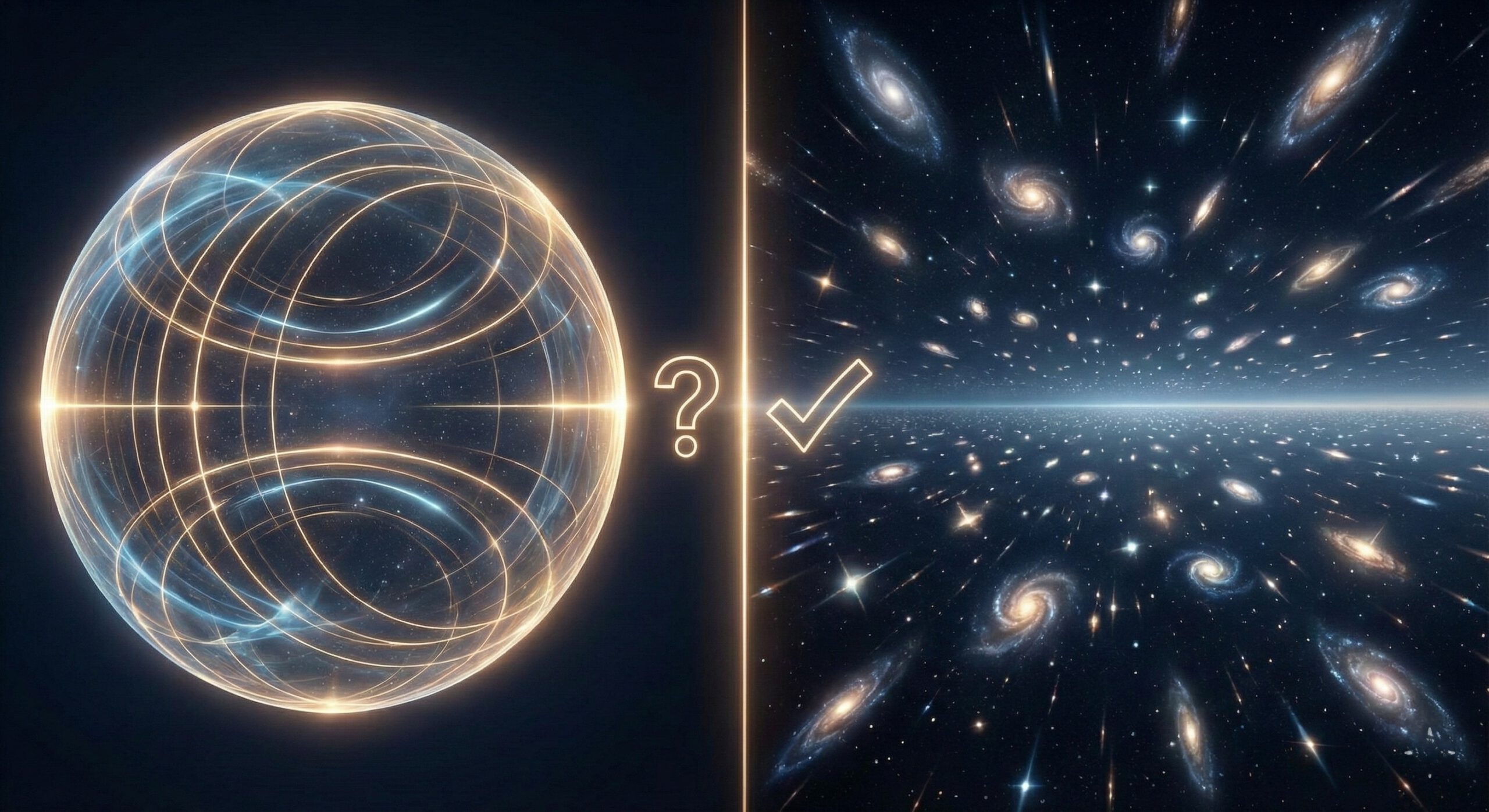
While the AdS/CFT correspondence is a mathematical triumph, it faces a severe reality check: We do not live in Anti-de Sitter (AdS) space.
AdS space acts like a box with a reflective wall at the edge, which makes the mathematics of holography work nicely. Our universe, however, is expanding and accelerating due to Dark Energy. We live in de Sitter (dS) space. Unlike the soup can, our universe is like an expanding bubble with no clear spatial boundary.
This discrepancy has led to the “Swampland” Program. String theorists have found it incredibly difficult to construct a stable, accelerating universe like ours within their equations. Some conjectures suggest that universes like ours might belong to the “Swampland”—a set of theories that look consistent at low energies but are actually impossible in a full theory of quantum gravity.
Celestial Holography: A Hologram on the Sky
Because our universe lacks the convenient “walls” of AdS space, physicists are developing a new framework called Celestial Holography.
Instead of projecting reality from a boundary at the edge of the universe, Celestial Holography treats the “Celestial Sphere”—the night sky itself—as the hologram. It proposes that the four-dimensional scattering of particles in our spacetime is mathematically dual to a two-dimensional theory living on the sphere where light rays eventually end up. Recent progress has focused on relating this flat-space holography to the better-understood AdS models, attempting to “flatten” the soup can to describe the real world.
Reality as Quantum Error Correction
One of the most compelling modern interpretations is that spacetime acts like a Quantum Error-Correcting Code.
In quantum computing, information is incredibly fragile. To protect a single bit of data (a logical qubit), engineers smear it across many physical qubits so that if one is corrupted, the information remains intact.
Calculations suggest the holographic universe works the same way. The “Bulk” (our perceptible reality) is the protected, logical information. The “Boundary” is the noisy physical hardware. Space, time, and gravity may simply be the efficient coding scheme the universe uses to protect its quantum data from decoherence. In this view, the reason you can walk across a room without disintegrating is that the universe is constantly running error-correction algorithms to maintain the continuity of spacetime.
Conclusion
We are left with a view of the cosmos that is radically different from our intuition. The distinction between “geometry” and “matter,” or “container” and “content,” appears to be false. Gravity is the hydrodynamics of entanglement; space is the visualization of quantum correlations. We are not merely inhabitants of a 3D stage; we are likely the holographic projections of a deeper, 2D reality playing out at the edge of time.
Further Reading
Foundational Papers & Concepts
- Maldacena, J. (1998). “The Large N limit of superconformal field theories and supergravity.” International Journal of Theoretical Physics. (The original paper proposing the AdS/CFT correspondence).
- ‘t Hooft, G. (1993). “Dimensional Reduction in Quantum Gravity.” arXiv:gr-qc/9310026. (The first proposal of the Holographic Principle).
- Susskind, L. (1995). “The World as a Hologram.” Journal of Mathematical Physics. (Formalizing the principle in String Theory).
- Ryu, S., & Takayanagi, T. (2006). “Holographic Derivation of Entanglement Entropy from AdS/CFT.” Physical Review Letters. (The geometric formula connecting entanglement to spacetime area).
Emergent Gravity & Entanglement
- Maldacena, J., & Susskind, L. (2013). “Cool horizons for entangled black holes.” Fortschritte der Physik. (The paper introducing the ER=EPR conjecture).
- Van Raamsdonk, M. (2010). “Building up spacetime with quantum entanglement.” General Relativity and Gravitation. (A thought experiment on tearing spacetime by removing entanglement).
- Almheiri, A., Dong, X., & Harlow, D. (2015). “Bulk Locality and Quantum Error Correction in AdS/CFT.” Journal of High Energy Physics. (The proposal that spacetime is a quantum error-correcting code).
Swampland & de Sitter Space
- Obied, G., Ooguri, H., Speltiin, L., & Vafa, C. (2018). “De Sitter Space and the Swampland.” arXiv:1806.08362. (Conjecturing that stable de Sitter universes cannot exist in String Theory).
- Strominger, A. (2001). “The dS/CFT Correspondence.” Journal of High Energy Physics. (Early attempts to apply holography to de Sitter space).
Celestial Holography
- Pasterski, S., Shao, S. H., & Strominger, A. (2017). “Flat Space Amplitudes and Conformal Symmetry of the Celestial Sphere.” Physical Review D. (Laying the groundwork for Celestial Holography).
- Raclariu, A. M. (2021). “Lectures on Celestial Holography.” arXiv:2107.02075. (A comprehensive review of the field).
Observational & Experimental Prospects
- Verlinde, E. P., & Zurek, K. M. (2019). “Observational Signatures of Quantum Gravity in Interferometers.” arXiv:1902.08207. (Proposing ways to detect holographic noise).
- Abedi, J., Dykaar, H., & Afshordi, N. (2017). “Echoes from the Abyss: Tentative evidence for Planck-scale structure at black hole horizons.” Physical Review D. (Investigating gravitational wave echoes).

