Inside the “bottom-up” revolution of Loop Quantum Gravity—the theory that reimagines space not as a stage, but as a living, granular tapestry.
Imagine for a moment that you are holding a magnifying glass of impossible power. You point it at the air in front of you, zooming past the dust, past the nitrogen molecules, past the individual atoms, and deep into the sub-atomic void. In our classical understanding of the world, you would find nothing but a smooth, continuous “emptiness”—a stage upon which the actors of the universe perform.
But if a dedicated group of theoretical physicists is correct, your magnifying glass would eventually hit a wall. At a scale so small it defies human intuition—the Planck scale—the “smoothness” of space would shatter. You would see that the void is not empty at all. Instead, it is an intricate, vibrating web of “loops” and “nodes.” You would discover that space itself is pixelated.
This is the central claim of Loop Quantum Gravity (LQG). It is often described as the “bottom-up” rival to String Theory. While String Theory dreams of being a “Theory of Everything,” LQG is more conservative, yet perhaps more radical: it is a “proposed theory of gravity” that attempts to quantize spacetime itself, building it from the ground up without assuming a background exists at all.
The Crisis of the Continuum
To understand why we need Loop Quantum Gravity, we have to understand the “ghost” that has haunted physics since 1915. Albert Einstein’s General Relativity gave us a beautiful, geometric vision of the world: gravity is not a force, but the curvature of the fabric of spacetime. Massive objects, like the Sun, warp this fabric, and planets simply follow the curves.
However, when we zoom into the micro-world of Quantum Mechanics, everything changes. Particles are jittery, probabilistic, and discrete. When physicists try to apply the rules of the micro-world to the macro-fabric of Einstein, the math breaks. Specifically, it produces “non-renormalizable infinities.” In simple terms, the equations for gravity explode when you try to calculate them at a single point in space.
For decades, the standard response was to treat gravity as just another force, mediated by a particle called the “graviton.” But this approach traditionally requires a “background”—a pre-existing, flat stage of space and time for the gravitons to move in.
LQG takes a different path. It adheres to the “Relativist’s Creed”: Background Independence. If gravity is space, then you cannot have a theory of gravity that is “plugged into” space. The theory must create space itself.
The Architects: A Historical Pivot
The story of LQG truly began in 1986. Before this, the math of General Relativity was notoriously difficult to quantize. The breakthrough came from Abhay Ashtekar, who reformulated Einstein’s equations using a new set of variables. Instead of focusing on the “metric” (the distance between points), Ashtekar focused on the “connection” (how a vector changes as it moves through space).
This seemingly small mathematical shift was a revolution. It made the equations of gravity look remarkably like the equations of the other forces of nature, specifically gauge theories like Electromagnetism.
Inspired by this, physicists Carlo Rovelli and Lee Smolin realized that the most natural solutions to these new equations weren’t points or particles, but “loops”—closed paths of gravitational force. By the early 1990s, they had moved from simple loops to “Spin Networks.” This became the foundational language of the theory: a mathematically rigorous way to describe a universe without a background.
Spin Networks: The Atoms of Space
In Loop Quantum Gravity, the “solid” ground you walk on is an illusion of scale. If you could see the world at \(10^{-35}\) meters, you would see a Spin Network.
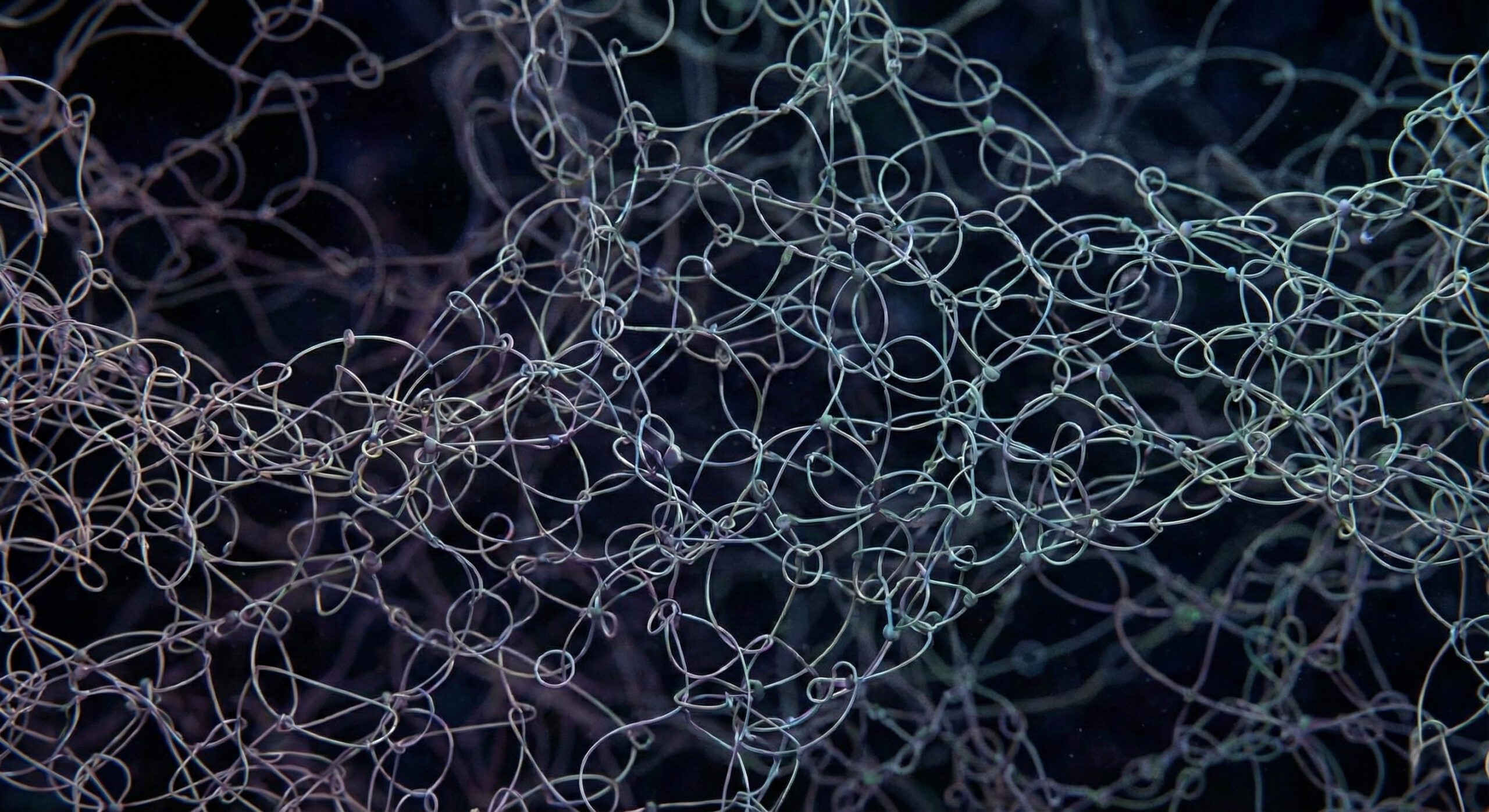
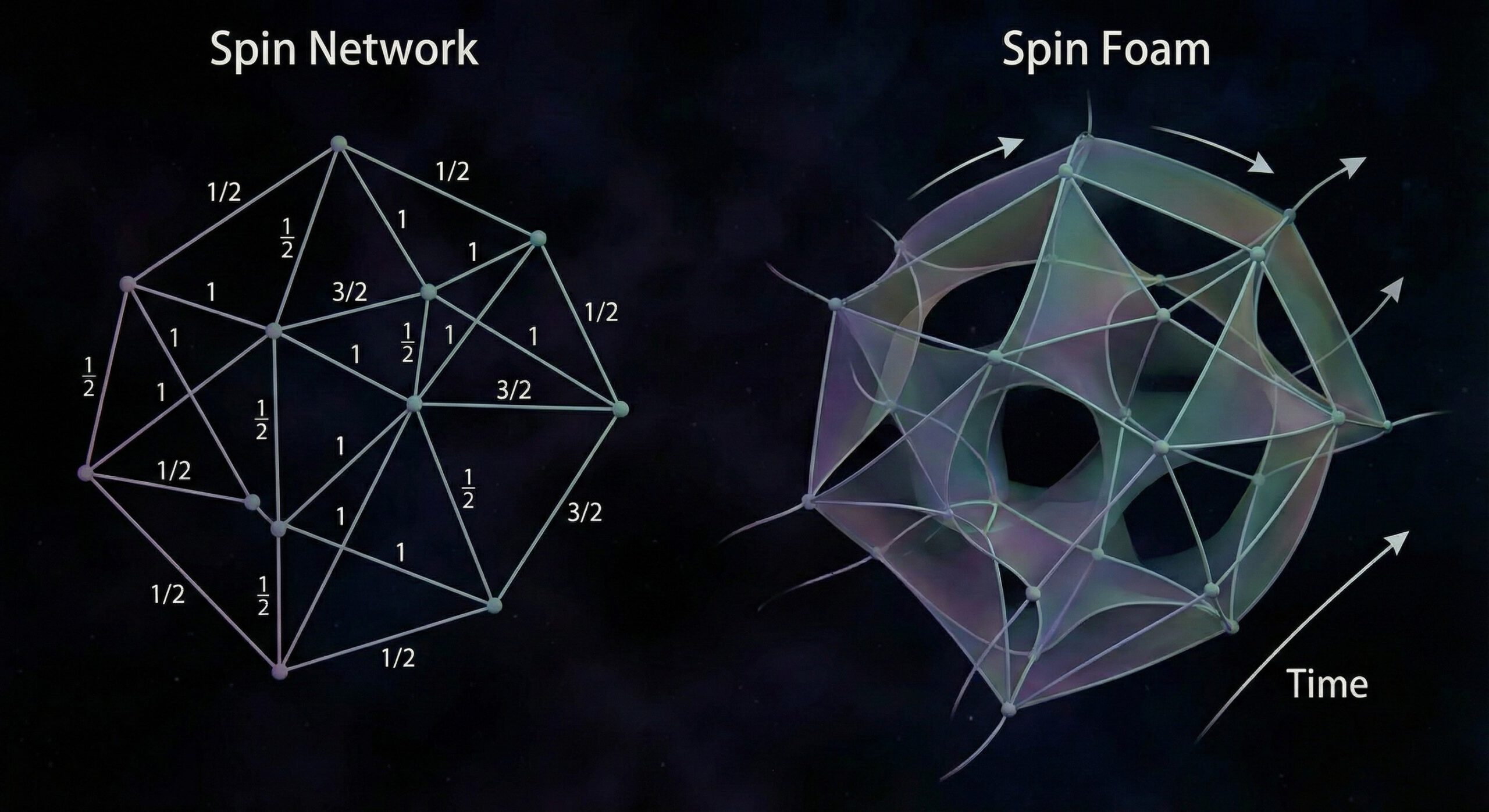
A spin network is a mathematical graph. Think of it as a web of lines (links) and points (nodes). But these aren’t just drawings; they are the physical building blocks of geometry:
- Nodes represent Volume: Each node in the network is a “quantum of volume.” In our everyday world, volume seems continuous. In LQG, you can only have specific, discrete amounts of volume. You cannot have “half a node’s worth” of space.
- Links represent Area: The lines connecting the nodes represent the “area” of the surface between those volumes.
This leads to the theory’s most famous prediction: Geometry is quantized. In 1994, Rovelli and Smolin proved that area and volume have a discrete spectrum. Just as an atom can only have specific energy levels, a surface can only have specific, discrete areas. There is a “smallest possible area” and a “smallest possible volume.” Below this scale, the concept of “space” literally ceases to exist.
The Problem of Time: Enter the Spin Foam
If space is a network of loops, what is time? In classical physics, time is a clock ticking in the background. In LQG, time is much more mysterious.
Because the theory is background-independent, there is no “external” clock. This leads to the Problem of Time: the fundamental equations of the theory don’t actually contain a time variable. Instead, time is “relational.” We only perceive time because the spin network changes.
To describe this change, physicists use Spin Foams. If a spin network is a “snapshot” of space at one moment, a spin foam is the “movie.” It is a four-dimensional structure that shows how nodes and links are created, destroyed, or rearranged. Imagine a network of bubbles: as the bubbles pop and merge, they trace out a history.
In this covariant formulation, spacetime is a “celestial tapestry” that is granular not just in space, but in its very evolution. This is where the Emergent Graviton appears. In LQG, the graviton is not a fundamental “thing” like an electron. Instead, it is a collective excitation—a tiny ripple moving across the spin foam. It is often compared to a “phonon” (a sound wave) in a crystal lattice. The lattice (the spin network) is the reality; the wave (the graviton) is just how we perceive a small vibration in that reality.
Erasing the Beginning: The Big Bounce
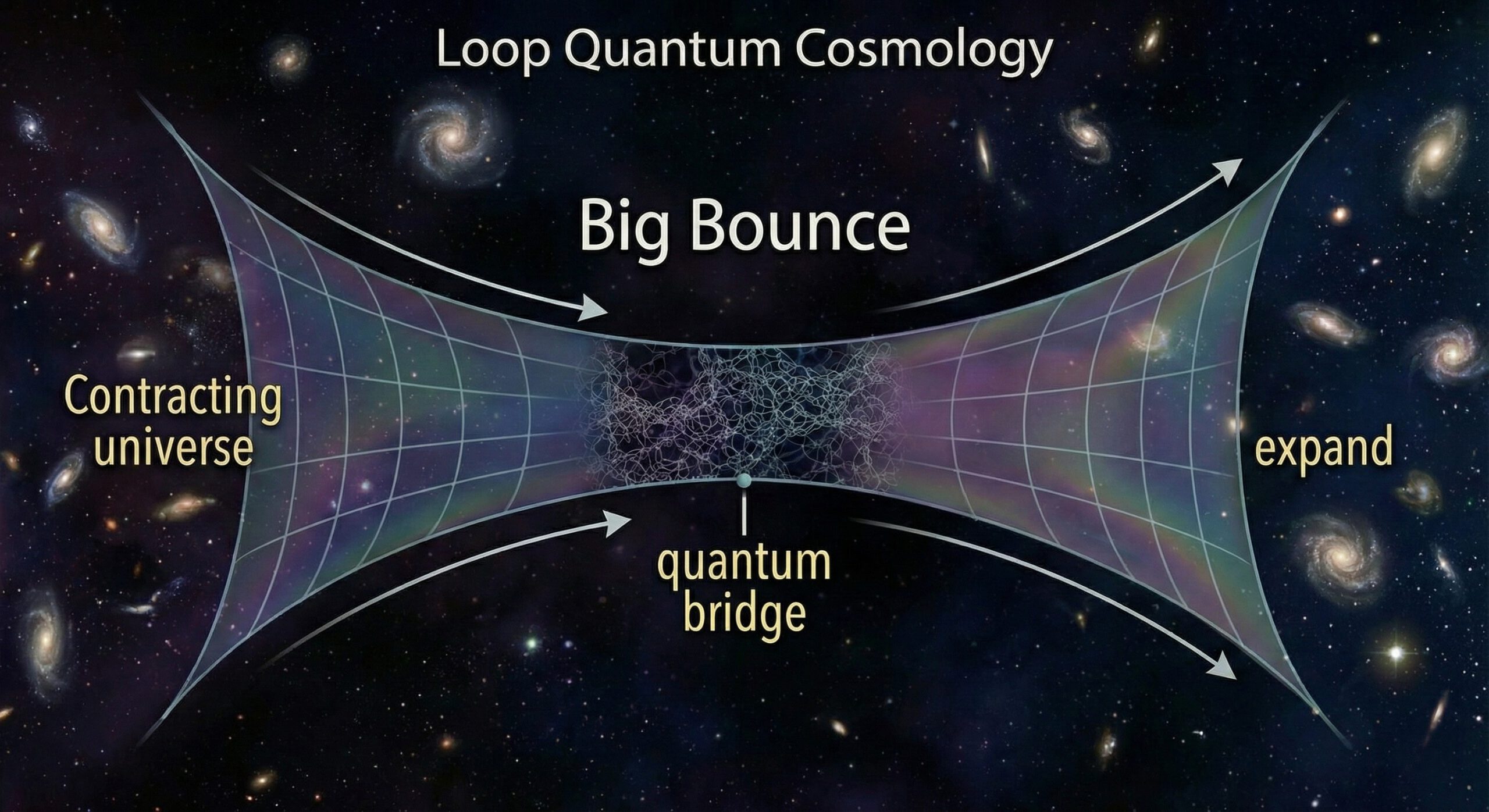
The most successful application of LQG to date is in the field of cosmology. For a century, the Big Bang has been a mathematical “singularity”—a point where our equations fail because density becomes infinite.
Loop Quantum Cosmology (LQC), developed largely by Abhay Ashtekar and his collaborators, changes the narrative. In the LQC model, as the early universe collapses toward a point of infinite density, the “atoms of space” are squeezed together. Because space is granular, it can only be squeezed so much. At a certain “Planck density,” the quantum geometry creates a powerful repulsive force—a “quantum bridge.”
The result is not a Big Bang, but a Big Bounce. Our universe may have been preceded by a collapsing universe that reached its limit and “rebounded.” This removes the need for a “beginning” out of nothingness and suggests a cyclic, perhaps eternal, cosmos.
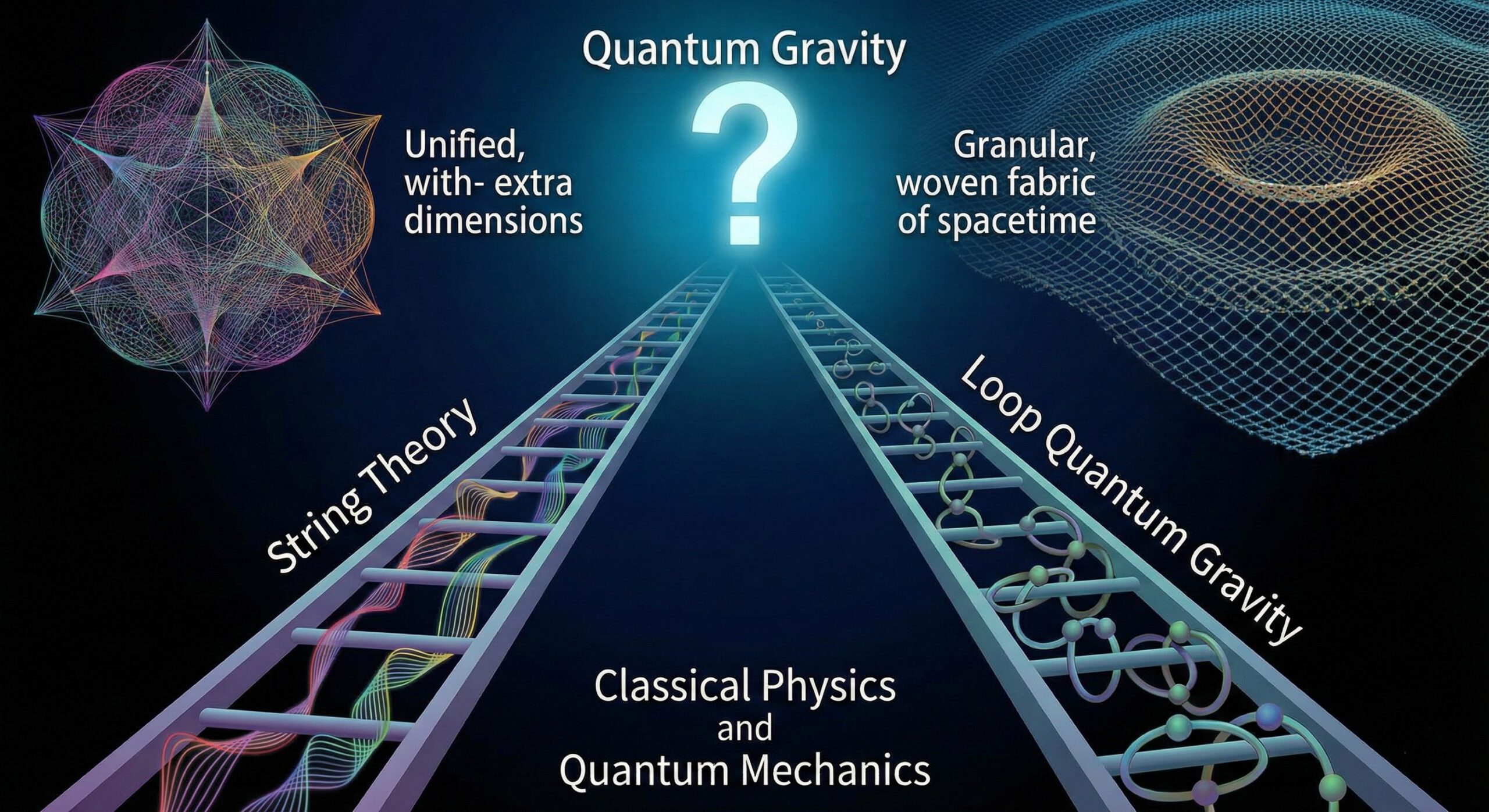
The Great Rivalry: Loops vs. Strings
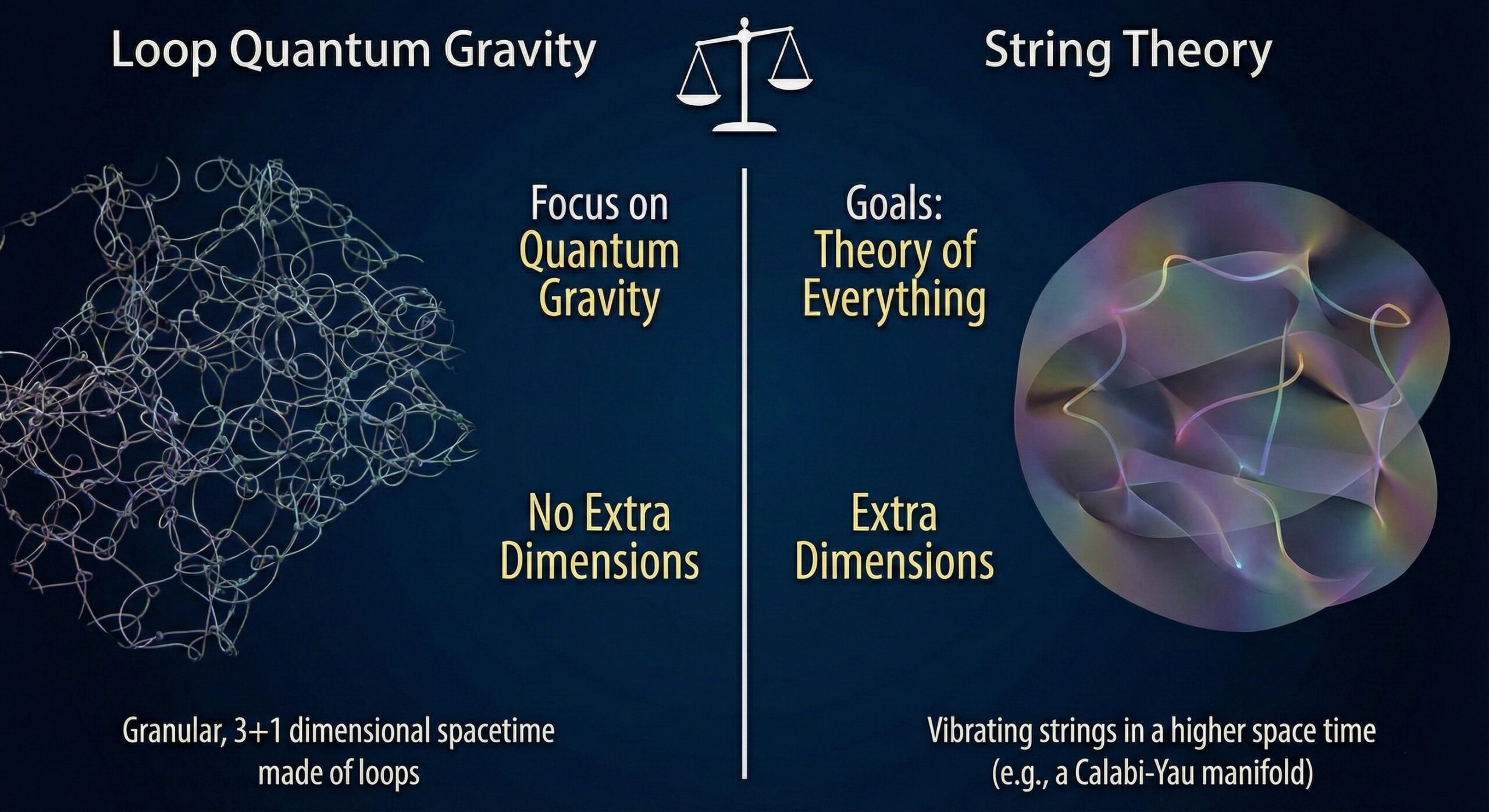
It is impossible to discuss LQG without mentioning its “big brother,” String Theory. In 2025, the debate remains one of the most vibrant in all of science.
- String Theory is “top-down.” It starts with the idea of unification—that all forces must be one. It is mathematically elegant and has led to profound discoveries in black hole entropy and holography. However, it often requires extra dimensions (\(10\) or \(11\)) and supersymmetry, neither of which has been seen in experiments yet.
- Loop Quantum Gravity is “bottom-up.” It doesn’t care about unifying the forces; it only cares about making gravity work with quantum mechanics. It doesn’t require extra dimensions or hidden particles. It is, in many ways, more “conservative” by sticking to 4D space and the principles of General Relativity.
The tension between the two often comes down to the graviton. In String Theory, the graviton is a fundamental vibration of a string. In LQG, it is an emergent property of the spacetime fabric itself.
The Search for the “Pixel”: Testing the Theory
For a long time, critics argued that LQG was untestable. The Planck scale is so small that we would need a particle accelerator the size of the galaxy to see it directly.
However, recent developments in Quantum Gravity Phenomenology are changing this. If space is truly granular, it should affect high-energy light traveling across the universe. Physicists are looking at:
- Modified Dispersion: Does high-energy light from a gamma-ray burst travel at the same speed as low-energy light? If space is “jagged” at the Planck scale, higher energy light might “bump” into the granularity, causing a tiny, detectable delay.
- The CMB Signature: Recent conferences (like “Testing Gravity 2025”) have focused on whether the “Big Bounce” left a specific imprint on the Cosmic Microwave Background—the oldest light in the universe.
- Solar System Precision: New studies in 2024 and 2025 have used data from the MESSENGER and Cassini missions to place tight constraints on “deformation parameters” in LQG-inspired models.
While we haven’t yet found a “smoking gun,” the fact that we can now place actual numerical bounds on these quantum gravity effects means the theory has moved from the realm of philosophy into the realm of hard science.
The Living Tapestry
Loop Quantum Gravity offers a radical, yet beautiful, vision of reality. It suggests that we do not live in space and move through time. Instead, we are part of a dynamic, shifting network of relationships.
If LQG is correct, then every volume of air you breathe, and every moment you experience, is composed of a finite number of “atoms of geometry.” We are actors on a stage that is itself alive—a celestial tapestry that is constantly being rewoven at the speed of light.
As we look toward the future of physics, the “bottom-up” approach of the Loops continues to challenge our most basic assumptions about the world. It reminds us that at the very heart of the universe, there is no emptiness—only connection.
References for Further Reading
- A foundational review of Loop Quantum Gravity’s history and its mathematical success in background-independent quantization.
- A comprehensive portal covering the distinction between canonical and covariant approaches.
- An insightful piece on the “rivalry” and the potential areas where the two theories might eventually meet.
- Recent (2025) research on using solar system experiments to test Loop Quantum Gravity parameters.
- A deep dive into the “Big Bounce” theory and its implications for an eternal universe.
- An excellent visual primer on the duality of spin networks and how they represent volume and area.

