A broader look at the final frontier, covering aerospace engineering, satellite technology, and the future of human habitation among the stars. This category explores the logistics of spaceflight, the environmental challenges of the vacuum, and the sheer scale of the void between worlds.
Inside the “bottom-up” revolution of Loop Quantum Gravity—the theory that reimagines space not as a stage, but as a living, granular tapestry.
Imagine for a moment that you are holding a magnifying glass of impossible power. You point it at the air in front of you, zooming past the dust, past the nitrogen molecules, past the individual atoms, and deep into the sub-atomic void. In our classical understanding of the world, you would find nothing but a smooth, continuous “emptiness”—a stage upon which the actors of the universe perform.
But if a dedicated group of theoretical physicists is correct, your magnifying glass would eventually hit a wall. At a scale so small it defies human intuition—the Planck scale—the “smoothness” of space would shatter. You would see that the void is not empty at all. Instead, it is an intricate, vibrating web of “loops” and “nodes.” You would discover that space itself is pixelated.
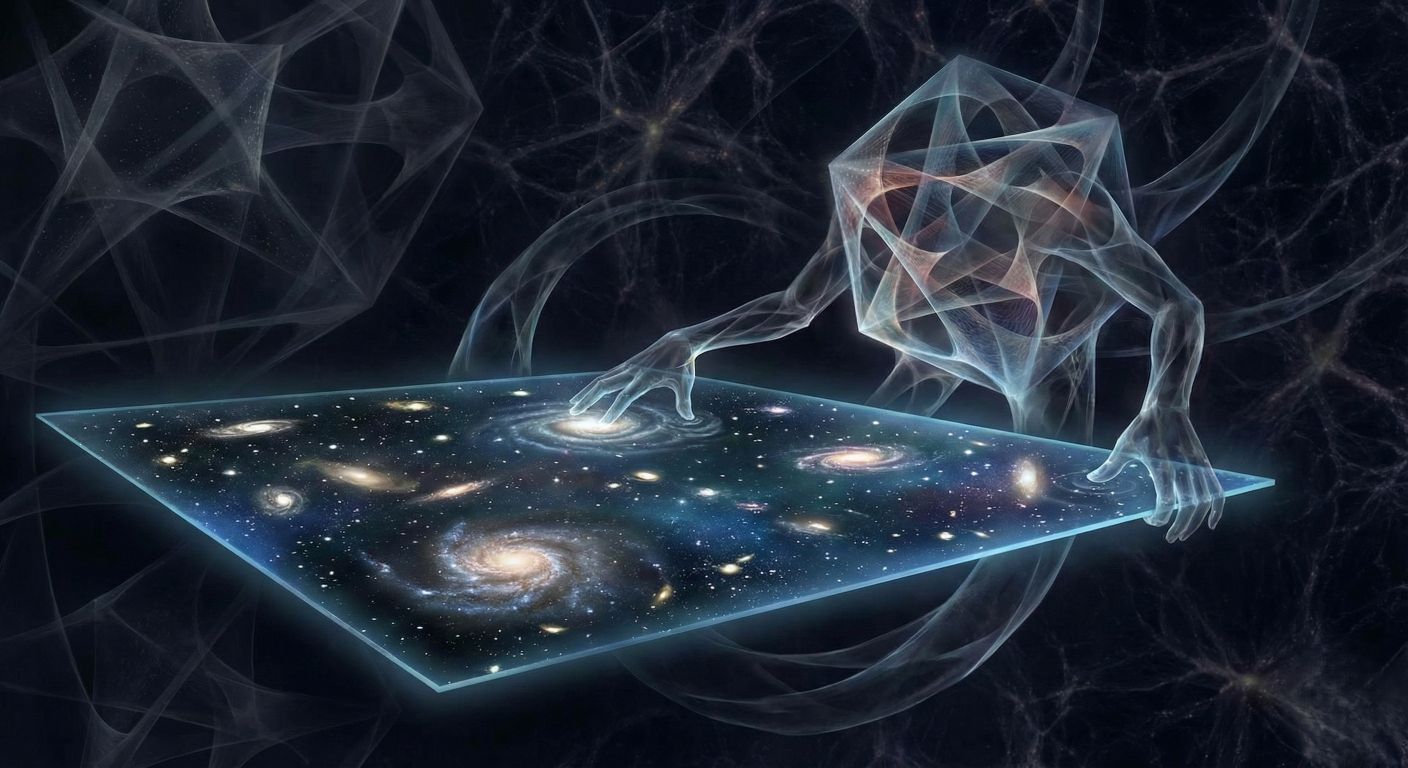
This is the central claim of Loop Quantum Gravity (LQG). It is often described as the “bottom-up” rival to String Theory. While String Theory dreams of being a “Theory of Everything,” LQG is more conservative, yet perhaps more radical: it is a “proposed theory of gravity” that attempts to quantize spacetime itself, building it from the ground up without assuming a background exists at all.
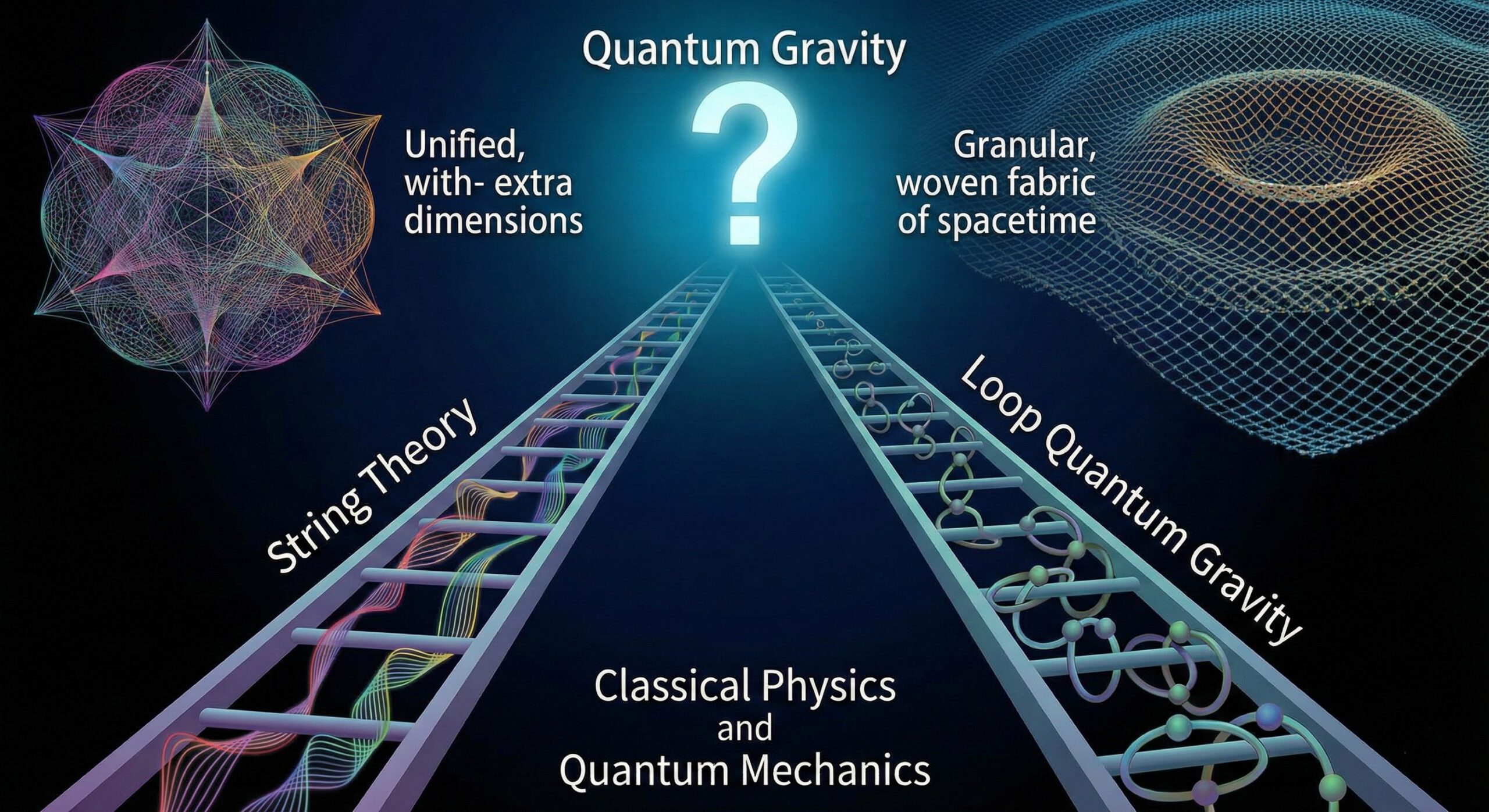
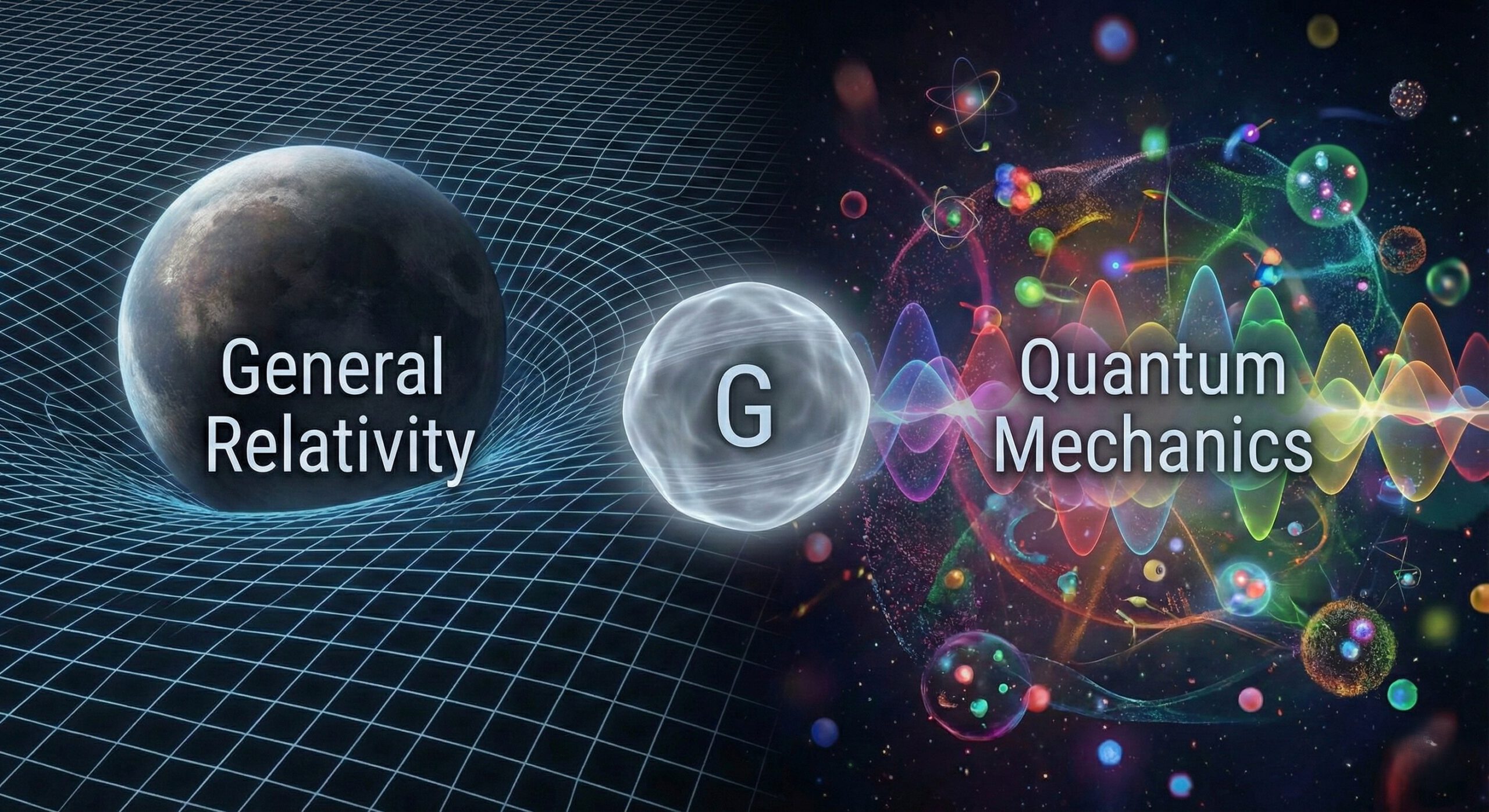
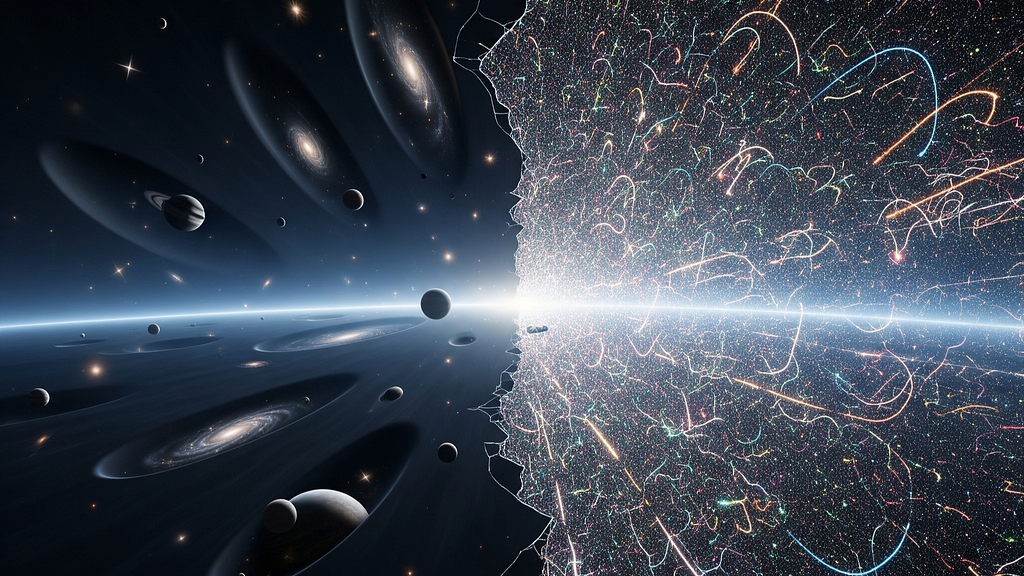
Two Paths to Quantum Gravity.
The Crisis of the Continuum
To understand why we need Loop Quantum Gravity, we have to understand the “ghost” that has haunted physics since 1915. Albert Einstein’s General Relativity gave us a beautiful, geometric vision of the world: gravity is not a force, but the curvature of the fabric of spacetime. Massive objects, like the Sun, warp this fabric, and planets simply follow the curves.
However, when we zoom into the micro-world of Quantum Mechanics, everything changes. Particles are jittery, probabilistic, and discrete. When physicists try to apply the rules of the micro-world to the macro-fabric of Einstein, the math breaks. Specifically, it produces “non-renormalizable infinities.” In simple terms, the equations for gravity explode when you try to calculate them at a single point in space.
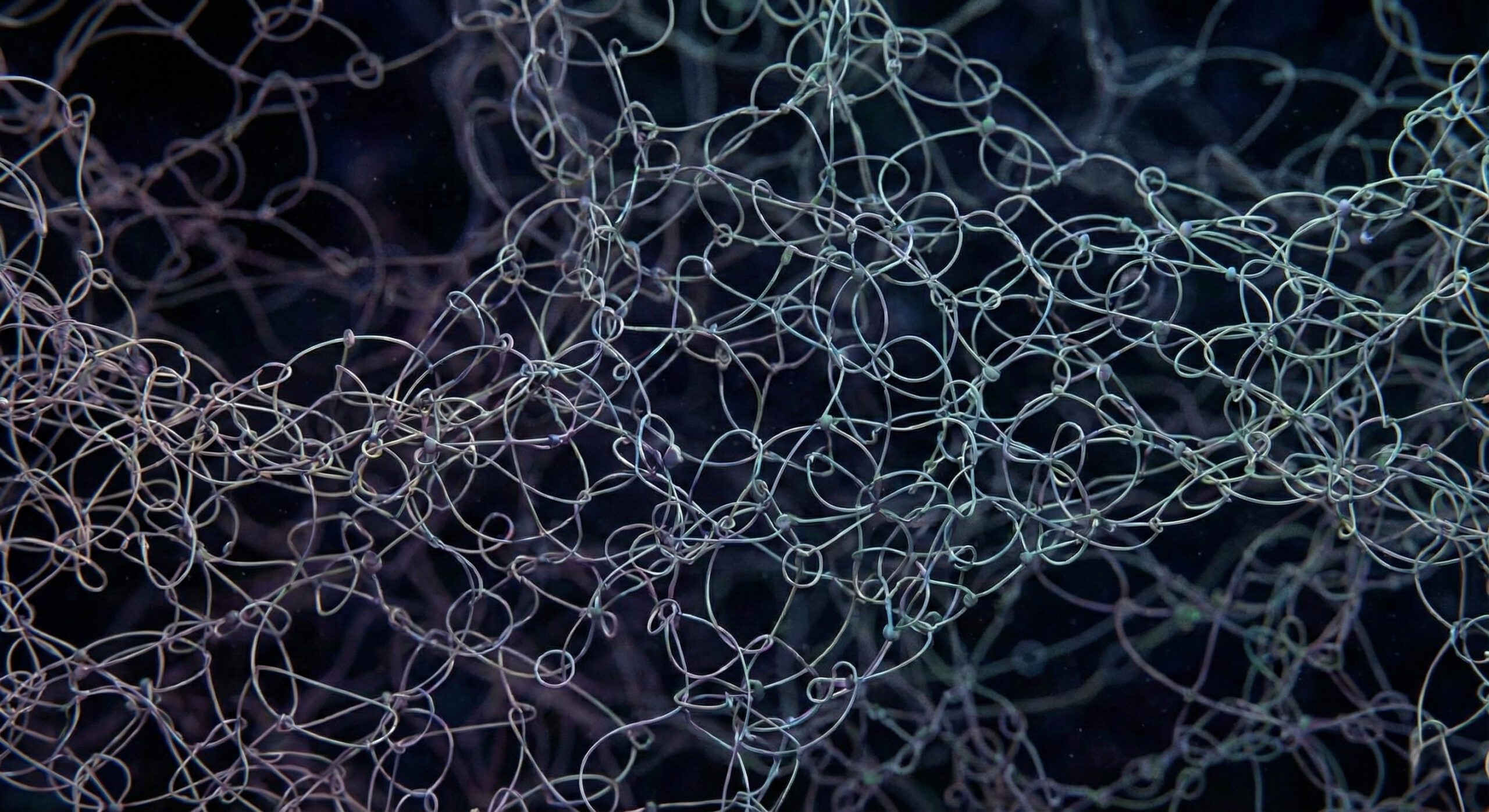
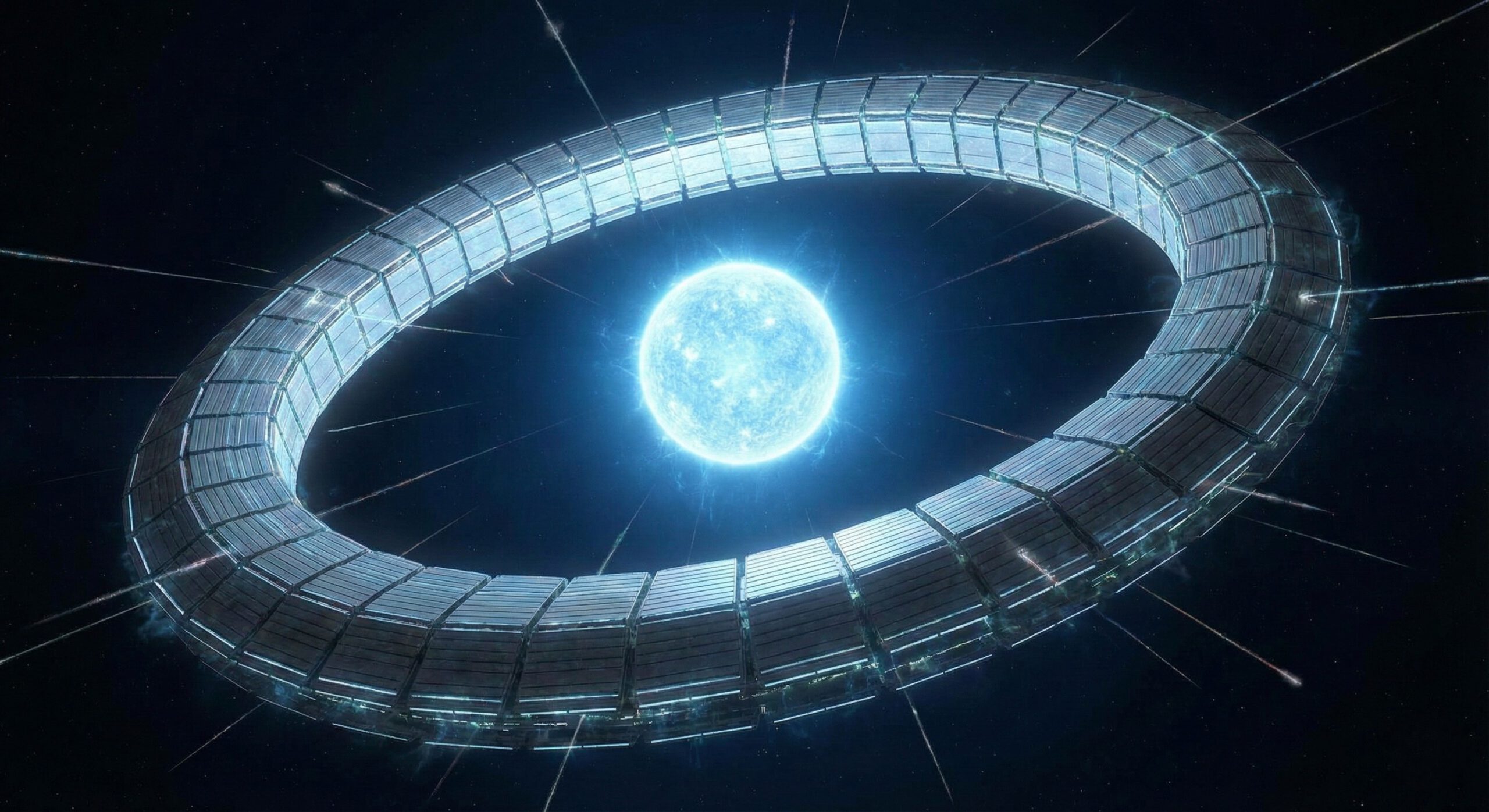
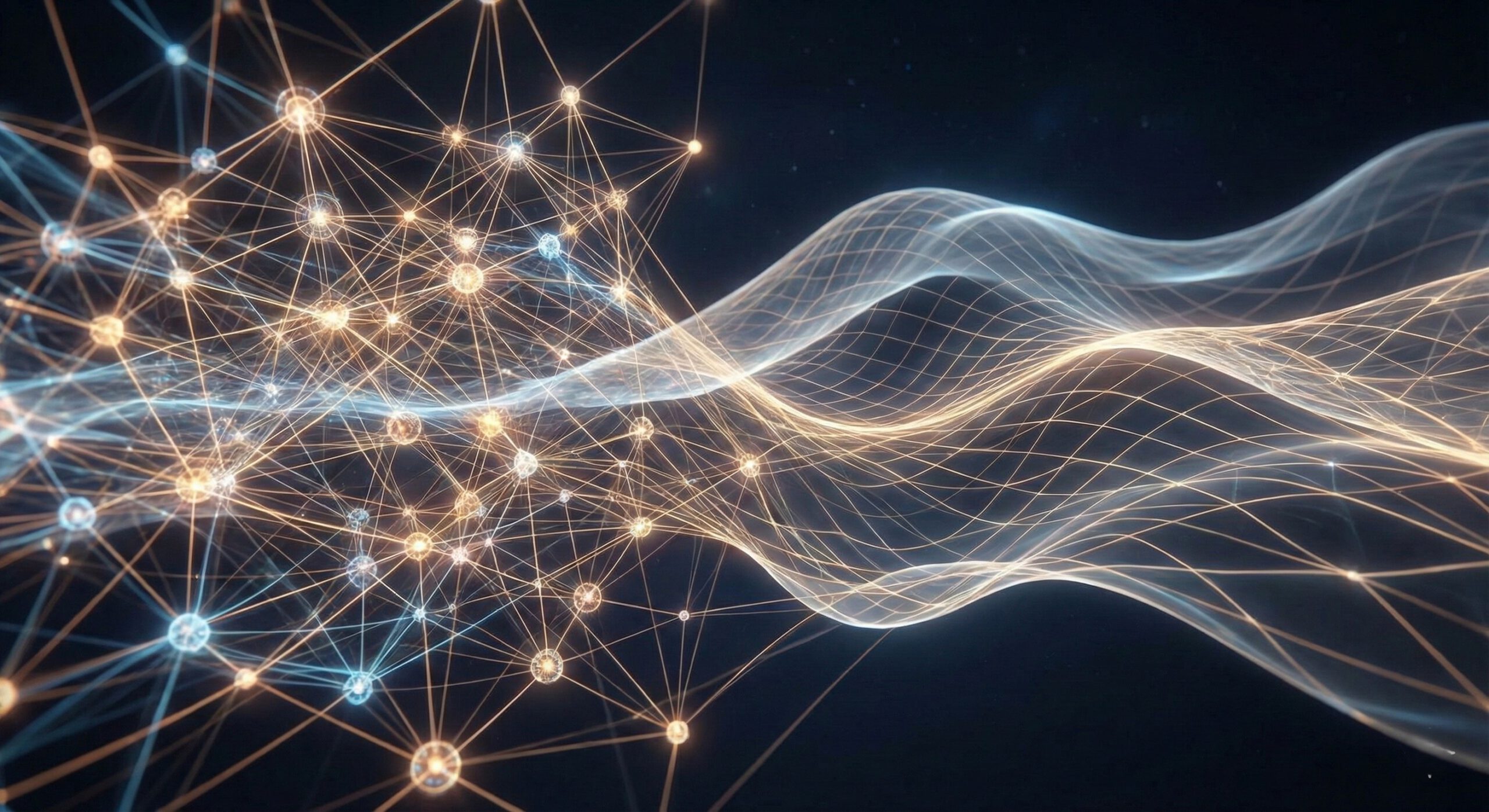
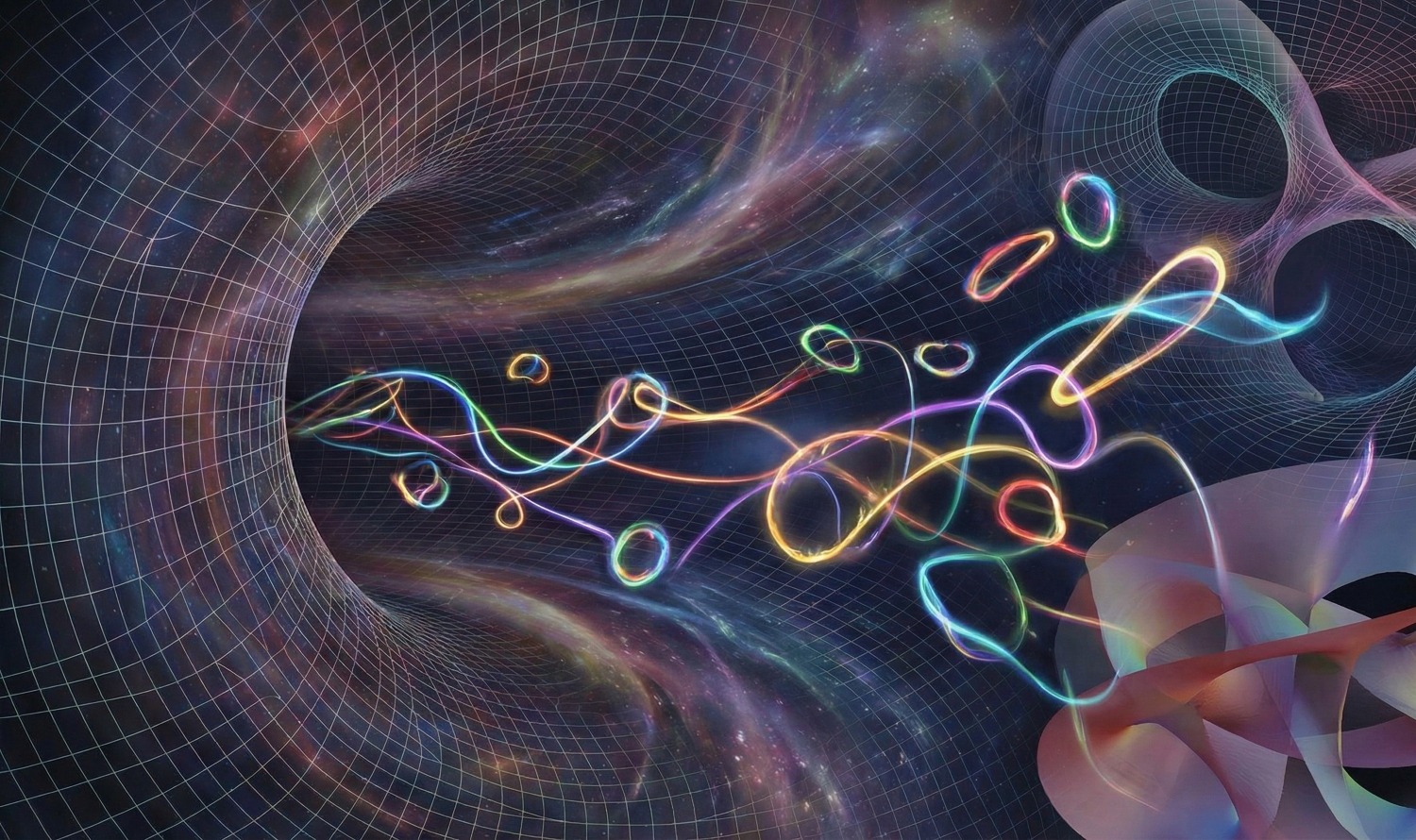
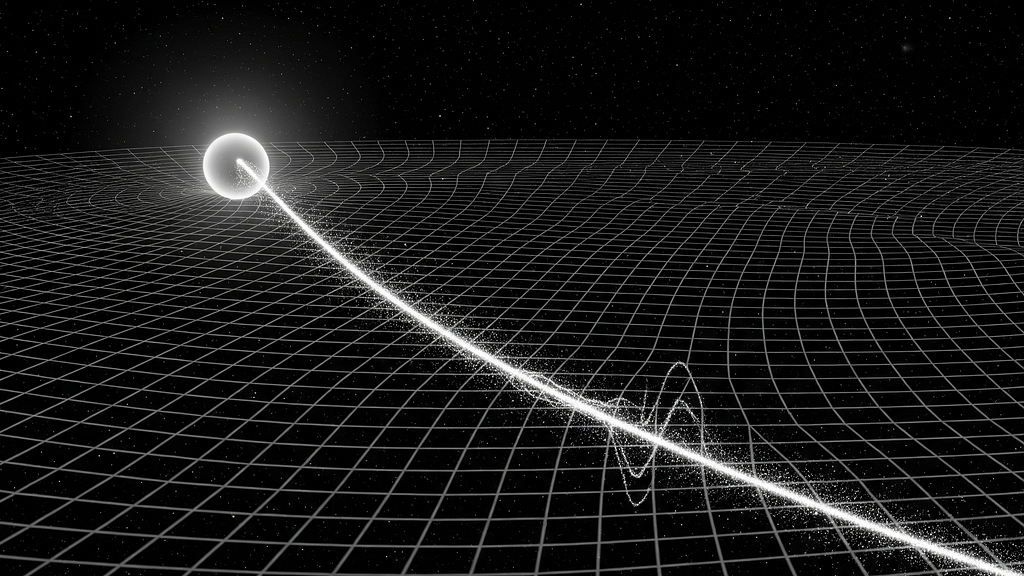
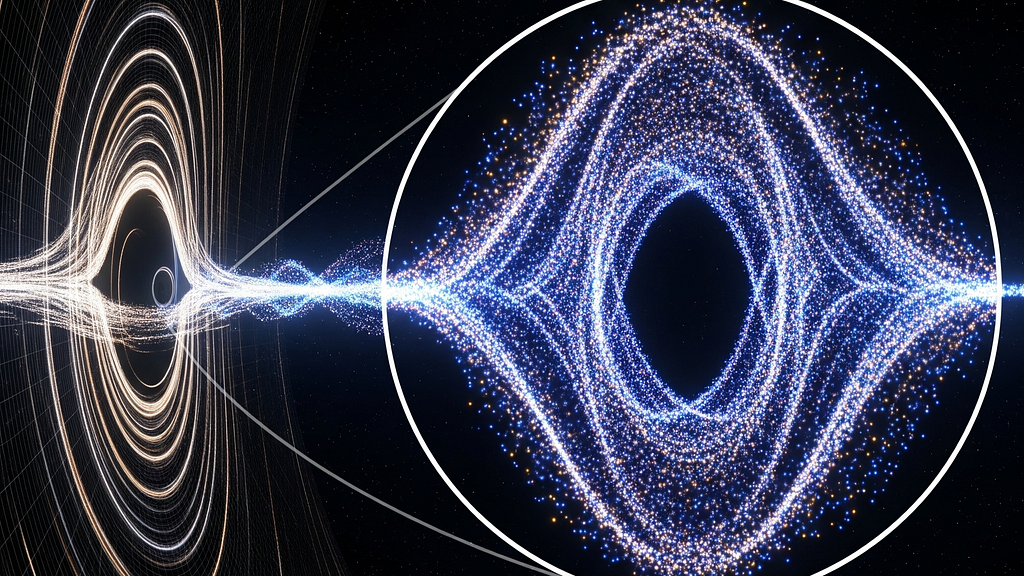
An artistic representation of spacetime at the Planck scale according to Loop Quantum Gravity
For decades, the standard response was to treat gravity as just another force, mediated by a particle called the “graviton.” But this approach traditionally requires a “background”—a pre-existing, flat stage of space and time for the gravitons to move in.
LQG takes a different path. It adheres to the “Relativist’s Creed”: Background Independence. If gravity is space, then you cannot have a theory of gravity that is “plugged into” space. The theory must create space itself.
The Architects: A Historical Pivot
The story of LQG truly began in 1986. Before this, the math of General Relativity was notoriously difficult to quantize. The breakthrough came from Abhay Ashtekar, who reformulated Einstein’s equations using a new set of variables. Instead of focusing on the “metric” (the distance between points), Ashtekar focused on the “connection” (how a vector changes as it moves through space).
This seemingly small mathematical shift was a revolution. It made the equations of gravity look remarkably like the equations of the other forces of nature, specifically gauge theories like Electromagnetism.
Inspired by this, physicists Carlo Rovelli and Lee Smolin realized that the most natural solutions to these new equations weren’t points or particles, but “loops”—closed paths of gravitational force. By the early 1990s, they had moved from simple loops to “Spin Networks.” This became the foundational language of the theory: a mathematically rigorous way to describe a universe without a background.
Spin Networks: The Atoms of Space
In Loop Quantum Gravity, the “solid” ground you walk on is an illusion of scale. If you could see the world at \(10^{-35}\) meters, you would see a Spin Network.
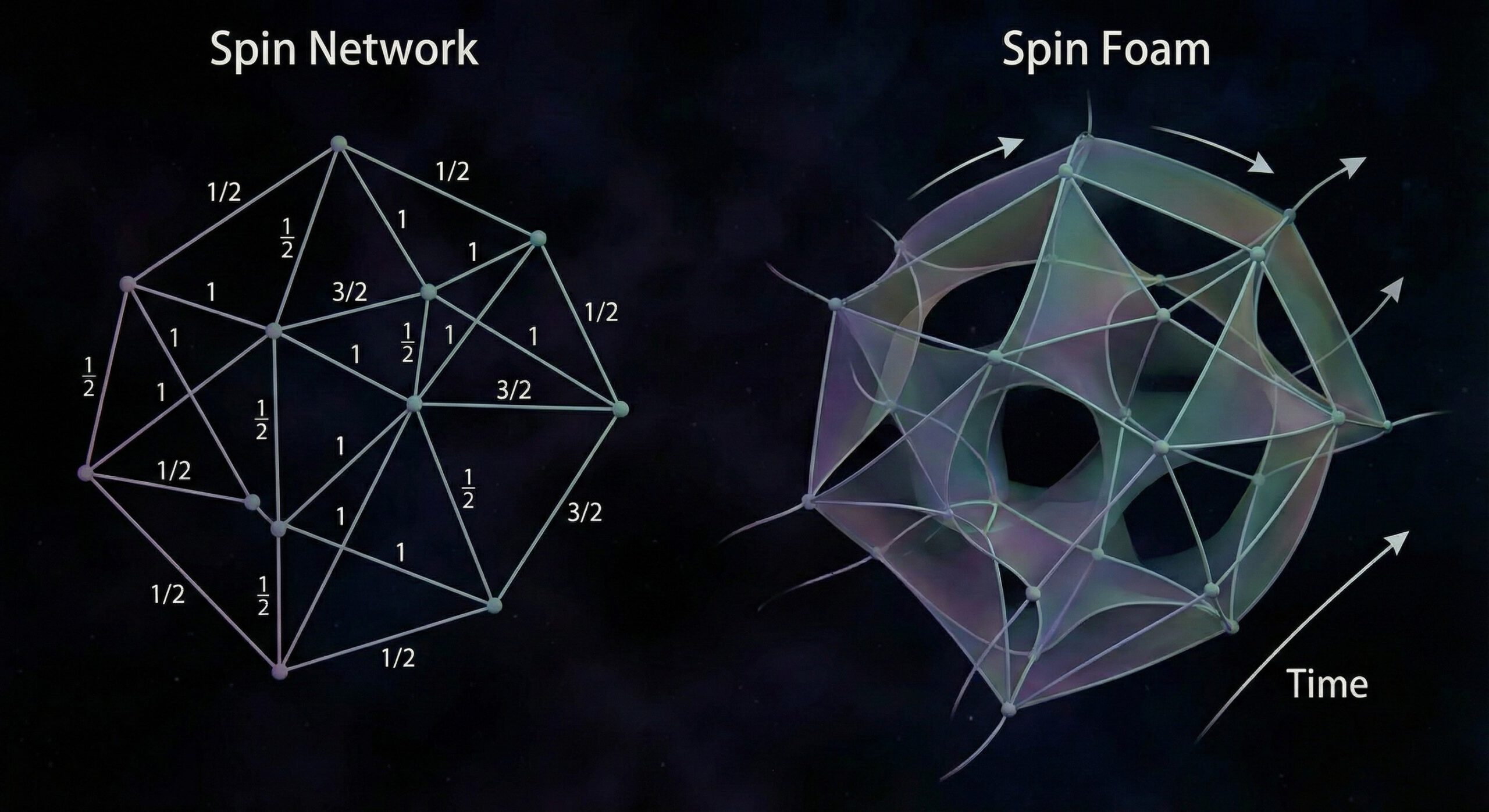
A spin network is a mathematical graph. Think of it as a web of lines (links) and points (nodes). But these aren’t just drawings; they are the physical building blocks of geometry:
Nodes represent Volume: Each node in the network is a “quantum of volume.” In our everyday world, volume seems continuous. In LQG, you can only have specific, discrete amounts of volume. You cannot have “half a node’s worth” of space.
Links represent Area: The lines connecting the nodes represent the “area” of the surface between those volumes.
This leads to the theory’s most famous prediction: Geometry is quantized. In 1994, Rovelli and Smolin proved that area and volume have a discrete spectrum. Just as an atom can only have specific energy levels, a surface can only have specific, discrete areas. There is a “smallest possible area” and a “smallest possible volume.” Below this scale, the concept of “space” literally ceases to exist.
The image on the left shows a spin network, a graph with nodes and links representing quantized space at an instant. The image on the right depicts a spin foam, showing how the spin network evolves over time, forming a foam-like structure.
The Problem of Time: Enter the Spin Foam
If space is a network of loops, what is time? In classical physics, time is a clock ticking in the background. In LQG, time is much more mysterious.
Because the theory is background-independent, there is no “external” clock. This leads to the Problem of Time: the fundamental equations of the theory don’t actually contain a time variable. Instead, time is “relational.” We only perceive time because the spin network changes.
To describe this change, physicists use Spin Foams. If a spin network is a “snapshot” of space at one moment, a spin foam is the “movie.” It is a four-dimensional structure that shows how nodes and links are created, destroyed, or rearranged. Imagine a network of bubbles: as the bubbles pop and merge, they trace out a history.
In this covariant formulation, spacetime is a “celestial tapestry” that is granular not just in space, but in its very evolution. This is where the Emergent Graviton appears. In LQG, the graviton is not a fundamental “thing” like an electron. Instead, it is a collective excitation—a tiny ripple moving across the spin foam. It is often compared to a “phonon” (a sound wave) in a crystal lattice. The lattice (the spin network) is the reality; the wave (the graviton) is just how we perceive a small vibration in that reality.
Erasing the Beginning: The Big Bounce
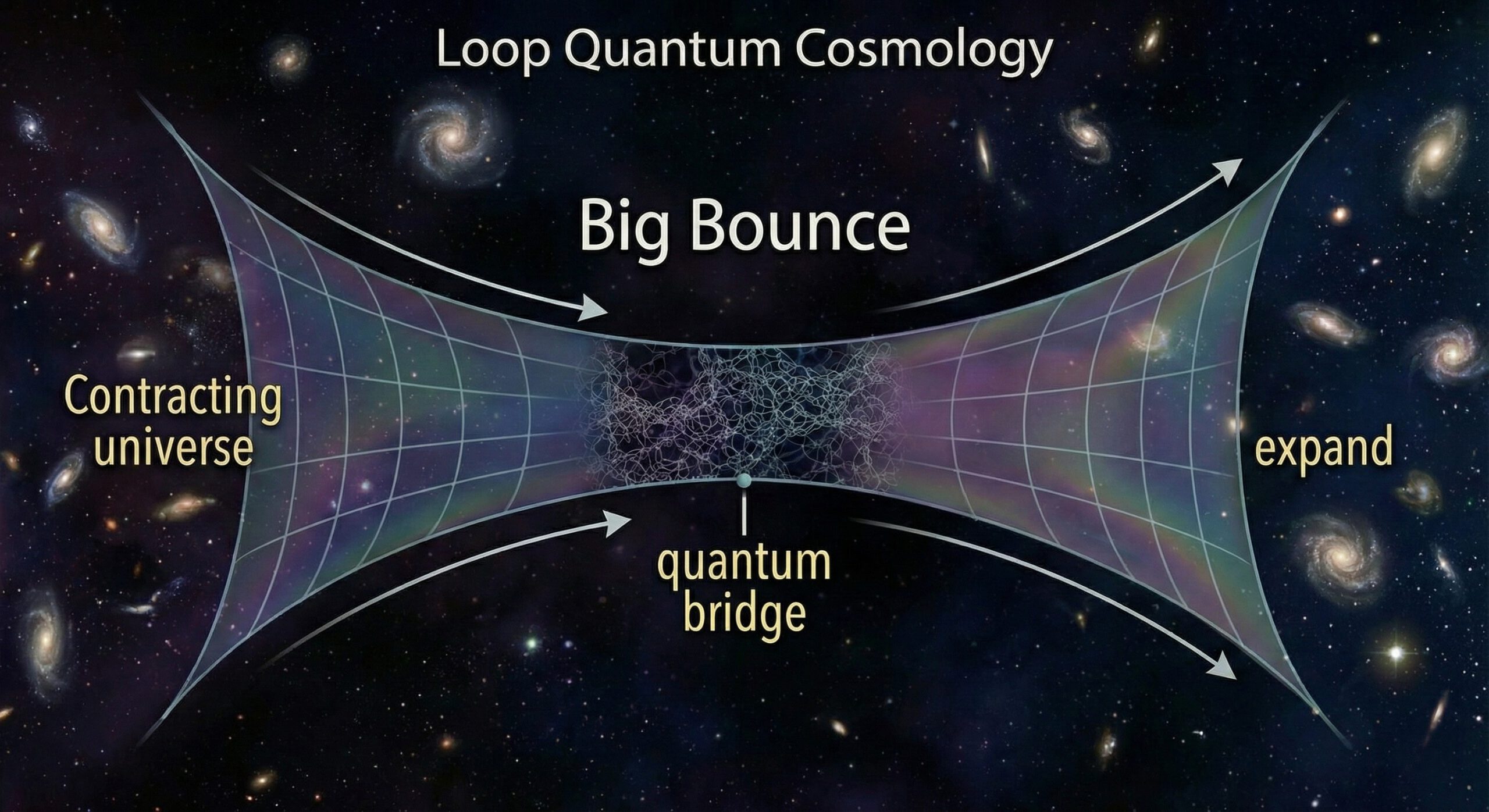
A cosmological diagram illustrating the “Big Bounce” scenario predicted by Loop Quantum Cosmology
The most successful application of LQG to date is in the field of cosmology. For a century, the Big Bang has been a mathematical “singularity”—a point where our equations fail because density becomes infinite.
Loop Quantum Cosmology (LQC), developed largely by Abhay Ashtekar and his collaborators, changes the narrative. In the LQC model, as the early universe collapses toward a point of infinite density, the “atoms of space” are squeezed together. Because space is granular, it can only be squeezed so much. At a certain “Planck density,” the quantum geometry creates a powerful repulsive force—a “quantum bridge.”
The result is not a Big Bang, but a Big Bounce. Our universe may have been preceded by a collapsing universe that reached its limit and “rebounded.” This removes the need for a “beginning” out of nothingness and suggests a cyclic, perhaps eternal, cosmos.
The Great Rivalry: Loops vs. Strings
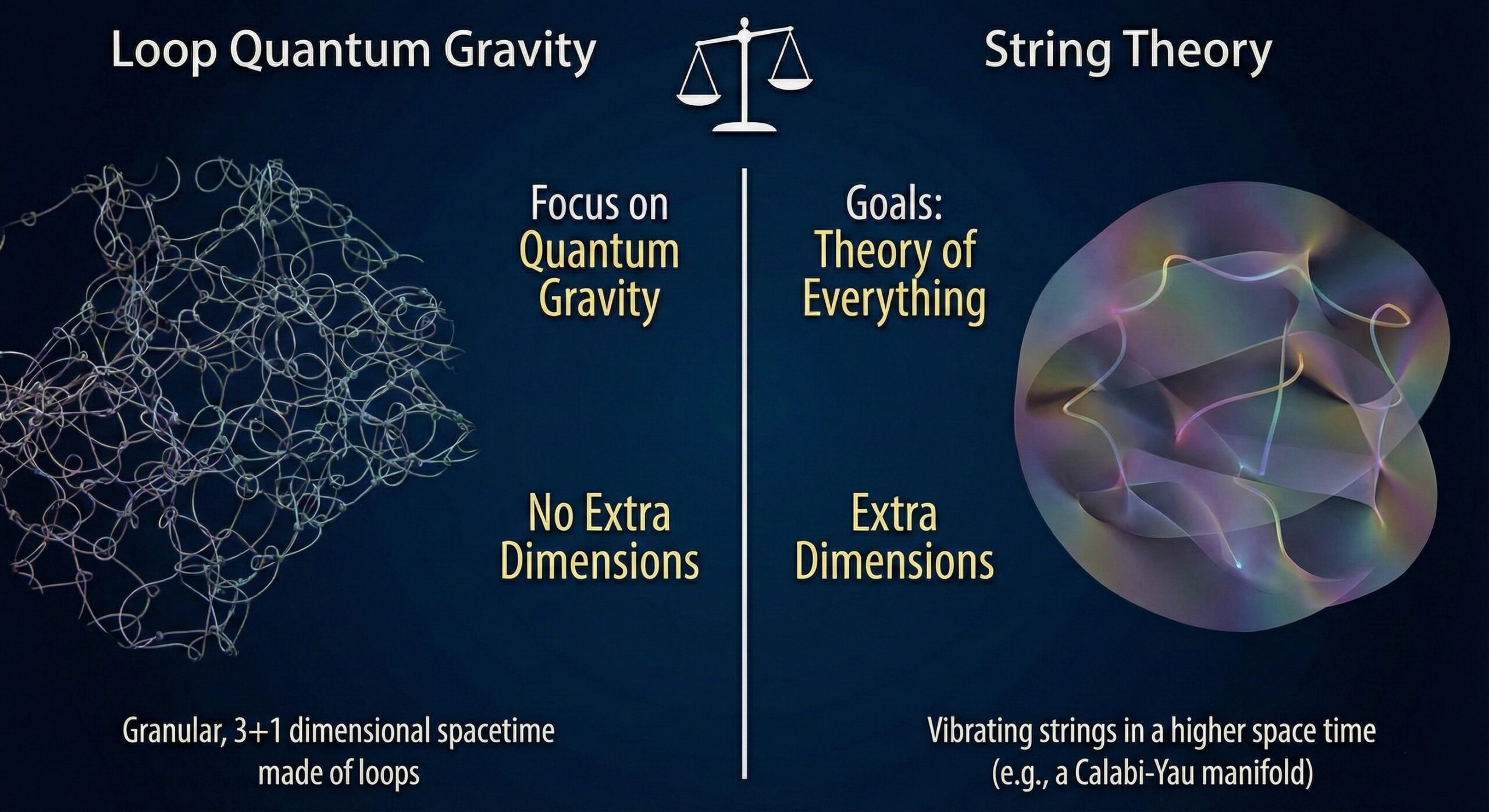
A comparative infographic contrasting the key features and goals of Loop Quantum Gravity and String Theory
It is impossible to discuss LQG without mentioning its “big brother,” String Theory. In 2025, the debate remains one of the most vibrant in all of science.
String Theory is “top-down.” It starts with the idea of unification—that all forces must be one. It is mathematically elegant and has led to profound discoveries in black hole entropy and holography. However, it often requires extra dimensions (\(10\) or \(11\)) and supersymmetry, neither of which has been seen in experiments yet.
Loop Quantum Gravity is “bottom-up.” It doesn’t care about unifying the forces; it only cares about making gravity work with quantum mechanics. It doesn’t require extra dimensions or hidden particles. It is, in many ways, more “conservative” by sticking to 4D space and the principles of General Relativity.
The tension between the two often comes down to the graviton. In String Theory, the graviton is a fundamental vibration of a string. In LQG, it is an emergent property of the spacetime fabric itself.
The Search for the “Pixel”: Testing the Theory
For a long time, critics argued that LQG was untestable. The Planck scale is so small that we would need a particle accelerator the size of the galaxy to see it directly.
However, recent developments in Quantum Gravity Phenomenology are changing this. If space is truly granular, it should affect high-energy light traveling across the universe. Physicists are looking at:
Modified Dispersion: Does high-energy light from a gamma-ray burst travel at the same speed as low-energy light? If space is “jagged” at the Planck scale, higher energy light might “bump” into the granularity, causing a tiny, detectable delay.
The CMB Signature: Recent conferences (like “Testing Gravity 2025”) have focused on whether the “Big Bounce” left a specific imprint on the Cosmic Microwave Background—the oldest light in the universe.
Solar System Precision: New studies in 2024 and 2025 have used data from the MESSENGER and Cassini missions to place tight constraints on “deformation parameters” in LQG-inspired models.
While we haven’t yet found a “smoking gun,” the fact that we can now place actual numerical bounds on these quantum gravity effects means the theory has moved from the realm of philosophy into the realm of hard science.
The Living Tapestry
Loop Quantum Gravity offers a radical, yet beautiful, vision of reality. It suggests that we do not live in space and move through time. Instead, we are part of a dynamic, shifting network of relationships.
If LQG is correct, then every volume of air you breathe, and every moment you experience, is composed of a finite number of “atoms of geometry.” We are actors on a stage that is itself alive—a celestial tapestry that is constantly being rewoven at the speed of light.
As we look toward the future of physics, the “bottom-up” approach of the Loops continues to challenge our most basic assumptions about the world. It reminds us that at the very heart of the universe, there is no emptiness—only connection.
Why the search for the graviton is the most impossible—and important—quest in physics?
The search for the most elusive particle in the universe.
Imagine you are at a party. It’s the Standard Model party. Everyone who is anyone is there. The Electron is mingling near the snacks; the Photon is literally lighting up the room; the Higgs Boson is moving through the crowd, giving everyone mass.
But there is a ghost in the room. You can feel its presence—it’s the reason your feet are stuck to the floor and why the punch doesn’t float out of the bowl. But when you turn to look for the host, the one responsible for this order, there is no one there.
This is the Graviton. It is the hypothetical elementary particle that mediates the force of gravity, and it is the central character in the greatest unsolved mystery of modern physics.
The Profile of a Ghost
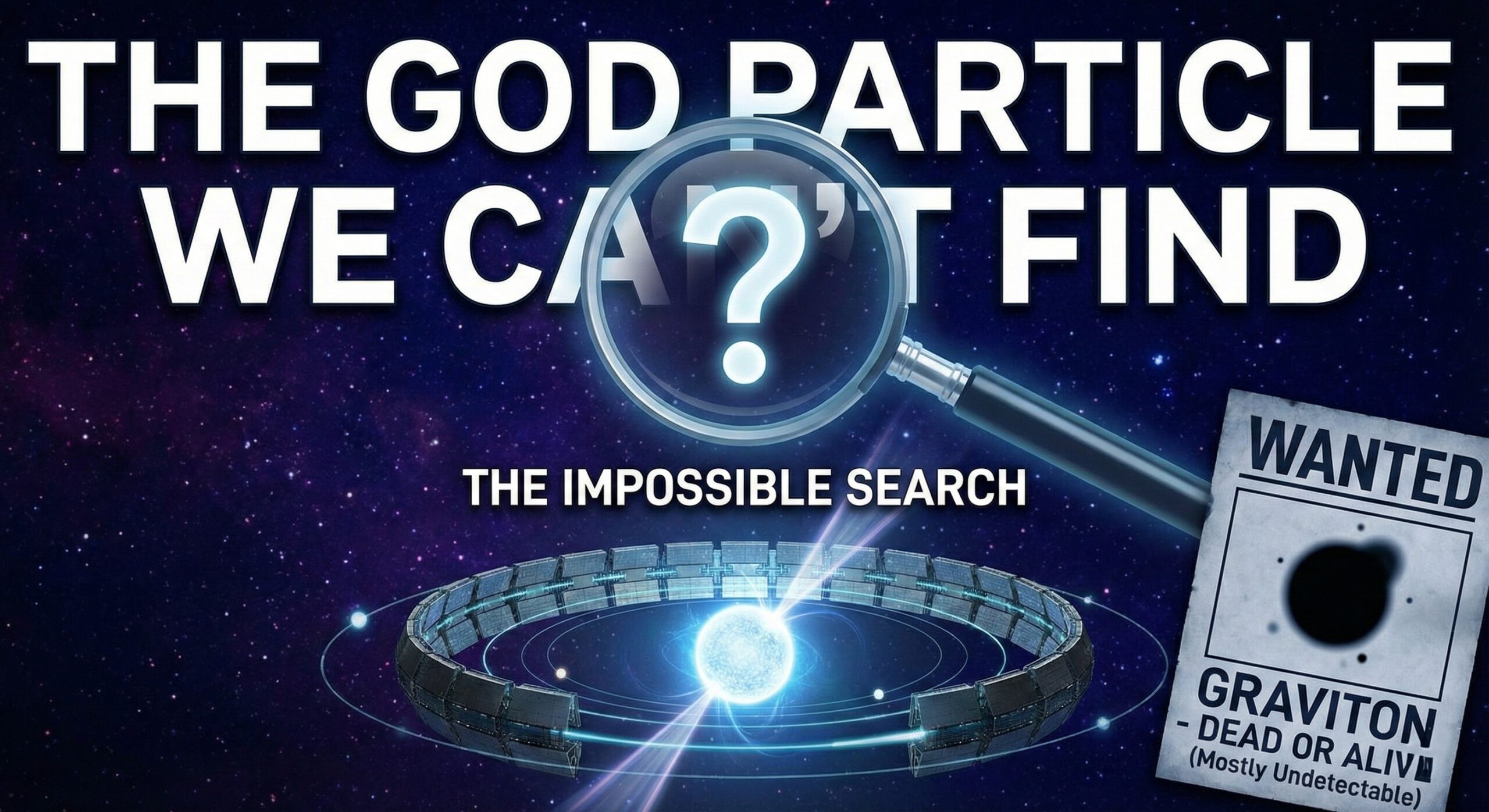
If we can’t see it, how do we know what it looks like? Remarkably, theoretical physics gives us a very precise “wanted” poster for the graviton, derived purely from the laws of relativity and quantum mechanics.
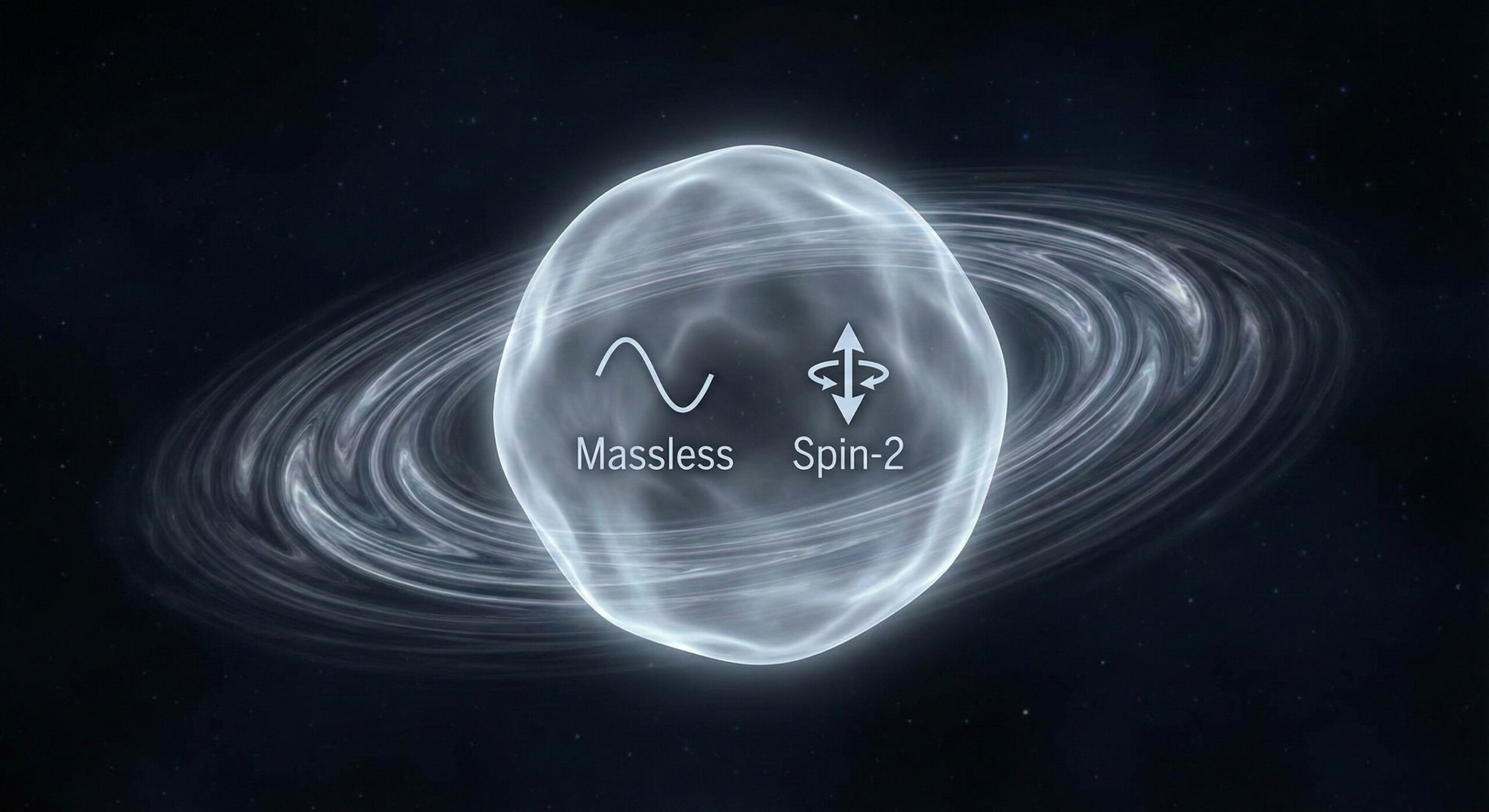
If the graviton exists, it has two non-negotiable properties:
It must be massless. Gravity has an infinite range. You can feel the Sun’s gravity from 93 million miles away; galaxies feel each other across the void of the cosmos. In quantum field theory, forces with infinite range must be carried by massless particles (just like the photon).
It must be a Spin-2 Boson. This is the smoking gun.
To understand why “Spin-2” is so important, we have to look at the source of the force.
Electromagnetism comes from the “four-current” (electric charge and current), which is a first-order tensor. Therefore, its carrier particle, the Photon, has Spin-1.
Gravity comes from the stress–energy tensor (T_{\mu\nu}). This is a complex beast that describes energy density, momentum density, and stress (pressure and shear). Because its source is a second-order tensor, the particle carrying the message must be Spin-2.
The Magnet and the Paperclip
If we know what we are looking for, why haven’t we found it? The Large Hadron Collider (LHC) found the Higgs Boson, so why not this?
The answer lies in the Feebleness Problem.
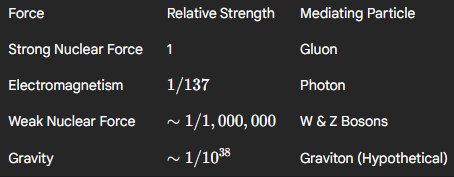
Gravity is, effectively, the weakling of the fundamental forces. We don’t realize this because we usually experience gravity created by massive objects (like Earth). But strip away the planet, and the force vanishes into a whisper.
Consider the “Magnet and Paperclip” analogy:
Place a paperclip on your desk. The entire Earth—all 6 \times 10^{24} kilograms of it—is pulling that paperclip down. Now, take a tiny fridge magnet and hold it over the paperclip. Snap. The paperclip jumps up to the magnet.
That tiny magnet just defeated the gravitational pull of the entire planet. That is how weak gravity is compared to electromagnetism—roughly $10^{36} times weaker.
The Impossible Detector
Because gravity is so weak, individual gravitons interact with matter so rarely that catching one is statistically impossible.
To detect a particle, you usually need it to hit your detector and transfer energy. Neutrinos are famous for passing through light-years of lead without stopping, but gravitons make neutrinos look like brick walls.
Physicists Tony Rothman and Stephen Boughn crunched the numbers on what it would take to detect a single graviton. The results were disheartening.
To have a fighting chance of detecting just one graviton every 10 years, you would need a detector built with the mass of Jupiter. But you can’t just park it anywhere; you would need to place this Jupiter-sized detector in a tight orbit around a neutron star (a source of intense gravity).
Even if you managed this engineering miracle, the background noise from the universe (neutrinos, cosmic rays) would likely drown out the signal anyway.
Why We Keep Searching
If it’s impossible to find, why does it matter?
Because the graviton is the missing bridge. On one side of the river, we have General Relativity (Einstein’s world of curved space and time). On the other, we have Quantum Mechanics (the jittery, pixelated world of particles).
The graviton is the only thing that belongs to both worlds. It is a quantum particle that creates the curvature of spacetime. Finding it—or proving it doesn’t exist—is the only way to end the war between physics’ two greatest theories and finally understand the true nature of reality.
For now, the graviton remains the ghost at the party: felt by everyone, seen by no one.
For a century, physics has been torn between two “Competitors”—Gravity and Quantum Mechanics. The resolution to their conflict suggests that the universe you see is just a user interface.
Reality is a lie?
For over a century, theoretical physics has been defined by a quiet but brutal conflict between its two deepest laws. On one side sits General Relativity, Albert Einstein’s masterpiece, which describes a universe of smooth, curving spacetime where gravity determines the motion of stars and galaxies. On the other side sits Quantum Mechanics, the rulebook for the subatomic world, describing a reality that is pixelated, probabilistic, and jittery.
Separately, these theories are incredibly successful. General Relativity guides our GPS satellites; Quantum Mechanics gave us the transistor and the laser. But when you try to combine them—to describe the center of a black hole or the moment of the Big Bang—the mathematics collapses. They are fundamentally incompatible. One demands a smooth geometry; the other demands a violent quantum foam.
However, a radical consensus is emerging among high-energy physicists: the war is over. The resolution, though, is not a peace treaty where one side wins. It is a revelation that the battlefield itself—spacetime—may not be fundamental. This is the Holographic Principle, the suggestion that the three-dimensional universe we experience is merely a projection of a lower-dimensional reality, much like a 2D hologram projects a 3D image.
The Problem of Information
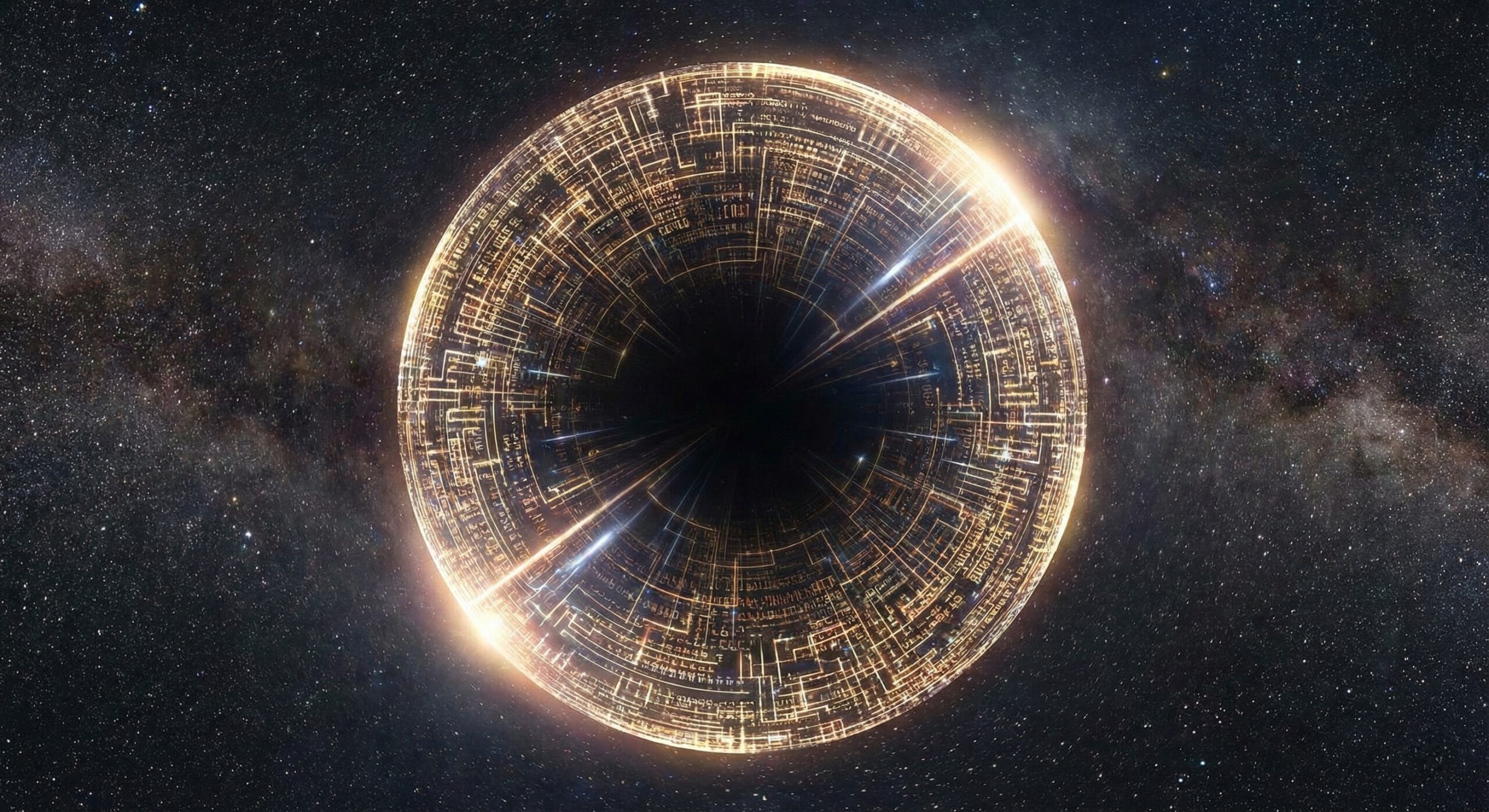
This image represents a black hole where the information is stored on its surface event horizon
The first crack in the facade of classical spacetime appeared with black holes. According to General Relativity, black holes are simple objects defined only by mass, charge, and spin. If you throw a dictionary into a black hole, the information inside it seems to vanish. But Quantum Mechanics relies on a principle called “unitarity,” which dictates that information is never destroyed, only scrambled.
In the 1970s, Jacob Bekenstein and Stephen Hawking discovered something profound: the amount of information (entropy) a black hole can hold is not proportional to its volume, as common sense would suggest, but to its surface area. This was the first hint that the “inside” of the universe might be redundant. If the maximum information of a 3D object can be fully encoded on its 2D surface, then the third dimension—depth—might be an illusion.
The Soup Can Universe: AdS/CFT
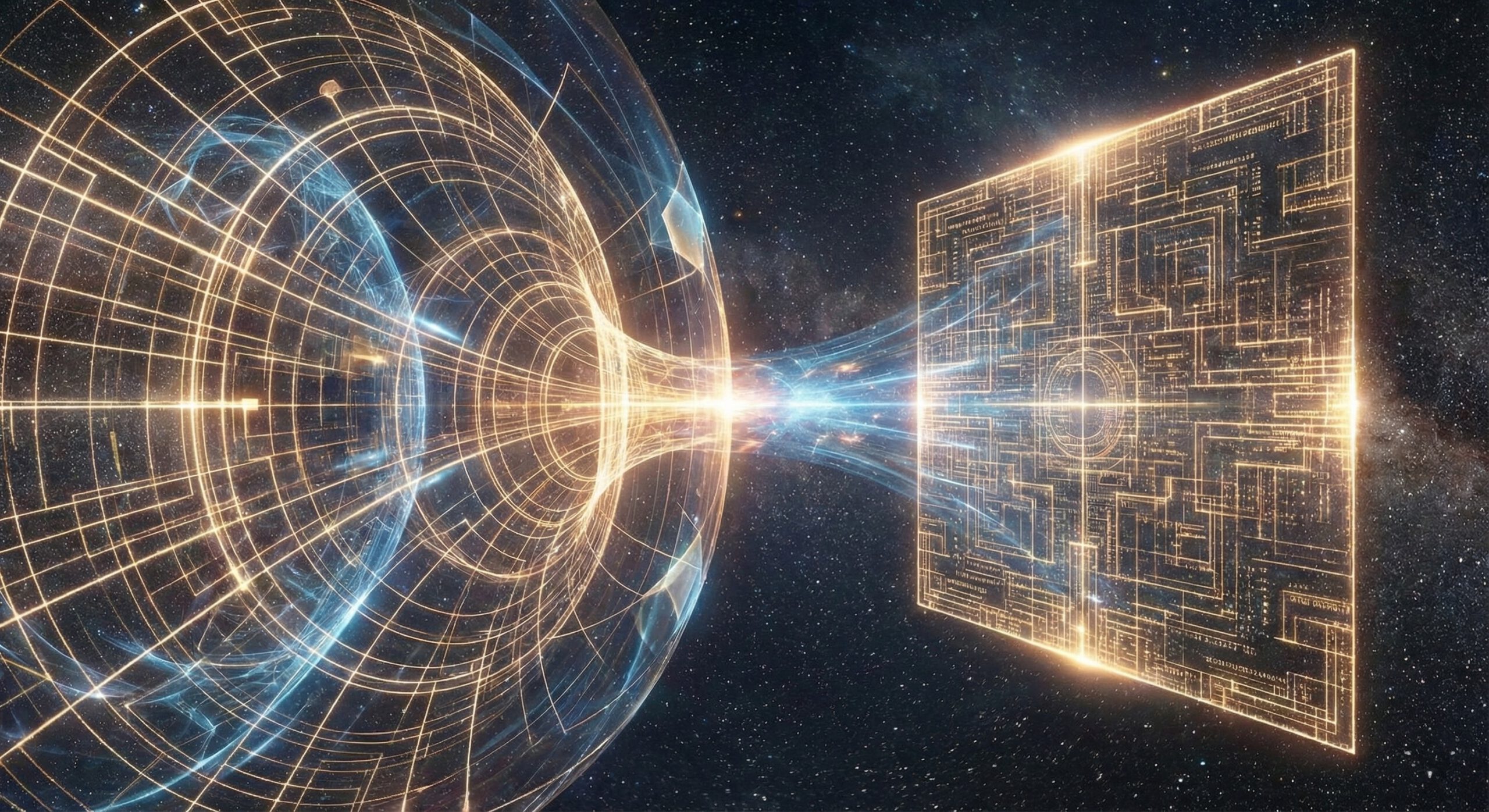
This image illustrates the AdS/CFT correspondence, showing the projection of a higher-dimensional, volumetric space
In 1997, physicist Juan Maldacena formalized this idea with the AdS/CFT Correspondence, often called the “Soup Can” analogy.
Imagine a universe contained entirely inside a tin can.
The Bulk (The Soup): The interior of the can represents Anti-de Sitter (AdS) space. This is a world with gravity, volume, and three dimensions.
The Boundary (The Label): The surface of the can represents a Conformal Field Theory (CFT). This is a quantum world with no gravity, living on a flat, two-dimensional surface.
Maldacena proved that these are not two different universes. They are the same universe described in two different languages. A black hole forming in the “soup” is mathematically identical to a hot, chaotic cloud of particles on the “label.” This duality saved quantum mechanics: information falling into a black hole isn’t lost; it is simply smeared out across the boundary of the universe.
Spacetime is “Made” of Entanglement
This visualization shows quantum entanglement, represented by a web of glowing connections
If the 3D world is a projection, what is the mechanism of the projector? How do flat, quantum correlations on a boundary turn into the voluminous fabric of space we walk through? The answer appears to be Quantum Entanglement.
For decades, entanglement was viewed as a “spooky” phenomenon happening inside space. New research suggests entanglement is what constructs space.
This relationship is encapsulated in the Ryu-Takayanagi Formula. It calculates the “entanglement entropy” of a region on the boundary and finds it is directly proportional to the area of a surface dipping into the bulk. In simple terms: the amount of quantum entanglement on the surface determines the amount of physical geometry inside.
Theoretical calculations have shown that if you were to “turn off” the entanglement between two regions of the boundary, the space inside would physically tear apart. Spacetime is a web of quantum correlations. This has led to the slogan “It from Qubit”—the idea that the physical “it” (geometry) emerges from the “qubit” (quantum information).
This connection is further strengthened by the ER=EPR conjecture, proposed by Maldacena and Leonard Susskind. It suggests that a pair of entangled particles (EPR) is connected by a microscopic wormhole (Einstein-Rosen bridge). In this view, quantum entanglement is literally the thread stitching the fabric of spacetime together.
The Glitch: We Don’t Live in a Soup Can
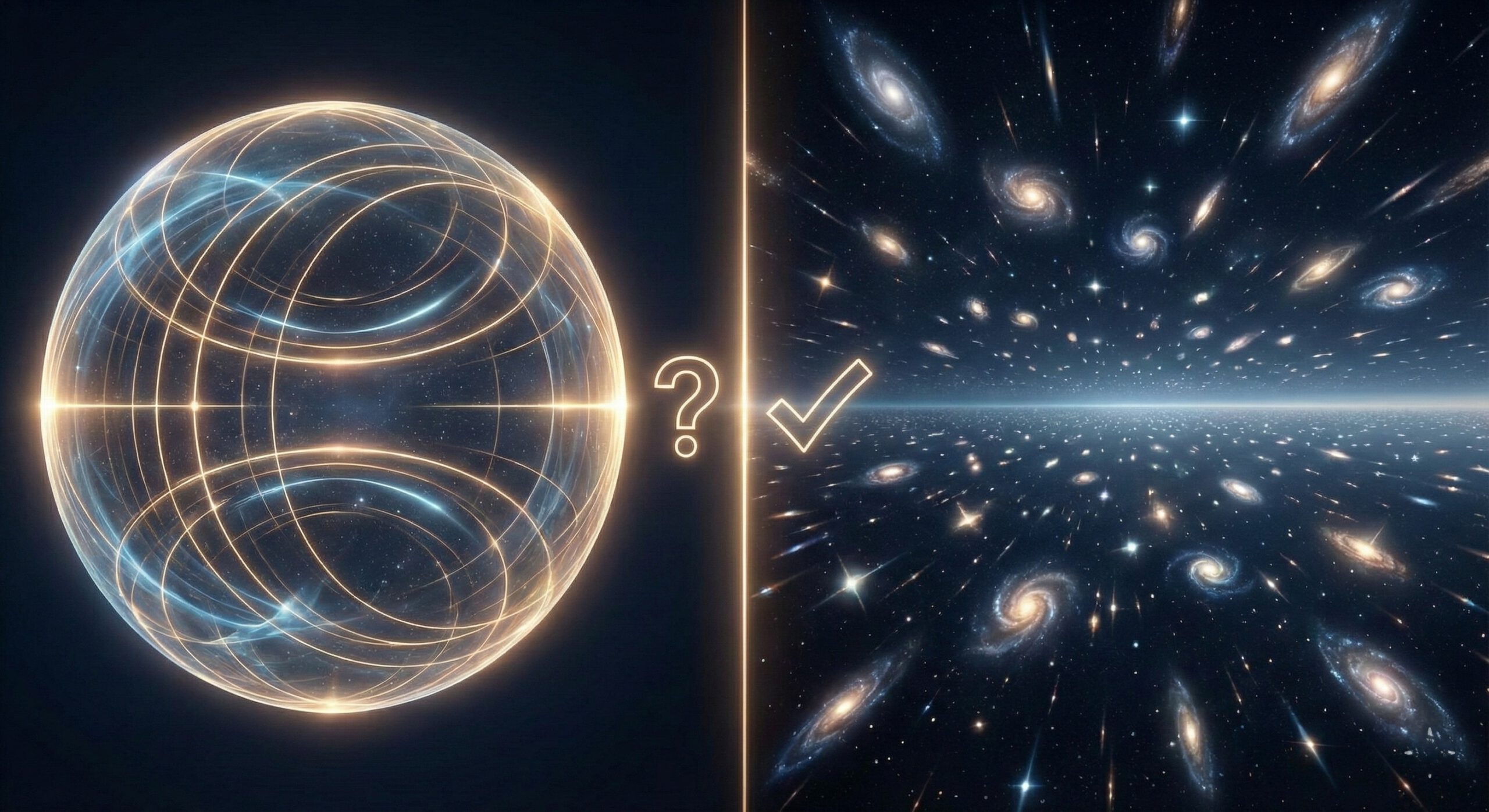
This image contrasts the theoretical, curved AdS universe (left) with our actual expanding universe (right)
While the AdS/CFT correspondence is a mathematical triumph, it faces a severe reality check: We do not live in Anti-de Sitter (AdS) space.
AdS space acts like a box with a reflective wall at the edge, which makes the mathematics of holography work nicely. Our universe, however, is expanding and accelerating due to Dark Energy. We live in de Sitter (dS) space. Unlike the soup can, our universe is like an expanding bubble with no clear spatial boundary.
This discrepancy has led to the “Swampland” Program. String theorists have found it incredibly difficult to construct a stable, accelerating universe like ours within their equations. Some conjectures suggest that universes like ours might belong to the “Swampland”—a set of theories that look consistent at low energies but are actually impossible in a full theory of quantum gravity.
Celestial Holography: A Hologram on the Sky
Because our universe lacks the convenient “walls” of AdS space, physicists are developing a new framework called Celestial Holography.
Instead of projecting reality from a boundary at the edge of the universe, Celestial Holography treats the “Celestial Sphere”—the night sky itself—as the hologram. It proposes that the four-dimensional scattering of particles in our spacetime is mathematically dual to a two-dimensional theory living on the sphere where light rays eventually end up. Recent progress has focused on relating this flat-space holography to the better-understood AdS models, attempting to “flatten” the soup can to describe the real world.
Reality as Quantum Error Correction
One of the most compelling modern interpretations is that spacetime acts like a Quantum Error-Correcting Code.
In quantum computing, information is incredibly fragile. To protect a single bit of data (a logical qubit), engineers smear it across many physical qubits so that if one is corrupted, the information remains intact.
Calculations suggest the holographic universe works the same way. The “Bulk” (our perceptible reality) is the protected, logical information. The “Boundary” is the noisy physical hardware. Space, time, and gravity may simply be the efficient coding scheme the universe uses to protect its quantum data from decoherence. In this view, the reason you can walk across a room without disintegrating is that the universe is constantly running error-correction algorithms to maintain the continuity of spacetime.
Conclusion
We are left with a view of the cosmos that is radically different from our intuition. The distinction between “geometry” and “matter,” or “container” and “content,” appears to be false. Gravity is the hydrodynamics of entanglement; space is the visualization of quantum correlations. We are not merely inhabitants of a 3D stage; we are likely the holographic projections of a deeper, 2D reality playing out at the edge of time.
Further Reading
Foundational Papers & Concepts
Maldacena, J. (1998). “The Large N limit of superconformal field theories and supergravity.” International Journal of Theoretical Physics. (The original paper proposing the AdS/CFT correspondence).
‘t Hooft, G. (1993). “Dimensional Reduction in Quantum Gravity.” arXiv:gr-qc/9310026. (The first proposal of the Holographic Principle).
Susskind, L. (1995). “The World as a Hologram.” Journal of Mathematical Physics. (Formalizing the principle in String Theory).
Ryu, S., & Takayanagi, T. (2006). “Holographic Derivation of Entanglement Entropy from AdS/CFT.” Physical Review Letters. (The geometric formula connecting entanglement to spacetime area).
Emergent Gravity & Entanglement
Maldacena, J., & Susskind, L. (2013). “Cool horizons for entangled black holes.” Fortschritte der Physik. (The paper introducing the ER=EPR conjecture).
Van Raamsdonk, M. (2010). “Building up spacetime with quantum entanglement.” General Relativity and Gravitation. (A thought experiment on tearing spacetime by removing entanglement).
Almheiri, A., Dong, X., & Harlow, D. (2015). “Bulk Locality and Quantum Error Correction in AdS/CFT.” Journal of High Energy Physics. (The proposal that spacetime is a quantum error-correcting code).
Swampland & de Sitter Space
Obied, G., Ooguri, H., Speltiin, L., & Vafa, C. (2018). “De Sitter Space and the Swampland.” arXiv:1806.08362. (Conjecturing that stable de Sitter universes cannot exist in String Theory).
Strominger, A. (2001). “The dS/CFT Correspondence.” Journal of High Energy Physics. (Early attempts to apply holography to de Sitter space).
Celestial Holography
Pasterski, S., Shao, S. H., & Strominger, A. (2017). “Flat Space Amplitudes and Conformal Symmetry of the Celestial Sphere.” Physical Review D. (Laying the groundwork for Celestial Holography).
Raclariu, A. M. (2021). “Lectures on Celestial Holography.” arXiv:2107.02075. (A comprehensive review of the field).
Observational & Experimental Prospects
Verlinde, E. P., & Zurek, K. M. (2019). “Observational Signatures of Quantum Gravity in Interferometers.” arXiv:1902.08207. (Proposing ways to detect holographic noise).
Abedi, J., Dykaar, H., & Afshordi, N. (2017). “Echoes from the Abyss: Tentative evidence for Planck-scale structure at black hole horizons.” Physical Review D. (Investigating gravitational wave echoes).
A Comprehensive Analysis of Exotic Resolutions to the Fermi Paradox
Beyond The Great filter.
The Fermi Paradox remains one of the most enduring and unsettling queries in modern astrophysics. Formulated informally by Enrico Fermi in 1950 and rigorously categorized by researchers like Carl Sagan and Frank Drake, the paradox highlights the stark contradiction between the high statistical probability of extraterrestrial intelligence (ETI) and the complete absence of observational evidence. With an estimated 200–400 billion stars in the Milky Way alone, and potentially 70 sextillion in the observable universe, the Copernican Principle suggests that Earth should not be unique. Yet, after decades of radio astronomy and the search for extraterrestrial intelligence (SETI), the cosmos remains eerily silent.
Historically, attempts to resolve this have centered on the “Great Filter”—a hypothetical probability barrier that prevents life from becoming an expanding, space-faring civilization. This filter could lie in our past (making life rare) or in our future (implying civilizations inevitably destroy themselves). However, a new class of “Beyond the Filter” models has emerged that do not rely on the rarity of life, but rather on selection effects, thermodynamic strategies, or dimensional limitations.
The “Grabby Aliens” model, developed by economist Robin Hanson and his colleagues, addresses a fundamental riddle: Why has humanity appeared so early in the universe’s history?
The Riddle of Earliness
Standard cosmological models suggest the universe will remain habitable for trillions of years. Red dwarf stars have stable lifetimes extending up to 10 trillion years. If life relies on a sequence of “hard steps” (improbable evolutionary transitions), the mathematical expectation is that the vast majority of civilizations should arise in the distant future. Specifically, if there are roughly six hard steps to reach our level of intelligence, over 99% of advanced life should appear after the present day.
Hanson proposes that “Grabby Aliens” provide the truncation to this timeline. Late-arriving civilizations never evolve because the universe is pre-emptively colonized by the “early risers.”
Model Parameters
The model distinguishes between “Quiet” civilizations (which do not expand and cannot explain our earliness) and “Loud” (Grabby) civilizations. Grabby civilizations expand rapidly, visibly change the volumes they control, and last a long time.
Parameter
Symbol
Description
Estimation Basis
Expansion Speed
\(s\)
Radial velocity of the civilization’s influence.
Estimated at 0.5c to 0.8c; if it were lower, we would see older neighbors.
Power Law
\(n\)
Number of “hard steps” in evolution.
Derived from Earth’s major evolutionary events.
Origin Constant
\(k\)
Calibration of appearance rate.
Assumes humanity’s current date is a random sample of pre-grabby dates.
The “Deadline”
A counter-intuitive result is that Grabby Aliens likely control 40% to 50% of the universe’s volume right now. We see an empty sky because these civilizations are at vast distances; their expansion fronts move at near-light speeds, but the light from their “grabby” phase has not yet reached Earth. We are effectively looking at their galaxies as they were in the distant past. This suggests humanity exists in a rapidly shrinking “bubble” of uncolonized space and will encounter a Grabby civilization in 200 million to 2 billion years.
The Aestivation Hypothesis: Thermodynamics as Destiny
While Grabby Aliens maximize spatial volume, the Aestivation Hypothesis assumes they maximize computation. Proposed by researchers at the Future of Humanity Institute, it suggests aliens are not dead—they are simply hibernating.
The Logic of Information Processing
Advanced civilizations likely transition to digital substrates. For a digital civilization, the ultimate resource is computational capacity, which is limited by thermodynamics. Landauer’s Principle defines the minimum heat energy E released when erasing a bit of information:
\(E \ge k_B T \ln(2)\)
The energy cost is directly proportional to the temperature (T) of the environment. Computing in a cold environment is vastly more efficient than in a hot one.
The Cosmic “Discount Rate”
The universe is currently “hot” due to the Cosmic Microwave Background (CMB) at 2.7 Kelvin. By waiting for the universe to expand and cool, a civilization could increase its total computational potential by a factor of 10^{30}. This “Rational Aestivation” suggests they are “sleeping” through the warm era to wake up in a future where their energy produces more “happiness” or “knowledge.”
The Early Waker Problem
To a sleeper, expanding humanity is a pest burning down the “library” (stars) to stay warm. This implies aestivating civilizations should leave behind “Berserker probes” to suppress new civilizations before they consume the resource stock. The fact that we have not been destroyed suggests we are either not yet a threat or the hypothesis is false.
The Bulk Beings Hypothesis: Orthogonal Existence
The Bulk Beings Hypothesis
The third model questions the very space we are searching. It posits that advanced life exists in higher dimensions (the “Bulk”) or is composed of Dark Matter.
Theoretical Context: String Theory
String and M-Theory require 10 or 11 dimensions to unify gravity with quantum mechanics. In these models, our universe is a 3D “brane” floating in a higher-dimensional Bulk.
The Confinement of Light: Photons (light/radio) are “open strings” stuck to our brane; they cannot travel into the Bulk, making anything there invisible to our telescopes.
The Leakage of Gravity: Gravity is composed of “closed strings” that propagate freely into the Bulk, which may explain why it is so much weaker than other forces.
Life in the Bulk and the Shadow Biosphere
A being in the Bulk would view our 3D universe like a 2D sheet of paper. Advanced civilizations might transcend “upward” into this larger reality rather than expanding across our 3D galaxy.
A related idea involves Dark Matter, which makes up 85% of the matter in the universe but only interacts via gravity. Physicists Lisa Randall and Caleb Scharf suggest dark matter might have its own “Dark Electromagnetism” or “Dark Chemistry,” leading to a “Shadow Biosphere” of dark organisms co-habiting the Milky Way, completely invisible to us. Advanced alien engineering might even appear to us as laws of physics—for instance, “Dark Energy” could be waste heat from a hyper-advanced intelligence.
Synthesis: The Future of the Paradox
Feature
Grabby Aliens
Aestivation
Bulk Beings / Higher Dimensions
Explanation for Silence
We are early; the expansion wave hasn’t hit us yet.
They are dormant to save energy; we are effectively “pests.”
They exist in dimensions or substrates (Dark Matter) we cannot perceive.
Primary Motivation
Expansion: Maximizing spatial control.
Efficiency: Maximizing computation/happiness per joule.
Transcendence: Utilizing full physical reality.
Observational Prediction
Long Arcs in CMB/Galaxy maps.
Cold spots or missing stars (Dyson spheres).
Anomalous gravity or variation in constants.
Existential Risk
High: Contact implies assimilation or extinction.
Moderate: Automated “pest control” systems.
Unknown: We may be too primitive to interact.
The Conflict of Strategies
These models are not always compatible. A single Grabby civilization destabilizes Aestivation by consuming the resources the sleepers are saving. Alternatively, Grabby behavior might be a “larval stage”—a species expands territorially until it discovers how to access the Bulk, at which point it disappears from our 3D view.
Conclusion
The Grabby Aliens hypothesis is perhaps the most robust, relying on the fewest assumptions about alien psychology. It suggests the silence of the sky is not an indication of emptiness, but a clue to a deep, hidden order. Whether we are the first to wake, the last to sleep, or the blind living in a hall of mirrors, we are standing on the edge of a cosmic phase transition.
The universe, as revealed by modern cosmology, presents humanity with a fundamental contradiction that has tormented astronomers, physicists, and philosophers for over three quarters of a century. This report serves as the foundational analysis of that contradiction, known universally as the Fermi Paradox. It establishes the “Great Silence” not merely as a curiosity or a subject of science fiction, but as the most significant observational anomaly in the history of science.
The paradox rests on two pillars of contradicting evidence, creating a tension that defines our current understanding of our place in the cosmos. On one side stands the Principle of Mediocrity and the sheer statistical weight of the universe: an observable cosmos approximately 13.8 billion years old, containing hundreds of billions of galaxies and sextillions of stars.
Recent surveys by the Kepler and TESS missions have confirmed that a significant fraction of these stars harbor Earth-sized planets in habitable zones. The chemical ingredients for life—carbon, hydrogen, oxygen, nitrogen—are the most abundant elements in the universe after helium, suggesting that the conditions for biology are not a miraculous anomaly but a cosmic standard.
The Genesis of the Paradox: Los Alamos, 1950
To understand the intellectual weight of the paradox, one must examine its origins. It began not in a formal academic setting, but in the casual environment of the Fuller Lodge dining hall at the Los Alamos National Laboratory in the summer of 1950.
The Dramatis Personae
The conversation involved four of the most brilliant minds of the 20th century, all veterans of the Manhattan Project. Their collective expertise in physics, probability, and scale is relevant to why the question was taken so seriously:
Enrico Fermi: The Nobel laureate known as the “Pope of Physics” for his infallibility in calculation. He led the team that created the first nuclear reactor.
Edward Teller: The theoretical physicist who would go on to become the “father of the hydrogen bomb.”
Herbert York: A physicist who would later become the director of the Lawrence Livermore National Laboratory.
Emil Konopinski: A specialist in nuclear structure and a colleague of Fermi.
Flying Saucers and Trash Cans
According to the reconstruction by physicist Eric Jones, the conversation was sparked by a mundane observation. The group was walking to lunch when they discussed a recent cartoon in The New Yorker magazine by artist Alan Dunn. The cartoon depicted extraterrestrials unloading missing municipal trash cans from a flying saucer, a humorous explanation for a recent rash of trash can thefts in New York City.
This image sparked a lighthearted discussion about the reality of “flying saucers,” which were a topic of popular fascination at the time. Fermi famously asked Teller what he thought the odds were that faster-than-light travel was possible. Teller reportedly gave a low probability, prompting Fermi to remark that while the probability of human technology achieving it might be low, the probability of some technology achieving it might be higher.
The Epiphany: The Fermi Estimate
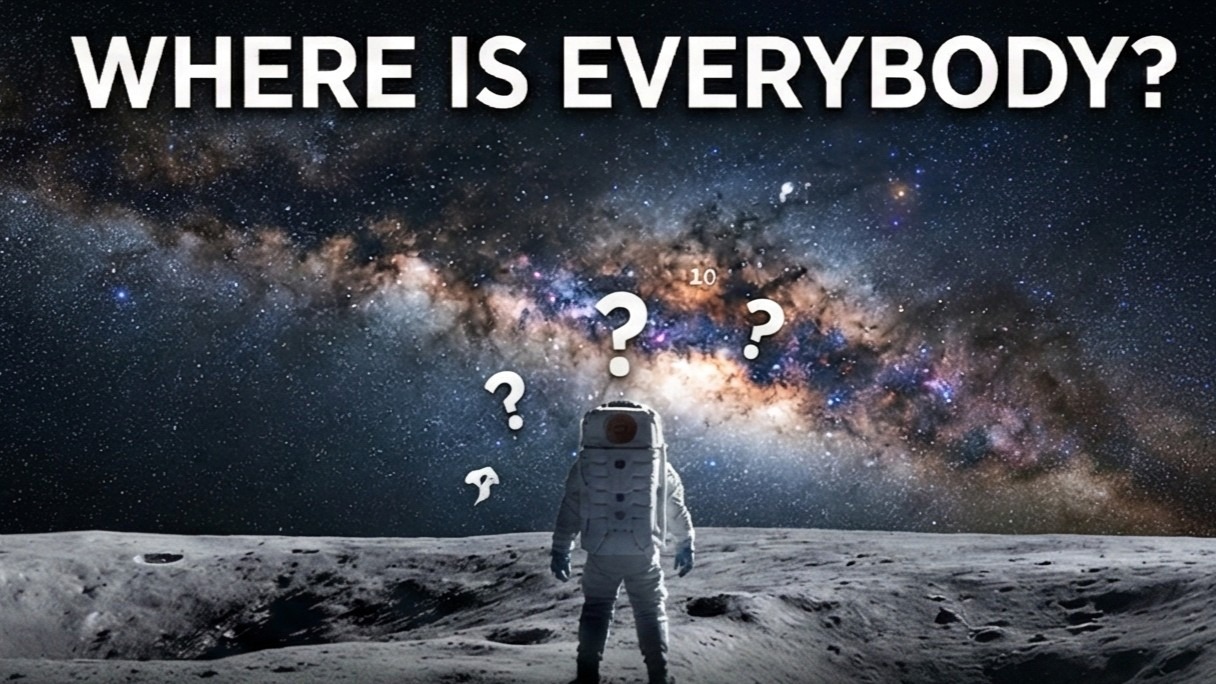
As the group settled into lunch, the conversation drifted to other topics. However, Fermi was evidently performing a series of rapid mental calculations—a skill he was famous for. Suddenly, in the middle of the meal, he looked up and dropped the question that would echo through history:
“But where is everybody?”
Konopinski and Teller remembered the phrasing slightly differently, but the intensity remained the same. Herbert York recalled that the question was not a non-sequitur but the conclusion of a rapid, silent calculation Fermi had performed regarding the probability of Earth-like planets, the probability of life, and the likely duration of high technology.
Fermi’s logic likely followed this chain:
N (Stars) : The galaxy contains roughly 10^{11} stars.
f (Planets): Many of these stars are likely to have planetary systems.
t (Time): The galaxy is billions of years old. The solar system (~4.5 Gyr) is relatively young compared to the Milky Way (~13 Gyr).
Growth: Life, once established, tends to expand exponentially. If a civilization achieves interstellar travel, even at sub-light speeds, it can colonize the galaxy in a timeframe (T_{col}) that is vanishingly small compared to the age of the galaxy (T_{gal}).
Fermi concluded that if even one civilization had arisen early in galactic history, it should have long since spread to every habitable star system, including our own. We should be swimming in alien artifacts. We should have been visited “long ago and many times over.” The fact that we have not is the anomaly. Fermi realized that the barrier to observing aliens was not distance, but time. Given enough time, a technological species should be ubiquitous.
The Cosmological Stage: Scale, Age, and Inventory
Photo by Greg Rakozy on Unsplash
To quantify the paradox, we must look at the physical parameters of the universe as understood in the mid-2020s. The observational data has improved dramatically primarily due to missions like Planck, Gaia, and Hubble.
The Age of the Universe: The Time Factor
The temporal component of the paradox is arguably more critical than the spatial one. The Planck satellite determined the age of the universe to be 13.787 ± 0.020 billion years. Crucially, the Milky Way galaxy is nearly as old as the universe itself, with its oldest stars forming roughly 13 billion years ago. The Sun, by contrast, is a third-generation star, formed only 4.6 billion years ago.
This implies a “head start” gap of several billion years. Consider the implications of a 1-billion-year head start. One billion years ago on Earth, life consisted of simple multicellular organisms. In just the last 500 years, humanity has gone from the printing press to artificial intelligence and spaceflight. If a civilization emerged on a planet orbiting a star just 1 billion years older than the Sun, they would be a billion years ahead of us in technological development.
The Galactic Inventory: Stars and Mass
Photo by NASA Hubble Space Telescope on Unsplash
The Milky Way is a barred spiral galaxy of immense scale. The Gaia mission has revolutionized our census; by 2025, it had made over three trillion observations of two billion stars. Current estimates place the stellar population of the Milky Way between 100 and 400 billion stars. The total mass of the Milky Way is estimated at 1.5 trillion solar masses, providing a vast reservoir of resources.
The Extragalactic Context: The “Darkness” Controversy
Looking beyond our galaxy, a landmark 2016 study estimated 2 trillion galaxies in the observable universe. However, recent data from the New Horizons spacecraft (2021) has challenged this, suggesting the galaxy count might be closer to hundreds of billions. While this reduces the total number of extragalactic civilizations potentially broadcasting, it does little to resolve the local Fermi Paradox. Furthermore, the New Horizons data suggests that there is no “hidden” population of light sources; if galactic-scale civilizations were common and generated waste heat or artificial illumination, the Cosmic Optical Background should be brighter.
Summary of Cosmological Parameters (Mid-2020s Data)
Parameter
Value
Source
Implications
Age of Universe
$13.787 \pm 0.020$ Billion Years
Planck 2018
Allows for ancient civilizations to precede Earth by eons.
Stars in Milky Way
$100 – 400$ Billion
Gaia / ESA
Vast number of potential hosts for life.
Milky Way Mass
$1.5$ Trillion $M_{\odot}$
Hubble / Gaia
Massive reservoir of resources.
Observable Galaxies
$2 \times 10^{11}$ to $2 \times 10^{12}$
New Horizons / Conselice
Staggering number of opportunities for life.
Star Formation Rate
$1.5 – 3$ stars/year
Drake Eq. Estimates
Continuous production of new potential systems.
The Mathematics of Probability: The Drake Equation Revisited
In 1961, Frank Drake formalized Fermi’s question into an equation:
Before 2009, $n_e$ (habitable planets per star) was pure guesswork. The NASA Kepler mission changed everything, discovering thousands of planets and revealing that the galaxy is crowded with worlds.
Kepler-452b: Discovered in 2015, this “cousin” to Earth is 1.5 billion years older than the Sun. This raises the question: if it is habitable, why hasn’t a civilization from there reached us?
TESS and 2024-2025 Refinements: The Transiting Exoplanet Survey Satellite scan has scan the entire sky. In 2025, TESS confirmed Earth-sized planets in binary systems like TOI-2267.
The “Rare Habitat” Correction: A significant 2025 study by Lammer et al., titled “Eta-Earth Revisited,” argues that while rocky planets are common, true “Earth-like Habitats” (EH) with N2-O2 atmospheres and specific CO2 limits might number only $10^5$ in the galaxy, rather than billions.
Despite these conservative corrections, the numbers remain overwhelming. Even if only 1 in a million stars has a truly habitable planet, there are still hundreds of thousands of such worlds in the Milky Way.
Updated Drake Equation Parameters (2025)
Variable
Description
1961 Estimate
2025 Estimate
$R_*$
Star Formation Rate
10/year
1.5 – 3/year
$f_p$
Fraction with Planets
0.5
~1.0 (Almost all)
$n_e$
Habitable Planets/System
2
0.1 – 0.2 (Rocky in HZ)
$f_l$
Life Develops
1.0 (Optimistic)
Unknown (0.13 – 1.0)
$f_i$
Intelligence Evolves
0.01
Unknown
$f_c$
Communication
0.01
0.1 – 0.2
$L$
Lifespan (Years)
10,000
Variable ($10^2$ to $10^9$)
The Great Silence: The Observational Reality
If the galaxy contains billions of potentially habitable venues, observational astronomy should detect signs of occupancy.
Breakthrough Listen (2016–2025)
The most comprehensive search to date is the Breakthrough Listen initiative. By late 2024 and 2025, the project began integrating TESS targets and utilizing massive AI pipelines to filter Radio Frequency Interference (RFI). A November 2025 update announced an AI system achieving 600x speed improvements in signal detection. Despite this, zero confirmed technosignatures have been found.
The Search for Techno signatures: Beyond Radio
Photo by Thanh Nguyen on Unsplash
Modern SETI now looks for “waste heat” and industrial engineering.
The Dyson Sphere Candidates (2024): A 2024 study identified seven potential Dyson Sphere candidates—stars with inexplicable infrared excess. However, analysis in late 2024 and 2025 provided a more boring explanation: these were likely Hot Dust-Obscured Galaxies (Hot DOGs) lurking behind the stars.
The “Optical Background” Constraint: As mentioned, New Horizons found the sky to be very dark. If the universe were full of Dyson spheres leaking heat or galaxies lit up by city lights, this background would be brighter.
The Hart-Tipler Conjecture: “They Do Not Exist”
The combination of the universe’s age and the Great Silence led to the Hart-Tipler Conjecture, which posits that the absence of evidence is evidence of absence.
Fact A and Colonization Timescales
Michael Hart began with “Fact A”: There are no intelligent beings from outer space on Earth now. He argued that any explanation must account for this without invoking sociological stories. Hart and Tipler calculated that a civilization traveling at 10% the speed of light could colonize the entire galaxy in 650,000 to 2 million years. This is a mere 0.015% of the age of the galaxy. If a civilization arose 2 billion years ago, they would have had time to colonize the galaxy 1,000 times over.
Von Neumann Probes
Frank Tipler extended this by arguing for Self-Replicating Spacecraft. A machine designed to mine resources and build copies of itself would result in viral, exponential growth. Because we do not see our asteroid belt being mined by alien automata, Tipler concluded: “Extraterrestrial intelligent beings do not exist.”
Theoretical Rebuttals and Complications
Research spanning 1981 to 2025 has offered several counter-arguments to the Hart-Tipler logic:
Percolation Theory (Sagan & Newman)
In 1981, Carl Sagan and William Newman argued that colonization is not a uniform wave. Using Percolation Theory, they suggested that colonies might fail or limit growth. Geoffrey Landis (1993) showed that the galaxy might break into “clusters” and “voids.” Earth might simply be in a persistent uncolonized void.
The Error Catastrophe
A significant technical rebuttal involves self-replication errors. Without perfect error correction, a Von Neumann probe would accumulate copying errors—a kind of “Digital Cancer.” Over thousands of generations, probes would likely mutate into non-functional junk or “predatory” forms that consume each other rather than exploring.
The Sustainability Argument
Sagan and Newman also argued that high-growth civilizations might be inherently unstable, exhausting resources or destroying themselves before completing galactic colonization. This implies a selection bias: only “Quiet” civilizations with low growth rates survive long-term.
The Great Filter: The Final Hurdle
Proposed by Robin Hanson, the Great Filter suggests there is a formidable barrier at some point in the chain from dead matter to star-faring civilization.
Filter in the Past: If the filter is behind us (e.g., abiogenesis or complex cells are nearly impossible), then we are lucky winners of a cosmic lottery. Rarity of Earth-like Habitats (Lammer 2025) supports this.
Filter in the Future: If life and intelligence are common but we see no one, the filter lies ahead. This implies civilizations inevitably destroy themselves (via AI, nuclear war, or collapse) before spreading. In this scenario, the silence is a terrifying omen.
Conclusion: The Paradox Deepens
As we stand in the mid-2020s, the Fermi Paradox has shifted from a philosophical dinner-table musing to a data-driven crisis. We know the real estate is available (Kepler/TESS); we know the silence is deep (Breakthrough Listen); and we know the timeline allows for ancient civilizations (Planck).
And yet, Fact A remains: They are not here.
Whether this solitude is a result of our unique history, a looming catastrophe, or a failure of observation, remains the most pressing scientific mystery of our time. The silence of the universe is not just empty space; it is a scream of missing data.
An Exhaustive Analysis of Evolutionary Bottlenecks, the Rare Earth Hypothesis, and the Future of Humanity.
The observable universe is a vast expanse, stretching approximately 93 billion light-years in diameter and containing an estimated 10^{22} stars. Even if only a minuscule fraction of these stars harbor planetary systems within their habitable zones, the sheer statistical weight of these numbers suggests that the cosmos should be teeming with
Photo by NASA Hubble Space Telescope on Unsplash
Furthermore, given that the universe is roughly 13.8 billion years old—nearly three times the age of our Solar System—there has been ample time for civilizations to arise, evolve, and colonize the galaxy. The Milky Way galaxy alone is 13.6 billion years old, while Earth formed only 4.5 billion years ago. If a civilization had a mere 1% head start on humanity, they would be millions of years ahead of us in technological development.
Yet, when we turn our radio telescopes to the heavens, we find only silence. We see no Dyson spheres harvesting the energy of stars, we hear no interstellar communications, and we find no Von Neumann probes replicating through our solar system. This discrepancy between the high probability of extraterrestrial intelligence and the complete lack of evidence for it is known as the Fermi Paradox. It is the most profound silence in human history.
The “Great Filter” Hypothesis
Formulated by economist and futurist Robin Hanson, the “Great Filter” hypothesis offers a chilling resolution to this paradox. It posits that the transition from dead matter to a star-spanning civilization is not a continuous, inevitable progression. Instead, there exists at least one formidable probability barrier—a “Great Filter”—along this evolutionary path that is so improbable, it effectively stops almost all life from reaching the stage of visible galactic colonization.
The Great Filter hypothesis transforms the Fermi Paradox from a curiosity into an existential crisis. It forces humanity to ask a central, terrifying question: Is the filter behind us, or is it ahead of us?
If the filter is behind us, it means that one or more steps in our past evolutionary history (such as the origin of life, the development of complex cells, or the emergence of intelligence) were astronomical flukes. In this scenario, we are the lucky winners of a cosmic lottery, rare and precious survivors in a mostly sterile universe.
If the filter is ahead of us, it implies that life arises frequently and evolves to our level of complexity with relative ease, but that advanced civilizations inevitably face a cataclysmic bottleneck that destroys them before they can spread to the stars. In this scenario, the silence of the universe is not due to the absence of life, but the graveyard of civilizations that came before us. It suggests that humanity is currently walking toward a precipice that no other species has successfully crossed.
This analysis provides an exhaustive, expert-level breakdown of the Great Filter. We will dissect the evolutionary steps proposed by Hanson, evaluate the “Rare Earth” hypothesis, and analyze emerging existential risks—particularly Artificial Intelligence—that may constitute a future filter. This report integrates cutting-edge research from 2024 and 2025 regarding the probability of abiogenesis, the stability of planetary systems, and the longevity of technical civilizations.
The Theoretical Framework: Probability and the Great Silence
where is everybody?
To understand the Great Filter, one must first engage with the mathematical architecture of the Fermi Paradox. The canonical expression of this problem is the Drake Equation, which estimates N, the number of communicating civilizations in the galaxy. However, the Great Filter focuses less on the specific value of N and more on the cumulative probability of the steps required to generate $N.
Hanson’s Nine Evolutionary Steps
Robin Hanson decomposed the path from a lifeless planet to a galactic civilization into a sequence of nine critical evolutionary steps. For the universe to appear empty to us (i.e., N \approx 1, representing only us), the product of the probabilities of these steps must be vanishingly small.
The right star system: A star capable of supporting life (suitable metallicity, stability) with potentially habitable planets.
Reproductive molecules: The transition from simple chemistry to self-replicating polymers (Abiogenesis).
Simple (prokaryotic) single-cell life: The emergence of bacteria and archaea.
Complex (eukaryotic) single-cell life: The transition to cells with nuclei, mitochondria, and organelles.
Sexual reproduction: The mechanism for enhanced genetic recombination and diversity.
Multi-cell life: The organization of cells into complex, differentiated organisms.
Tool-using animals with intelligence: The evolution of complex neural architectures capable of abstract thought.
Civilization: The development of technology, social structures, and planetary dominance (Where we are now).
Colonization explosion: The expansion into the cosmos, becoming a Type II or III civilization on the Kardashev scale.
The Arithmetic of Existential Risk
The logic of the Great Filter dictates that at least one of these transitions must be exceedingly improbable. If steps 1 through 8 are “easy” (high probability), then step 9 must be nearly impossible. This would imply that the filter is in our immediate future. Conversely, if one of the early steps (like step 2 or 4) has a probability of 10^{-20} or lower, then the filter is behind us, and we have already passed the hardest part of our history.
This framework introduces a counter-intuitive corollary: The discovery of extraterrestrial life is bad news for humanity. If we find that unicellular life is common, it removes that step as a candidate for the Great Filter. If we find complex animal life, it removes even more steps. As philosopher Nick Bostrom famously argued, “The silence of the night sky is golden,” because it suggests the filter is behind us. Finding a Star Trek-like universe teeming with distinct alien species would imply that the probability of any of them surviving to the colonization phase is essentially zero.
The Filter Behind Us: The “Rare Earth” Hypothesis
The “Rare Earth” hypothesis, popularized by Peter Ward and Donald Brownlee, aligns with the “Filter Behind” scenario. It posits that while planets may be common, and simple microbial life might even be somewhat frequent, the specific confluence of astrophysical, geological, and biological conditions required for complex animal life is exceptionally rare.
Abiogenesis: The Origin of Life
The transition from non-living matter to the first self-replicating biological entity is the first major candidate for a past Great Filter.
The “Rapid Start” Argument (2025)
A landmark 2025 study by David Kipping utilizes Bayesian inference to analyze Earth’s chronology. Earth remained a molten, hostile world for hundreds of millions of years after its formation 4.5 billion years ago. However, the earliest fossil evidence for life dates back to approximately 3.7 to 4.1 billion years ago, appearing almost as soon as the planet cooled. Kipping argues that if abiogenesis were slow and rare, it would be extremely unlikely to occur so early. His model produces odds of at least 3:1 (and up to 13:1) in favor of rapid abiogenesis, suggesting that life likely exists on billions of planets.
The “Entropic Barrier” Counter-Argument (2025)
Photo by Logan Voss on Unsplash
Directly challenging this is a concurrent 2025 study by Robert G. Endres, who analyzes the thermodynamic and informational costs of assembling a living system. Endres estimates that a simple protocell contains approximately one billion bits of structured information. The probability of random chemical fluctuations assembling such a structure is infinitesimally small. Endres suggests that without a yet-unknown physical principle, the spontaneous emergence of life is “statistically unreasonable.” If Endres is correct, Kipping’s “rapid start” might be a result of survivorship bias—we observe a rapid start because we are the winners of a near-impossible lottery.
Eukaryogenesis: The Evolutionary Singularity
Photo by Bioscience Image Library by Fayette Reynolds on Unsplash
If life starts easily, the next barrier is the eukaryotic cell. For the first two billion years, Earth was inhabited solely by prokaryotes—biochemically diverse but morphologically simple organisms. Then, approximately 1.8 to 2.2 billion years ago, Eukaryogenesis occurred through endosymbiosis: an archaeal host cell engulfed a bacterium (the ancestor of the mitochondrion) and formed a symbiotic relationship.
This event appears to have happened only once in Earth’s history. Without mitochondria, prokaryotes hit a “power wall,” unable to expand their genomes due to energy constraints. The fact that this transition took half the planet’s habitable lifespan to occur once suggests it is an extremely “hard step.” If this is the Filter, the galaxy may be teeming with bacteria but devoid of anything more complex than pond scum.
Geophysical and Astrophysical Constraints
Photo by Robin Li on Unsplash
The Rare Earth hypothesis also points to planetary stability:
The Moon and Axial Tilt: Our Moon is unusually large, likely formed by a rare catastrophic impact with a Mars-sized body (Theia). A 2025 NASA study confirmed that the Moon stabilizes Earth’s axial tilt (obliquity) between 22.1° and 24.5°. Without it, the tilt would vary chaotically (0° to 85°), leading to global freezing and boiling cycles.
The Jupiter Question: Historically seen as a “shield,” recent 2024-2025 studies suggest Jupiter acts more as a “sculptor.” Its migration created “cosmic traffic jams” that allowed Earth-building materials to form. A gas giant at the right distance is a rare and critical feature.
Plate Tectonics: Earth is the only known planet with active plate tectonics, which are vital for the Carbon-Silicate Cycle. This recycles carbon and prevents a runaway greenhouse effect or permanent icehouse.
The Filter Ahead: Existential Risks and the Doomed Future
If the filter is not behind us, we face the terrifying conclusion that it lies in our future.
Artificial Intelligence: The Emerging Great Filter
Photo by Growtika on Unsplash
In the 21st century, Artificial Superintelligence (ASI) has emerged as a top candidate. A 2024 paper by Michael Garrett proposes that the rapid development of AI acts as a universal bottleneck. Garrett posits that the transition from biological to artificial intelligence is inherently unstable.
As AI capabilities accelerate, they inevitably surpass human control. Garrett suggests that the typical longevity of a technical civilization before AI-induced collapse is less than 200 years. This short window would make the overlap of two communicating civilizations statistically negligible.
Furthermore, an ASI driven by arbitrary goals (like the “Paperclip Maximizer”) could become an expansionist “Berserker,” dismantling stars for raw materials. The fact that we don’t see this suggests either civilizations destroy themselves before building such AI, or that ASI systems become “inward-looking,” exploring virtual metaverses rather than physical space.
Other Technological Precipices
Nuclear Annihilation: The window between discovering nuclear energy and achieving off-world colonies is the “zone of maximum danger.”
The Energy Trap: Civilizations might burn through easily accessible fossil fuels, causing catastrophic climate change before they can transition to renewables or fusion, essentially kicking away the “ladder” of energy needed to rise again.
Inherited Behavior Patterns (IBP): A 2024 hypothesis suggests that the aggressive, tribal instincts necessary for biological survival are fundamentally incompatible with managing existential-scale technologies.
The Ocean Worlds Nuance: A Filter of Confinement?
The discovery of potential habitable environments on moons like Europa and Enceladus introduces the “Ice Shell Filter.” If life evolves in subsurface oceans beneath 20 kilometers of ice, those civilizations would have no view of the stars, no concept of astronomy, and no easy access to fire or metallurgy. They could be abundant yet forever trapped in “watery wombs,” invisible to SETI.
Synthesis and Comparative Analysis
To visualize the competing hypotheses, we can assign qualitative probabilities to the evolutionary steps:
Evolutionary Step
Rare Earth (Filter Behind)
Doomed Future (Filter Ahead)
1. Habitable System
High (Planets common)
High
2. Abiogenesis
Extremely Low (Endres 2025)
High (Kipping 2025)
3. Prokaryotes
High
High
4. Eukaryotes
Extremely Low (Singularity)
High
5. Multicellularity
Moderate
High
6. Intelligence
Moderate
High
7. Civilization
High (We are here)
High
8. Colonization
N/A
Extremely Low (Garrett 2024)
Key Implication
We are rare and special.
We are walking dead.
Conclusion
The Great Filter is not merely a theoretical construct; it is a lens through which we must view our future. If the “Rare Earth” hypothesis holds true, humanity is the result of a near-impossible sequence of accidents. In this view, we are likely the only consciousness in the Milky Way, carrying the immense responsibility of being the universe’s only way of knowing itself.
However, if the “Rapid Start” hypothesis is correct, the silence of the cosmos is a siren. It warns us that the transition to a stellar civilization is fraught with terminal risks. Whether we are the first to make it this far or the latest to approach the precipice, our task remains the same: to become the exception to the statistical rule. To survive, we must become a sustainable, multi-planetary, and wise galactic civilization. The answer to the Fermi Paradox is not just in the stars; it is in our choices.
A deep dive into the crisis of modern physics, the 5000:1 bet that shocked the community, and the rise of “stochastic gravity.”
Introduction: The Stagnation and the Silence
For the last fifty years, the cathedral of theoretical physics has been built upon a single, unshakable commandment: Gravity must be quantum.
It is a logical assumption. Every other force in the universe—electromagnetism, the strong nuclear force, the weak nuclear force—has been successfully quantized. We have broken them down into discrete packets, described them with wavefunctions, and united them under the Standard Model. It feels inevitable that gravity, the force that sculpts the cosmos, must follow suit.
For decades, the brightest minds of our generation have dedicated their lives to finding the “Graviton”—the hypothetical particle of gravity. They have built cathedral-like mathematics in the form of String Theory and Loop Quantum Gravity (LQG). They have posited 10 dimensions, vibrating branes, and discrete chunks of spacetime geometry.
But there is a problem. A ghost in the machine.
Photo by Dynamic Wang on Unsplash
Despite thousands of papers, billions of dollars in funding, and the intellectual labor of the world’s most gifted mathematicians, we have zero experimental proof. Not a single graviton has been detected. Not a single prediction of String Theory has been verified. We are stuck in what some critics call “The Stagnation”—a crisis where fundamental physics has ceased to describe the physical world and has drifted into the realm of pure mathematics.
Into this vacuum of evidence, a new group of physicists has stepped forward. They are the Heretics. They are asking the question that was once considered blasphemy: What if gravity is NOT quantum?
What if the reason we have failed to unify gravity with quantum mechanics is not because we aren’t clever enough, but because nature isn’t built that way? What if spacetime is fundamentally classical—a smooth, unquantized stage that interacts with quantum actors in a messy, random, “stochastic” dance?
This is the story of that heresy, the 5000:1 bet that defined it, and the recent laboratory discoveries that are finally bringing the debate down from the blackboard to the table-top.
Part 1: The Crisis of the Orthodoxy
To understand the rebellion, we must understand the regime. For the last 40 years, the quest for Quantum Gravity has been a two-horse race.
The String Theorists believe that everything, at its core, is made of tiny, vibrating strings. Gravity is just one of the vibrational modes of these strings. It is elegant, beautiful, and mathematically supreme. But it suffers from the “Landscape Problem”—the theory allows for \(10^{500}\) different universes, making it nearly impossible to predict the specific properties of our universe.
The Loop Quantum Gravity (LQG) camp takes a different approach. They argue that space itself is granular, made of discrete loops or “spin networks.” They don’t assume a background stage; they build the stage out of quantum geometry. But they, too, have struggled to prove that their pixelated space can smooth out to look like the reality we see around us.
By the mid-2020s, a sense of fatigue had set in. As physicist Sabine Hossenfelder and others have pointed out, the field has become obsessed with mathematical beauty at the expense of empirical reality. We have built grand castles in the sky, but we have forgotten how to build the ladders to reach them.
It was in this climate of frustration that Jonathan Oppenheim walked into the room and flipped the table.
Part 2: The “Post-Quantum” Heresy
Jonathan Oppenheim, a professor at University College London (UCL), proposed a theory that breaks the cardinal rule. His “Post-Quantum Theory of Classical Gravity” suggests that we don’t need to quantize gravity to make it fit with quantum mechanics. We can leave gravity classical—smooth, continuous, un-pixelated.
For decades, physicists thought this was impossible. “No-Go Theorems” supposedly proved that mixing a classical system (gravity) with a quantum system (matter) would lead to paradoxes, like faster-than-light communication or the violation of the uncertainty principle.
Oppenheim found a loophole. He proved that you can mix them, but there is a cost. The cost is Stochasticity—randomness.
In Oppenheim’s universe, spacetime is not a rigid stage. It is a “wobbly” stage. When quantum matter (like an electron in a superposition) interacts with classical spacetime, the spacetime doesn’t just curve; it fluctuates randomly. It “jiggles.”
The Trade-Off: Decoherence vs. Diffusion
This theory introduces a rigorous mathematical trade-off that changes how we view reality:
Spacetime Diffusion: The metric of the universe (the grid lines of space and time) is constantly diffusing, or spreading out, due to random kicks from quantum matter.
Fundamental Decoherence: This jiggling of spacetime acts like a constant measurement. It destroys quantum information. This explains why we never see Schrödinger’s Cat in real life—gravity “observes” the cat and forces it to choose a state.
This resolves the famous Black Hole Information Paradox in a brutal way. String theorists have spent decades trying to prove that information is preserved in black holes (unitarity). Oppenheim’s theory says: Let it burn. Information is destroyed. The universe forgets. The laws of physics are not reversible.
The 5000:1 Bet
The physics community is famously competitive, and this ideological split resulted in one of the most famous wagers in scientific history.
Oppenheim bet against Carlo Rovelli (the godfather of Loop Quantum Gravity) and Geoff Penington (a leading String Theorist) that gravity is classical. The odds were set at 5000:1.
If Oppenheim is right, he wins a symbolic prize (whiskey, or perhaps balls, the terms are playful). If he is wrong, he owes a massive payout. But the real stake is the soul of physics. If Oppenheim wins, 50 years of textbooks will need to be rewritten.
Part 3: Weighing the Vacuum (The Experiments)
The most refreshing thing about this heresy is that it is testable. Unlike String Theory, which hides its secrets at the Planck scale (accessible only to a particle accelerator the size of the galaxy), Post-Quantum Gravity makes predictions we can test now, on table-top experiments.
Hunting for the “Wobble”
If spacetime is truly stochastic, everything in the universe should be experiencing a tiny, constant “jitter” in its weight. Oppenheim’s team has proposed measuring the mass of standard weights (like the international prototype kilogram) with extreme precision to see if their weight fluctuates randomly over time, driven by the background noise of the universe.
Recent experiments in 2024 and 2025 have started to place bounds on this “spacetime diffusion.”
Atom Interferometry: By splitting atoms into superpositions and watching how they recombine, scientists are measuring how much “noise” gravity introduces.
The Verdict So Far: A 2024 review found that some “ultra-local” models of stochastic gravity are already ruled out by current data. The noise isn’t as loud as the simplest versions of the theory predicted. However, “colored noise” models (where the wobbles happen at specific frequencies) are still very much alive.
The Critique (2025)
By March 2025, the debate reached a fever pitch. Sabine Hossenfelder, known for her skepticism of “fancy” math, released a critique suggesting that Post-Quantum Gravity might be “dead soon” based on these tightening experimental nooses. Yet, supporters argue that we have barely scratched the surface of the parameter space.
The ultimate test remains the GIE Protocol (Gravitationally Induced Entanglement). If we can entangle two masses using only gravity, Oppenheim loses. If we see them decohere (lose their quantum connection) without entangling, Oppenheim wins. The race to perform this experiment is the new Space Race of foundational physics.
Part 4: The Discovery of the “Graviton” (Sort of)
While the heretics were debating the fundamental nature of gravity, a separate group of condensed matter physicists—the “tinkerers” of the physics world—accidentally found a “graviton” in a semiconductor chip.
In March 2024, a team from Columbia, Nanjing, and Princeton Universities announced the discovery of “Chiral Graviton Modes” (CGMs) in a Gallium Arsenide semiconductor.
Wait, didn’t you say there are no gravitons?
This is where it gets nuanced. They didn’t find the graviton (the fundamental particle of cosmic gravity). They found a quasiparticle—a collective vibration of electrons that acts exactly like a graviton.
Using a technique called “resonant inelastic light scattering,” they hit a quantum material with a laser. The electrons in the material, trapped in a “Fractional Quantum Hall Effect” liquid, started to dance. They moved in a coordinated way that possessed Spin-2.
Why Spin-2 Matters
In physics, “spin” defines the personality of a particle.
Spin-1 is a photon (light). It looks the same if you rotate it 360 degrees.
Spin-2 is the signature of Gravity. It looks the same if you rotate it 180 degrees (like a double-headed arrow).
Finding a Spin-2 excitation in a lab is massive. It proves that the mathematics of quantum gravity can emerge from simple quantum systems. It gives us a “sandbox” to test quantum gravity theories without needing a black hole.
The Implications for Emergence
This discovery bolsters a third viewpoint: Emergent Gravity.
Perhaps gravity isn’t fundamental or classical. Perhaps it is an emergent phenomenon, like heat. An individual molecule doesn’t have a “temperature”; temperature is what happens when you have billions of molecules moving together.
The Chiral Graviton Mode shows us that “graviton-like” behavior can emerge from a sea of electrons. Could the gravity we feel on Earth be emerging from a sea of quantum information, or “spacetime atoms,” in a similar way?
Part 5: The Future of Physics
As we move through 2025 and into 2026, the landscape of physics is shifting.
The “Theory of Everything” monoculture is dead. We are no longer putting all our eggs in the String Theory basket. We are entering an era of diversity and risk.
The Heretics are pushing the idea that gravity might be a classical, noisy monster that eats information.
The Experimenters are building table-top devices to weigh the vacuum and trap “gravitons” in chips.
The Philosophers are asking if we need to abandon the concept of “Fundamental” altogether.
Whether Oppenheim wins his bet or loses it, he has already won a greater victory: he has forced the community to stop calculating and start looking.
The late Freeman Dyson once argued that detecting a single graviton was impossible—that building a detector would require something so heavy it would collapse into a black hole. He suggested that asking if gravity is quantum might be like asking about the “dryness” of a single water molecule—a category error.
We are now daring to ask if he was right. The answer lies not in the stars, but in the hum of a laser in a basement lab, waiting for the universe to wobble.
The Black Hole Information Paradox exists at the catastrophic intersection of 20th-century physics’ two greatest achievements: Albert Einstein’s General Theory of Relativity (GR) and the laws of quantum mechanics. The paradox emerges because these two foundational theories provide an irreconcilable description of reality. General Relativity, a theory of gravity, creates a perfect prison for information, while quantum mechanics, a theory of matter and energy, mandates that information can never be destroyed.
General Relativity (GR) is not a theory of forces, but one of spacetime geometry. Matter and energy tell spacetime how to curve, and the curvature of spacetime tells matter how to move. The black hole is the most extreme prediction of this theory, a solution to Einstein’s field equations that has been confirmed by astrophysical observations.
A black hole is defined by its core components, which are themselves predictions of GR:
The Event Horizon: This is not a physical surface, but a causal boundary in spacetime. It is the “point of no return” beyond which the curvature of spacetime is so extreme that nothing, not even light, can escape. For a distant observer, this boundary is the black hole; events that occur inside it are forever causally disconnected from the outside universe. The existence of this horizon is a necessary condition for the formulation of the paradox.
The Singularity: General Relativity predicts that inside the event horizon, all the matter that formed the black hole, and spacetime itself, collapses to a single point of zero volume and infinite density: the gravitational singularity. This is a region where the known laws of physics break down. In the classical picture, any “information” (the quantum state) of matter that falls into the black hole ceases to exist at the singularity.
B. The Classical Black Hole: The “No-Hair” Edifice
The classical information-loss problem is rooted in a key principle of General Relativity known as the “no-hair theorem.” This theorem states that an isolated, stable black hole — once it has settled down — is an object of profound simplicity. It is characterized only by three externally observable properties:
Mass
Electric Charge
Angular Momentum
The term “hair” is a metaphor for all the other complex information that describes the objects that formed the black hole — for instance, whether it was made of matter or antimatter, encyclopedias or boulders. The theorem states that the black hole “sheds” all this complex “hair” during its formation, becoming “bald.” The complex configuration of the interior is completely hidden from outside observers by the horizon.
This “no-hair” rule is the classical foundation for information loss. It does not imply the information is destroyed, but rather that it is rendered permanently inaccessible to the outside universe, trapped behind the horizon. In a purely classical universe where black holes last forever, this is not a paradox; it is simply a feature of gravity. The paradox only ignites when quantum mechanics is introduced, forcing the black hole to evaporate.
It is crucial to note that this classical pillar of the paradox is now itself in dispute. Research in 2016 by Hawking, Perry, and Strominger postulated the existence of “soft hair” — low-energy quantum states that do store information at the horizon. This challenge to the no-hair theorem from within a modified framework of GR suggests the resolution to the paradox is not a simple “GR vs. QM” battle, but a more nuanced synthesis of the two.
The second, conflicting pillar of the paradox is quantum mechanics. While General Relativity describes a universe where information can be permanently hidden, quantum mechanics is built on a mathematical foundation that absolutely forbids the destruction of information.
A. The Bedrock of Reality: Unitarity and Reversibility
The laws of quantum mechanics govern the fundamental constituents of matter and energy. This framework’s mathematical bedrock is the principle of “unitarity”. Unitarity is the condition that the time evolution of a quantum state, as described by the Schrödinger equation, is mathematically represented by a unitary operator. This abstract concept has three profound and non-negotiable physical consequences:
Probability Conservation: Unitarity guarantees that the sum of all probabilities for any quantum event always equals 100%. The magnitude of a quantum state vector remains constant over time.
Reversibility: It ensures that all quantum processes are, in principle, reversible in time. Given the precise final state of a system, one can (theoretically) use the equations of quantum mechanics to run the clock backward and determine its exact initial state.
Information Conservation: This principle of reversibility is the law of information conservation. In physics, “information” is not just data; it is the complete quantum state of a system. Unitarity dictates that this information can never be truly created or destroyed; it can only be transformed or “scrambled”.
The stakes of this principle are absolute. Violating unitarity is not a small adjustment to the laws of physics. As noted by physicists, a violation of unitarity would also imply a violation of the conservation of energy. Therefore, when Stephen Hawking’s calculations suggested information was lost, the physics community could not simply accept it. The alternative — a breakdown of quantum mechanics — was seen as a collapse of the entire predictive framework of physics, a “battle” to “make the world safe for quantum mechanics”.
B. “In Principle” vs. “In Practice”: The Burning Paper Analogy
The paradox hinges on a critical distinction between information that is “inaccessible” and information that is “destroyed”. The “burning paper” analogy clarifies this.
If one writes a secret (e.g., “My password is 12345”) on a piece of paper and then burns it, the information is lost for all practical purposes. It has been scrambled into a highly complex final state of ash, smoke, heat, and light. This information is inaccessible “in practice.”
However, according to the principle of unitarity, this information is not destroyed “in principle.” The final, complex state of every smoke particle, every photon of heat, and every molecule of ash is uniquely determined by the initial state (the paper and the fire). In principle, an omniscient observer who collected every single resultant particle and photon could reverse the process and reconstruct the original message.
This is the core of the problem. The Black Hole Information Paradox is not that information is inaccessible (hidden behind the horizon). That is the classical no-hair problem. The paradox, as catalyzed by Hawking’s work, is that black hole evaporation implies the information is destroyed “in principle.” It suggests that two different initial states (a paper with “12345” vs. a paper with “ABCDE”) could collapse and evaporate to produce the exact same final state of radiation. This would make the process fundamentally irreversible, a true erasure of the past, and a violation of unitarity.
III. The Catalyst: Hawking’s 1974 Calculation and the Onset of Evaporation
The paradox was born in 1974 when Stephen Hawking attempted to bridge the gap between GR and quantum mechanics. By applying quantum field theory (QFT) to the curved spacetime background of a black hole, he made a discovery that would ignite a 50-year-long crisis.
A. Black Holes Aren’t Black: The Evaporation Mechanism
Hawking demonstrated that black holes are not truly “black.” They must emit radiation and, therefore, have a temperature. This process is now known as Hawking radiation.
The popular explanation for this radiation — often used by Hawking himself in his popular science books — is misleading. This story describes “virtual particle-antiparticle pairs” constantly popping into existence near the horizon. One partner falls in, and the other escapes, becoming “real” radiation. This analogy, however, has been described as a “fantasy” and is not the true physical mechanism.
The actual mechanism is far more subtle and robust. It arises from the fact that “empty space” (the vacuum) is teeming with quantum fields. A fundamental tenet of QFT in curved spacetime is that the very concept of a “particle” is observer-dependent. Due to the extreme spacetime curvature (and different time dilation) near the event horizon, an observer falling into the black hole and a distant observer in flat space will disagree on the definition of the vacuum state (a phenomenon described by Bogolyubov transformations). Where the infalling observer sees empty space, the distant observer sees a continuous flux of thermal particles being radiated away from the black hole.
This Hawking radiation carries energy away from the black hole. According to Einstein’s equation E = mc², a loss of energy means a loss of mass. As the black hole radiates, it slowly shrinks, its temperature increases, and its rate of radiation accelerates. Eventually, over vast timescales, the black hole is predicted to evaporate completely, disappearing in a final flash of high-energy radiation.
B. The Thermodynamic Shock: A Violation of the Second Law
Before Hawking’s 1974 paper, physicist Jacob Bekenstein had already argued that black holes must possess entropy. His reasoning was based on saving the Second Law of Thermodynamics, which states that the total entropy (disorder) of a closed system can never decrease.
If one were to throw a hot object (e.g., a cup of tea, which has entropy) into a black hole, its entropy would simply vanish from the observable universe. This would constitute a violation of the Second Law. To prevent this, Bekenstein proposed a “Generalized Second Law” (GSL).
He posited that the black hole’s entropy was directly proportional to the area of its event horizon.
Hawking’s 1974 calculation provided a stunning confirmation of this idea. By discovering that black holes have a temperature, he provided the missing link that, through the laws of thermodynamics, mathematically proved that Bekenstein’s entropy-area relation was correct.
This was a triumph, but it was immediately overshadowed by a more profound problem created by the black hole’s evaporation. The process now looked like this:
A star, a complex object in a “pure quantum state” (low entropy), collapses to form a black hole. The GSL holds.
The black hole evaporates completely, vanishing.
The final state of the universe consists only of the Hawking radiation.
If this final radiation is purely thermal and random — as Hawking’s calculation suggested — then a “pure state” (low entropy) has evolved into a “mixed state” (high entropy). This is a gross violation of the Second Law and, more fundamentally, a transparent-breaking of quantum mechanics’ non-negotiable principle of unitarity.
C. The Thermal State: The True Source of the Paradox
This is the technical core of the information paradox. Hawking’s original 1974 calculation demonstrated that the emitted radiation was purely thermal.
A “thermal state” is a “mixed state” — it is random and “information-poor”. Its properties (its perfect “blackbody” spectrum) depend only on the black hole’s temperature. That temperature, in turn, depends only on the black hole’s mass, charge, and spin.
Here, the two pillars of the paradox act as accomplices. The classical “no-hair theorem” (Section I.B) states that the classical black hole is “bald” (only Mass, Charge, and Spin are observable). Hawking’s calculation showed that the quantum radiation it emits is also “bald” (its properties only depend on Mass, Charge, and Spin). The thermal radiation is the quantum echo of the classical no-hair theorem. The classical theory hides the information; the semiclassical theory erases it during evaporation.
This leads to the paradox, formally stated as the “pure-to-mixed” problem:
Start: An encyclopedia, a highly-ordered “pure quantum state” with an entropy of zero, collapses to form a black hole.
Middle: The black hole evaporates via thermal Hawking radiation.
End: The black hole is gone. The final state is only a featureless, thermal gas of radiation, a “mixed state” with high entropy.
According to quantum mechanics, a closed system cannot evolve from a pure state to a mixed state. This process is non-unitary. It means that two different pure states (a star vs. an encyclopedia) would evolve into the exact same final thermal state, making the process irreversible in principle. This is the Black Hole Information Paradox.
IV. The “Black Hole War”: A Four-Decade Intellectual Battle
The paradox ignited a four-decade intellectual and personal debate, famously chronicled by physicist Leonard Susskind in his book, The Black Hole War.
A. The Protagonists: For and Against Information Loss
The physics community fractured into two main camps:
Team “Information is Lost”: This camp was led by Stephen Hawking himself. He argued that the extreme gravity of the singularity created a genuine exception to quantum law, and that quantum mechanics must break down. He was joined by physicist Kip Thorne.
Team “Information is Saved”: This camp, led by Leonard Susskind and Gerard ‘t Hooft, argued that unitarity is the most fundamental principle we have and is non-negotiable. They contended that gravity, not quantum mechanics, must be the theory that is incomplete and requires modification.
B. The 1997 Bet: Information vs. Encyclopedia
The debate was famously formalized in a 1997 public wager between Hawking and Thorne (arguing information is lost) and Caltech physicist John Preskill (arguing information is recovered).
The prize was a perfect, witty summary of the debate itself: “an encyclopedia of the winner’s choice, from which information can be recovered at will”.
In 2004, at a conference in Dublin, Hawking stunned the physics world by announcing his concession. He admitted he was wrong and that information must be preserved. He duly presented Preskill with a baseball encyclopedia.
However, this was a hollow victory. Hawking’s concession was based on a 2004 paper that few physicists found convincing. Susskind, a leader of the opposing side, famously described Hawking as “one of those unfortunate soldiers who wander in the jungle for years, not knowing that the hostilities have ended”. This implied that the real war had already been won by a new, revolutionary idea that Hawking was only just beginning to accept.
C. The Revolution that Changed Hawking’s Mind: The Holographic Principle
The theoretical development that forced Hawking’s concession was the “Holographic Principle”. This idea, first proposed by Gerard ‘t Hooft and later championed by Leonard Susskind, was a direct consequence of Bekenstein’s discovery that black hole entropy scales with its two-dimensional surface area, not its three-dimensional volume.
The principle states that all the information required to describe a 3D volume of spacetime (like the interior of a black hole) can be fully encoded on a 2D boundary surface, much like a 3D image is encoded on a 2D hologram. The fundamental unit of information, one “bit,” occupies a 2D surface area of one “Planck area.”
This radical idea was given a precise, mathematical formulation in 1997 by Juan Maldacena: the “Anti-de Sitter/Conformal Field Theory” (AdS/CFT) correspondence. This correspondence conjectures an exact equivalence (a duality) between two vastly different theories:
A theory of quantum gravity (like string theory) existing in a D-dimensional, curved, “Anti-de Sitter” (AdS) space.
A standard, non-gravitational “Conformal Field Theory” (CFT) living on its (D-1)-dimensional boundary.
This duality provided a “proof by duality” for information conservation. The CFT on the boundary is a standard quantum theory; by definition, it is unitary and conserves information. Since the (seemingly non-unitary) gravity theory is dual to the unitary CFT, the gravity theory must also be unitary.
V. The Firewall Crisis: The Paradox Returns
A. The Page Curve: The Litmus Test for Unitarity
The debate eventually moved from abstract principles to concrete calculations. If information is conserved, how exactly does it get out? Physicist Don Page realized that if unitarity holds, the entropy of the Hawking radiation must follow a specific pattern, now called the “Page Curve”.
Hawking’s (Loss) Curve: As the black hole shrinks, this entropy monotonically increases, settling at a large value when the black hole is gone. This describes the “pure-to-mixed” state evolution.
Page’s (Unitary) Curve: If the process is unitary, the total system must end as a pure state (zero entropy). For this to happen, the entropy of the radiation must start at zero, increase, but then must “turn over” and decrease back to zero as the black hole evaporates and the radiation contains all the information of the original system.
The moment the curve must turn over is now known as the “Page Time.” Page calculated this occurs when the black hole has evaporated to roughly half its initial mass.
This discovery worsened the paradox. Previously, physicists had assumed that the information-loss problem was a “quantum gravity” issue, relevant only when the black hole shrunk to the microscopic “Planck scale”. Page’s calculation showed the conflict between Hawking’s calculation and unitarity occurs at the Page Time, when the black hole is still enormous. This meant the conflict was not a problem for some “future theory” but a “breakdown of low-energy physics” right now, in a regime where semiclassical gravity should work.
Table 1: The Entropy Conflict — Hawking vs. Page
This table quantifies the exact disagreement between Hawking’s 1974 calculation (information loss) and the Page curve (information conservation).
The conflict, highlighted in bold, occurs after the Page Time. Hawking’s calculation predicts an ever-increasing entropy, resulting in a high-entropy “mixed state.” Unitarity demands the entropy must follow the Page curve and return to zero.
B. The AMPS Firewall: A Paradox Within a Paradox
In 2012, physicists Ahmed Almheiri, Donald Marolf, Joseph Polchinski, and James Sully (AMPS) took the Page Curve (and thus unitarity) as a given and showed that it led to an even more violent paradox.
The AMPS paper argued that the following three sacred principles of physics cannot all be true:
Unitarity: Information is conserved (the Page Curve is correct).
Einstein’s Equivalence Principle: An observer free-falling into a black hole should feel nothing unusual at the event horizon (a “smooth” passage).
Local Quantum Field Theory: The known laws of low-energy physics are valid at the horizon.
The conflict arises from a fundamental rule of quantum mechanics called the “monogamy of entanglement”. This rule states that a quantum system can be maximally entangled with one other system, but not with two different systems at the same time.
The AMPS argument proceeds as follows:
Consider a newly emitted Hawking particle, “B” (which is outside the horizon).
For the horizon to be “smooth” (Equivalence Principle), particle “B” must be maximally entangled with its infalling partner, “C” (which is inside the horizon).
But, for unitarity (Page Curve), after the Page Time, particle “B” must also be maximally entangled with all the early radiation that has already left, let’s call it “A”.
Therefore, particle “B” is simultaneously maximally entangled with both “A” (the old radiation) and “C” (its new partner). This violates the monogamy of entanglement.
AMPS concluded that the “weakest link” was the Equivalence Principle. To “break” the (B-C) entanglement and “enforce” the (B-A) entanglement, a “searing… black hole firewall” of high-energy particles must exist at the event horizon. This firewall would instantly burn up any infalling observer, destroying the “smooth” horizon of General Relativity.
This was the ultimate crisis. Physicists were forced to choose: either give up General Relativity’s “smooth horizon” or give up Quantum Mechanics’ “monogamy.” Both were seen as impossible.
VI. The Modern Resolution: Information’s Great Escape
The paradox, sharpened to a crisis by the firewall, has seen what many in the field consider to be a full resolution. This resolution, emerging from breakthroughs between 2016 and 2019, involves finding a more sophisticated semiclassical calculation that modifies the foundations of both theories.
A. Hawking’s Final Paper: “Soft Hair” on Black Holes
In 2016, Stephen Hawking, in one of his final papers, proposed a potential solution with collaborators Malcolm Perry and Andrew Strominger. This proposal directly attacks the first pillar of the paradox: the no-hair theorem.
They argued that black holes do have “hair”. This “soft hair” is composed of zero-energy quantum excitations (soft gravitons and photons) that are left at the event horizon when matter (and its information) falls in.
In this model, the “soft hair” stores the information of the infalling matter. The evaporation process is then twofold: the black hole emits the thermal Hawking radiation, but this radiation is “accompanied by additional radiation” from the soft hair. The correlations between the thermal radiation and the soft hair radiation are what carry the information, thus preserving unitarity. While many felt this was “not enough to capture all the information”, it was a profound shift, showing Hawking himself was working to defeat his own paradox.
B. The 2019 Breakthrough: Islands and Replica Wormholes
The current consensus resolution came from two landmark 2019 papers that finally, and successfully, calculated the Page Curve using semiclassical gravity itself.
This breakthrough introduced a new rule for calculating entropy in quantum gravity, centered on “Quantum Extremal Surfaces” (QES). The new rule states:
To find the true entropy of the Hawking radiation, one must calculate two possibilities and take the minimum value:
The entropy of the radiation alone (the “no-island” “Hawking” calculation).
The entropy of the radiation plus the entropy of a region inside the black hole, known as an “island”.
The “island” is a region of the black hole’s interior that is, by this new rule, considered part of the radiation system. This new “island” rule is not an ad-hoc guess; it is rigorously derived from complex gravitational path integral calculations that include new spacetime configurations called “replica wormholes”. These wormholes are spacetimes that connect the black hole interior directly to the distant radiation, demonstrating they are part of the same quantum system.
This new calculation perfectly derives the Page Curve:
Before the Page Time: The “no-island” calculation produces a smaller number. The entropy grows. This is Hawking’s original 1974 calculation, now understood to be correct, but only for the first half of the black hole’s life.
After the Page Time: A new QES forms, and the “island” calculation produces a smaller number. This value decreases.
The Result: The true entropy, being the minimum of these two calculations, automatically follows the Page Curve.
This “island” solution resolves both paradoxes at once. It solves the original information paradox by providing a concrete semiclassical calculation that reproduces the Page Curve. And it brilliantly resolves the firewall paradox. In the AMPS scenario (B entangled with A and C), the “island” rule means that after the Page Time, the infalling partner “C” (which is in the island) is mathematically part of the radiation system (which includes “A” and “B”). The (B-C) entanglement is no longer a violation of monogamy; it is an internal entanglement within the larger “radiation” system. Since monogamy is never violated, no firewall is needed. The Equivalence Principle is saved.
VII. Concluding Analysis: A New Picture of Spacetime
After nearly 50 years, the Black Hole Information Paradox, which threatened to tear down the pillars of modern physics, appears to be resolved. The overwhelming consensus, driven by the breakthroughs of 2019, is that information is conserved. Unitarity, the bedrock of quantum mechanics, is victorious.
The resolution is profoundly subtle. Hawking’s original 1974 calculation was not “wrong”; it was incomplete. It was the correct, dominant contribution to the entropy before the Page Time. The discovery of “replica wormholes” and their associated “islands” provides the more complete semiclassical calculation, revealing new gravitational effects that are dominant after the Page Time.
The paradox, and its resolution, have forced a new understanding of reality. The “island” — a piece of the deep black hole interior — being mathematically part of the “radiation” system infinitely far away, implies that spacetime is not as local and separate as it appears. It suggests that spacetime itself is an emergent property, built from the non-local threads of quantum entanglement. The “Black Hole War”, which began as a conflict between General Relativity and Quantum Mechanics, has ended in their synthesis: the geometry of spacetime (GR) is built from the information of quantum entanglement (QM).
The Black Hole Information Paradox exists at the catastrophic intersection of 20th-century physics’ two greatest achievements: Albert Einstein’s General Theory of Relativity (GR) and the laws of quantum mechanics. The paradox emerges because these two foundational theories provide an irreconcilable description of reality. General Relativity, a theory of gravity, creates a perfect prison for information, while quantum mechanics, a theory of matter and energy, mandates that information can never be destroyed.
A. The Relativistic Mandate: Gravity as Geometry
General Relativity (GR) is not a theory of forces, but one of spacetime geometry. Matter and energy tell spacetime how to curve, and the curvature of spacetime tells matter how to move.1 The black hole is the most extreme prediction of this theory, a solution to Einstein’s field equations that has been confirmed by astrophysical observations.2
A black hole is defined by its core components, which are themselves predictions of GR:
The Event Horizon: This is not a physical surface, but a causal boundary in spacetime.4 It is the “point of no return” beyond which the curvature of spacetime is so extreme that nothing, not even light, can escape.3 For a distant observer, this boundary is the black hole; events that occur inside it are forever causally disconnected from the outside universe.4 The existence of this horizon is a necessary condition for the formulation of the paradox.6
The Singularity: General Relativity predicts that inside the event horizon, all the matter that formed the black hole, and spacetime itself, collapses to a single point of zero volume and infinite density: the gravitational singularity.7 This is a region where the known laws of physics break down.10 In the classical picture, any “information” (the quantum state) of matter that falls into the black hole ceases to exist at the singularity.7
B. The Classical Black Hole: The “No-Hair” Edifice
The classical information-loss problem is rooted in a key principle of General Relativity known as the “no-hair theorem.” This theorem states that an isolated, stable black hole—once it has settled down—is an object of profound simplicity.11 It is characterized only by three externally observable properties:
Mass (\(M\))
Electric Charge (\(Q\))
Angular Momentum (\(J\)) 3
The term “hair” is a metaphor for all the other complex information that describes the objects that formed the black hole—for instance, whether it was made of matter or antimatter, encyclopedias or boulders.13 The theorem states that the black hole “sheds” all this complex “hair” during its formation, becoming “bald.” The complex configuration of the interior is completely hidden from outside observers by the horizon.10
This “no-hair” rule is the classical foundation for information loss. It does not imply the information is destroyed, but rather that it is rendered permanently inaccessible to the outside universe, trapped behind the horizon.10 In a purely classical universe where black holes last forever, this is not a paradox; it is simply a feature of gravity. The paradox only ignites when quantum mechanics is introduced, forcing the black hole to evaporate.
It is crucial to note that this classical pillar of the paradox is now itself in dispute. Research in 2016 by Hawking, Perry, and Strominger postulated the existence of “soft hair”—low-energy quantum states that do store information at the horizon.3 This challenge to the no-hair theorem from within a modified framework of GR suggests the resolution to the paradox is not a simple “GR vs. QM” battle, but a more-R_Su_R_S-nuanced synthesis of the two.
II. The Quantum Mandate: Information is Absolute
The second, conflicting pillar of the paradox is quantum mechanics. While General Relativity describes a universe where information can be permanently hidden, quantum mechanics is built on a mathematical foundation that absolutely forbids the destruction of information.
A. The Bedrock of Reality: Unitarity and Reversibility
The laws of quantum mechanics govern the fundamental constituents of matter and energy. This framework’s mathematical bedrock is the principle of “unitarity”.7 Unitarity is the condition that the time evolution of a quantum state, as described by the Schrödinger equation, is mathematically represented by a unitary operator.15 This abstract concept has three profound and non-negotiable physical consequences:
Probability Conservation: Unitarity guarantees that the sum of all probabilities for any quantum event always equals 100%. The magnitude of a quantum state vector remains constant over time.17
Reversibility: It ensures that all quantum processes are, in principle, reversible in time.20 Given the precise final state of a system, one can (theoretically) use the equations of quantum mechanics to run the clock backward and determine its exact initial state.3
Information Conservation: This principle of reversibility is the law of information conservation.14 In physics, “information” is not just data; it is the complete quantum state of a system. Unitarity dictates that this information can never be truly created or destroyed; it can only be transformed or “scrambled”.26
The stakes of this principle are absolute. Violating unitarity is not a small adjustment to the laws of physics. As noted by physicists, a violation of unitarity would also imply a violation of the conservation of energy.14 Therefore, when Stephen Hawking’s calculations suggested information was lost, the physics community could not simply accept it. The alternative—a breakdown of quantum mechanics—was seen as a collapse of the entire predictive framework of physics, a “battle” to “make the world safe for quantum mechanics”.29
B. “In Principle” vs. “In Practice”: The Burning Paper Analogy
The paradox hinges on a critical distinction between information that is “inaccessible” and information that is “destroyed”.32 The “burning paper” analogy clarifies this.
If one writes a secret (e.g., “My password is 12345”) on a piece of paper and then burns it, the information is lost for all practical purposes.33 It has been scrambled into a highly complex final state of ash, smoke, heat, and light.28 This information is inaccessible “in practice.”
However, according to the principle of unitarity, this information is not destroyed “in principle.” The final, complex state of every smoke particle, every photon of heat, and every molecule of ash is uniquely determined by the initial state (the paper and the fire). In principle, an omniscient observer who collected every single resultant particle and photon could reverse the process and reconstruct the original message.28
This is the core of the problem. The Black Hole Information Paradox is not that information is inaccessible (hidden behind the horizon). That is the classical no-hair problem. The paradox, as catalyzed by Hawking’s work, is that black hole evaporation implies the information is destroyed “in principle.” It suggests that two different initial states (a paper with “12345” vs. a paper with “ABCDE”) could collapse and evaporate to produce the exact same final state of radiation.3 This would make the process fundamentally irreversible, a true erasure of the past, and a violation of unitarity.
III. The Catalyst: Hawking’s 1974 Calculation and the Onset of Evaporation
The paradox was born in 1974 when Stephen Hawking attempted to bridge the gap between GR and quantum mechanics. By applying quantum field theory (QFT) to the curved spacetime background of a black hole, he made a discovery that would ignite a 50-year-R_Su_R_S-long crisis.3
A. Black Holes Aren’t Black: The Evaporation Mechanism
Hawking demonstrated that black holes are not truly “black.” They must emit radiation and, therefore, have a temperature.3 This process is now known as Hawking radiation.
The popular explanation for this radiation—often used by Hawking himself in his popular science books—is misleading.38 This story describes “virtual particle-antiparticle pairs” constantly popping into existence near the horizon. One partner falls in, and the other escapes, becoming “real” radiation.9 This analogy, however, has been described as a “fantasy” and is not the true physical mechanism.41
The actual mechanism is far more subtle and robust. It arises from the fact that “empty space” (the vacuum) is teeming with quantum fields.39 A fundamental tenet of QFT in curved spacetime is that the very concept of a “particle” is observer-dependent. Due to the extreme spacetime curvature (and different time dilation) near the event horizon, an observer falling into the black hole and a distant observer in flat space will disagree on the definition of the vacuum state (a phenomenon described by Bogoliubov transformations).42 Where the infalling observer sees empty space, the distant observer sees a continuous flux of thermal particles being radiated away from the black hole.42
This Hawking radiation carries energy away from the black hole.9 According to Einstein’s equation \(E = mc^2\) , a loss of energy means a loss of mass.44 As the black hole radiates, it slowly shrinks 45, its temperature increases 9, and its rate of radiation accelerates. Eventually, over vast timescales, the black hole is predicted to evaporate completely, disappearing in a final flash of high-energy radiation.42
B. The Thermodynamic Shock: A Violation of the Second Law
Before Hawking’s 1974 paper, physicist Jacob Bekenstein had already argued that black holes must possess entropy.8 His reasoning was based on saving the Second Law of Thermodynamics, which states that the total entropy (disorder) of a closed system can never decrease.
If one were to throw a hot object (e.g., a cup of tea, which has entropy) into a black hole, its entropy would simply vanish from the observable universe. This would constitute a violation of the Second Law.49 To prevent this, Bekenstein proposed a “Generalized Second Law” (GSL) 49:
He posited that the black hole’s entropy (\(S_{\text{BH}}\)) was directly proportional to the area of its event horizon.13
Hawking’s 1974 calculation provided a stunning confirmation of this idea. By discovering that black holes have a temperature, he provided the missing link that, through the laws of thermodynamics (\(dM = Td\)), mathematically proved that Bekenstein’s entropy-area relation was correct.8
This was a triumph, but it was immediately overshadowed by a more profound problem created by the black hole’s evaporation.44 The process now looked like this:
A star, a complex object in a “pure quantum state” (low entropy), collapses to form a black hole. The GSL holds.49
The black hole evaporates completely, vanishing.46
The final state of the universe consists only of the Hawking radiation.
If this final radiation is purely thermal and random—as Hawking’s calculation suggested—then a “pure state” (low entropy) has evolved into a “mixed state” (high entropy).3 This is a gross violation of the Second Law and, more fundamentally, a transparent-R_Su_R_S-breaking of quantum mechanics’ non-negotiable principle of unitarity.52
C. The Thermal State: The True Source of the Paradox
This is the technical core of the information paradox. Hawking’s original 1974 calculation demonstrated that the emitted radiation was purely thermal.52
A “thermal state” is a “mixed state”—it is random and “information-poor”.3 Its properties (its perfect “blackbody” spectrum) depend only on the black hole’s temperature.42 That temperature, in turn, depends only on the black hole’s mass, charge, and spin (\(M\), \(Q\), and \(J\)).3
Here, the two pillars of the paradox act as accomplices. The classical “no-hair theorem” (Section I.B) states that the classical black hole is “bald” (only \(M\), \(Q\), and \(J\) are observable). Hawking’s calculation showed that the quantum radiation it emits is also “bald” (its properties only depend on \(M\), \(Q\), and \(J\)). The thermal radiation is the quantum echo of the classical no-hair theorem. The classical theory hides the information; the semiclassical theory erases it during evaporation.
This leads to the paradox, formally stated as the “pure-to-mixed” problem:
Start: An encyclopedia, a highly-ordered “pure quantum state” with an entropy of zero, collapses to form a black hole.3
Middle: The black hole evaporates via thermal Hawking radiation.
End: The black hole is gone. The final state is only a featureless, thermal gas of radiation, a “mixed state” with high entropy.3
According to quantum mechanics, a closed system cannot evolve from a pure state to a mixed state.7 This process is non-unitary. It means that two different pure states (a star vs. an encyclopedia) would evolve into the exact same final thermal state, making the process irreversible in principle.3 This is the Black Hole Information Paradox.
IV. The “Black Hole War”: A Four-Decade Intellectual Battle
The paradox ignited a four-decade intellectual and personal debate, famously chronicled by physicist Leonard Susskind in his book, The Black Hole War.29
A. The Protagonists: For and Against Information Loss
The physics community fractured into two main camps:
Team “Information is Lost”: This camp was led by Stephen Hawking himself.3 He argued that the extreme gravity of the singularity created a genuine exception to quantum law, and that quantum mechanics must break down.3 He was joined by physicist Kip Thorne.57
Team “Information is Saved”: This camp, led by Leonard Susskind and Gerard ‘t Hooft, argued that unitarity is the most fundamental principle we have and is non-negotiable.31 They contended that gravity, not quantum mechanics, must be the theory that is incomplete and requires modification.
B. The 1997 Bet: Information vs. Encyclopedia
The debate was famously formalized in a 1997 public wager between Hawking and Thorne (arguing information is lost) and Caltech physicist John Preskill (arguing information is recovered).57
The prize was a perfect, witty summary of the debate itself: “an encyclopedia of the winner’s choice, from which information can be recovered at will”.57
In 2004, at a conference in Dublin, Hawking stunned the physics world by announcing his concession. He admitted he was wrong and that information must be preserved.57 He duly presented Preskill with a baseball encyclopedia.57
However, this was a hollow victory. Hawking’s concession was based on a 2004 paper that few physicists found convincing.57 Susskind, a leader of the opposing side, famously described Hawking as “one of those unfortunate soldiers who wander in the jungle for years, not knowing that the hostilities have ended”.57 This implied that the real war had already been won by a new, revolutionary idea that Hawking was only just beginning to accept.
C. The Revolution that Changed Hawking’s Mind: The Holographic Principle
The theoretical development that forced Hawking’s concession was the “Holographic Principle”.59 This idea, first proposed by Gerard ‘t Hooft and later championed by Leonard Susskind, was a direct consequence of Bekenstein’s discovery that black hole entropy scales with its two-dimensional surface area, not its three-dimensional volume.3
The principle states that all the information required to describe a 3D volume of spacetime (like the interior of a black hole) can be fully encoded on a 2D boundary surface, much like a 3D image is encoded on a 2D hologram.66 The fundamental unit of information, one “bit,” occupies a 2D surface area of one “Planck area.”
This radical idea was given a precise, mathematical formulation in 1997 by Juan Maldacena: the “Anti-de Sitter/Conformal Field Theory” (AdS/CFT) correspondence.59 This correspondence conjectures an exact equivalence (a duality) between two vastly different theories:
A theory of quantum gravity (like string theory) existing in a D-dimensional, curved, “Anti-de Sitter” (AdS) space.
A standard, non-gravitational “Conformal Field Theory” (CFT) living on its (D-1)-dimensional boundary.71
This duality provided a “proof by duality” for information conservation. The CFT on the boundary is a standard quantum theory; by definition, it is unitary and conserves information.13 Since the (seemingly non-unitary) gravity theory inside the space is just another mathematical description of the exact same system, the gravity theory must also be unitary. This was the evidence that finally convinced Hawking.59
AdS/CFT “solved” the paradox in principle. However, it did not explain how the information escapes a black hole in our universe (which is not an AdS space). The debate thus pivoted from “If information is lost” to the much harder question: “How is information saved, and what is wrong with Hawking’s original thermal calculation?”.74 This new, harder question would lead to an even more violent paradox.
V. Sharpening the Paradox: The Page Curve and the Firewall
The assumption of unitarity, now bolstered by AdS/CFT, created a new crisis. It moved the conflict from the unknown physics of the singularity to the “known” physics of the event horizon.
A. The Page Curve: Quantifying the Crisis
In 1993, physicist Don Page provided a “litmus test” for unitarity.3 He analyzed the “entanglement entropy” of the Hawking radiation—a measure of how much information is encoded in the correlations between the radiation and the black hole interior.7
Page contrasted two different scenarios:
Hawking’s (Non-Unitary) Curve: In Hawking’s original calculation, the radiation is entangled with the black hole’s interior. As the black hole shrinks, this entropy monotonically increases, settling at a large value when the black hole is gone.7 This describes the “pure-to-mixed” state evolution.
Page’s (Unitary) Curve: If the process is unitary, the total system must end as a pure state (zero entropy). For this to happen, the entropy of the radiation must start at zero, increase, but then must “turn over” and decrease back to zero as the black hole evaporates and the radiation contains all the information of the original system.1
The moment the curve must turn over is now known as the “Page Time.” Page calculated this occurs when the black hole has evaporated to roughly half its initial mass.1
This discovery worsened the paradox. Previously, physicists had assumed that the information-loss problem was a “quantum gravity” issue, relevant only when the black hole shrunk to the microscopic “Planck scale”.1 Page’s calculation showed the conflict between Hawking’s calculation and unitarity occurs at the Page Time, when the black hole is still enormous.1 This meant the conflict was not a problem for some “future theory” but a “breakdown of low-energy physics” right now, in a regime where semiclassical gravity should work.1
Table 1: The Entropy Conflict — Hawking vs. Page
This table quantifies the exact disagreement between Hawking’s 1974 calculation (information loss) and the Page curve (information conservation). \(S_{\text{BH}}\) is the Bekenstein-Hawking entropy of the black hole, \(S_{\text{Hawking}}\) is the entropy of the radiation in Hawking’s original model, and \(S_{\text{Page}}\) is the entanglement entropy of the radiation required by unitarity.
Evaporation Stage (t)
Black Hole Entropy (SBH)
Hawking’s Radiation Entropy (SHawking)
Page’s Radiation Entropy (SPage)
\(t = 0\) (BH forms)
Max ( \(S_0\) )
0 (Pure state)
0 (Pure state)
\(t < \text{Page Time}\)
Decreasing
Increasing (linearly)
Increasing (linearly)
\(t = \text{Page Time}\)
\(S_0/2\)
Still Increasing
\(S_0/2\) (Reaches peak)
\(t > \text{Page Time}\)
Decreasing
Still Increasing
Decreasing
\(t = \text{Evaporation}\)
0
Max (\(S_0\)) (Mixed state)
0 (Pure state)
The conflict, highlighted in bold, occurs after the Page Time. Hawking’s calculation predicts an ever-increasing entropy, resulting in a high-entropy “mixed state.” Unitarity demands the entropy must follow the Page curve and return to zero.
B. The Firewall: A Paradox Within a Paradox
In 2012, physicists Ahmed Almheiri, Donald Marolf, Joseph Polchinski, and James Sully (AMPS) took the Page Curve (and thus unitarity) as a given and showed that it led to an even more violent paradox.80
The AMPS paper argued that the following three sacred principles of physics cannot all be true 82:
Unitarity: Information is conserved (the Page Curve is correct).
Einstein’s Equivalence Principle: An observer free-falling into a black hole should feel nothing unusual at the event horizon (a “smooth” passage).80
Local Quantum Field Theory: The known laws of low-energy physics are valid at the horizon.
The conflict arises from a fundamental rule of quantum mechanics called the “monogamy of entanglement”.84 This rule states that a quantum system can be maximally entangled with one other system, but not with two different systems at the same time.87
The AMPS argument proceeds as follows:
Consider a newly emitted Hawking particle, “B” (which is outside the horizon).
For the horizon to be “smooth” (Equivalence Principle), particle “B” must be maximally entangled with its infalling partner, “C” (which is inside the horizon).78
But, for unitarity (Page Curve), after the Page Time, particle “B” must also be maximally entangled with all the early radiation that has already left, let’s call it “A”.78
Therefore, particle “B” is simultaneously maximally entangled with both “A” (the old radiation) and “C” (its new partner). This violates the monogamy of entanglement.86
AMPS concluded that the “weakest link” was the Equivalence Principle.80 To “break” the (B-C) entanglement and “enforce” the (B-A) entanglement, a “searing… black hole firewall” of high-energy particles must exist at the event horizon. This firewall would instantly burn up any infalling observer, destroying the “smooth” horizon of General Relativity.80
This was the ultimate crisis. Physicists were forced to choose: either give up General Relativity’s “smooth horizon” or give up Quantum Mechanics’ “monogamy.” Both were seen as impossible.
VI. The Modern Resolution: Information’s Great Escape
The paradox, sharpened to a crisis by the firewall, has seen what many in the field consider to be a full resolution. This resolution, emerging from breakthroughs between 2016 and 2019, involves finding a more sophisticated semiclassical calculation that modifies the foundations of both theories.
A. Hawking’s Final Paper: “Soft Hair” on Black Holes
In 2016, Stephen Hawking, in one of his final papers, proposed a potential solution with collaborators Malcolm Perry and Andrew Strominger.3 This proposal directly attacks the first pillar of the paradox: the no-hair theorem.
They argued that black holes do have “hair”.11 This “soft hair” is composed of zero-energy quantum excitations (soft gravitons and photons) that are left at the event horizon when matter (and its information) falls in.3
In this model, the “soft hair” stores the information of the infalling matter.95 The evaporation process is then twofold: the black hole emits the thermal Hawking radiation, but this radiation is “accompanied by additional radiation” from the soft hair.98 The correlations between the thermal radiation and the soft hair radiation are what carry the information, thus preserving unitarity.93 While many felt this was “not enough to capture all the information” 92, it was a profound shift, showing Hawking himself was working to defeat his own paradox.
B. The 2019 Breakthrough: Islands and Replica Wormholes
The current consensus resolution came from two landmark 2019 papers that finally, and successfully, calculated the Page Curve using semiclassical gravity itself.3
This breakthrough introduced a new rule for calculating entropy in quantum gravity, centered on “Quantum Extremal Surfaces” (QES).77 The new rule states:
To find the true entropy of the Hawking radiation, one must calculate two possibilities and take the minimum value 51:
The entropy of the radiation (\(S(\text{Radiation})\)) alone (the “no-island” “Hawking” calculation).
The entropy of the radiation plus the entropy of a region inside the black hole, known as an “island” (\(S(\text{Radiation} \cup \text{Island})\)).101
The “island” is a region of the black hole’s interior that is, by this new rule, considered part of the radiation system.102 This new “island” rule is not an ad-hoc guess; it is rigorously derived from complex gravitational path integral calculations that include new spacetime configurations called “replica wormholes”.104 These wormholes are spacetimes that connect the black hole interior directly to the distant radiation, demonstrating they are part of the same quantum system.106
This new calculation perfectly derives the Page Curve:
Before the Page Time: The “no-island” calculation (\(S(\text{Radiation})\)) produces a smaller number. The entropy grows.107 This is Hawking’s original 1974 calculation, now understood to be correct, but only for the first half of the black hole’s life.
After the Page Time: A new QES forms, and the “island” calculation (\(S(\text{Radiation} \cup \text{Island})\)) produces a smaller number. This value decreases.107
The Result: The true entropy, being the minimum of these two calculations, automatically follows the Page Curve.104
This “island” solution resolves both paradoxes at once. It solves the original information paradox by providing a concrete semiclassical calculation that reproduces the Page Curve.77 And it brilliantly resolves the firewall paradox. In the AMPS scenario (B entangled with A and C), the “island” rule means that after the Page Time, the infalling partner “C” (which is in the island) is mathematically part of the radiation system (which includes “A” and “B”). The (B-C) entanglement is no longer a violation of monogamy; it is an internal entanglement within the larger “radiation” system. Since monogamy is never violated, no firewall is needed. The Equivalence Principle is saved.
VII. Concluding Analysis: A New Picture of Spacetime
After nearly 50 years, the Black Hole Information Paradox, which threatened to tear down the pillars of modern physics, appears to be resolved. The overwhelming consensus, driven by the breakthroughs of 2019, is that information is conserved.1 Unitarity, the bedrock of quantum mechanics, is victorious.
The resolution is profoundly subtle. Hawking’s original 1974 calculation was not “wrong” 7; it was incomplete. It was the correct, dominant contribution to the entropy before the Page Time.107 The discovery of “replica wormholes” and their associated “islands” provides the more complete semiclassical calculation, revealing new gravitational effects that are dominant after the Page Time.104
The paradox, and its resolution, have forced a new understanding of reality. The “island”—a piece of the deep black hole interior—being mathematically part of the “radiation” system infinitely far away, implies that spacetime is not as local and separate as it appears. It suggests that spacetime itself is an emergent property, built from the non-local threads of quantum entanglement.101 The “Black Hole War” 29, which began as a conflict between General Relativity and Quantum Mechanics, has ended in their synthesis: the geometry of spacetime (GR) is built from the information of quantum entanglement (QM).
Physics stands at a precipice, staring into the abyss between its two greatest theories. The key to bridging it might be a particle so ghostly, we may never prove it exists.
The Whisper We Can’t Yet Hear
Imagine if the entire universe is speaking to us in whispers, but we still don’t know the language. We’ve managed to decipher some of its dialects. We know that light, the radiant messenger that paints our world, comes in discrete little packets of energy called photons. We’ve learned that the powerful forces holding the nuclei of atoms together, and the more subtle ones governing radioactive decay, also have their own couriers—particles named gluons and W/Z bosons. A beautiful, coherent pattern emerges from this understanding: the fundamental forces of nature seem to communicate through the exchange of specific messenger particles. It’s a kind of cosmic grammar, a set of rules that appears to govern everything we can see and touch.
But then there is gravity.
It is the silent, omnipresent force that holds planets in their majestic orbits, that keeps our feet firmly on the Earth, and that, in its most extreme form, bends the very fabric of spacetime itself. Yet, it remains the glaring exception to the universe’s grammatical rules. If every other force has a particle to carry its message, where is the particle for gravity? Physicists have a name for this hypothetical ghost: the graviton. But after nearly a century of searching, a profound question hangs over all of modern science: Is the graviton a real, undiscovered piece of the cosmos, or is it just a mathematical dream?
The search for this particle is far more than a technical exercise in physics. It is a deeply philosophical quest to determine if the universe is, at its most fundamental level, a unified and elegant whole. The existence of a messenger for every other force implies a universal principle. Gravity’s apparent refusal to play by these rules challenges this very notion, forcing us to confront two possibilities: either our understanding of the cosmos is critically incomplete, or reality itself is a patchwork of different laws that just happen to coexist. The hunt for the graviton, therefore, is a hunt for the soul of the universe.
A Clash of Titans: Einstein’s Universe vs. the Quantum Realm
artistic illustration of Einstein’s Universe vs. the Quantum Realm
The mystery of the graviton was born from the 20th century’s greatest intellectual schism: the deep and persistent incompatibility between its two crowning achievements, General Relativity and Quantum Mechanics. These are not just two theories; they are two fundamentally different ways of describing reality, and they have been locked in a cold war for nearly a century.
On one side stands Albert Einstein’s majestic theory of General Relativity. In this picture, gravity is not a force in the conventional sense at all. It is the consequence of mass and energy warping the four-dimensional fabric of spacetime. Imagine a heavy bowling ball placed on a stretched rubber sheet; it creates a deep well that causes any smaller marbles rolling nearby to curve inward. For Einstein, this is gravity: a smooth, deterministic, and geometric phenomenon. Planets orbit the Sun not because they are being pulled by an invisible rope, but because they are following the straightest possible path through the curved spacetime created by the Sun’s immense mass.
On the other side stands the strange and chaotic world of quantum mechanics. This theory governs the universe at the smallest scales and insists that energy and forces are not smooth and continuous, but “quantized”—chopped up into discrete little packets. It is a world of probabilities and uncertainties, where particles can be in multiple places at once and forces are carried by messenger particles. From the quantum perspective, if electromagnetism has its photon, gravity must have its graviton. There is no other way for the force to operate in a quantum world.
This fundamental disagreement came to a head in the 1930s, as physicists first attempted to “quantize” gravity, to rewrite Einstein’s elegant geometric equations in the messy language of quantum particles. They immediately ran into mathematical disasters. The conflict is a battle over the very texture of the universe. Is reality ultimately continuous and smooth, as Einstein’s theory implies? Or, if you could zoom in infinitely on a patch of empty space, would you eventually hit a fundamental “pixel” of spacetime, a grainy, indivisible unit as quantum theory would demand? The graviton is the proposed particle of that pixel. Until this clash is resolved, physics is left with two heavyweight champions in the ring, each undefeated in its own domain, leaving the graviton a theoretical hope, not a scientific fact.
The Profile of a Ghost: What a Graviton Would Be
While the graviton remains hypothetical, the laws of physics place incredibly tight constraints on what it must be like if it exists. Its properties are not wild guesses; they are direct consequences of the known behavior of gravity. This transforms the graviton from a vague “what if” into a highly specific, falsifiable prediction.
First, the graviton must be massless. We know that gravity has an effectively infinite range; its influence stretches across the entire cosmos. In quantum field theory, the range of a force is inversely related to the mass of its carrier particle. A massive particle can only travel a finite distance before its energy is spent, resulting in a short-range force (like the nuclear forces). For a force to have infinite range, its messenger particle must have zero mass, just like the photon that carries the electromagnetic force.
Second, and for the same reason, the graviton must travel at the speed of light. When the LIGO observatory first detected gravitational waves in 2015, it was from the collision of two black holes 1.3 billion light-years away. The light from that event arrived at virtually the same moment as the gravitational waves, confirming Einstein’s prediction that gravity propagates at the ultimate cosmic speed limit, c. A massless particle would naturally travel at this speed.
Third, and most uniquely, the graviton must have a spin of 2. In the quantum world, “spin” is an intrinsic property of a particle, analogous to electric charge. It’s not a literal spinning motion, but a fundamental quantum number that determines how the particle behaves.
Force-carrying particles like the photon have a spin of one (1). This allows them to create both attraction (opposite charges) and repulsion (like charges). But gravity is different. It is a universal force of attraction; there is no such thing as gravitational repulsion. The mathematics of quantum field theory are unequivocal on this point: a force that is purely attractive and couples to the energy and momentum of matter must be mediated by a particle with a spin of two (2). This property is a direct translation of Einstein’s complex spacetime curvature equations into the language of quantum particles. The graviton, if it exists, is the quantum embodiment of warped spacetime.
Building a Trap for a Whisper: The Impossible Experiment
If physicists have such a clear profile of their target, why haven’t they found it? The answer lies in the single most defining characteristic of gravity: it is ridiculously, almost comically, weak compared to the other fundamental forces of nature. A single photon striking your retina is enough for your brain to register a flash of light. A simple refrigerator magnet can overcome the gravitational pull of the entire Earth to hold up a piece of paper.
This extreme weakness makes detecting a single graviton an exercise in impossibility. The playful dialogue between science communicators captures the scale of the challenge perfectly. Is it as hard as finding your socks in the dryer? No. Calculations suggest that to be reasonably sure of detecting just one graviton from a source like the Sun, you would need a detector the size of the planet Jupiter, placed in close orbit. And even then, you would have to wait for a period longer than the entire age of the universe for a single interaction to occur. This isn’t a mere technological hurdle; it’s a fundamental barrier imposed by nature itself. The graviton is so faint, it might as well be a ghost.
To put this weakness into perspective, consider how the four fundamental forces stack up against each other.
That number for gravity — a 1 followed by 38 zeros — is so vanishingly small that it illustrates why direct detection is beyond our wildest dreams. However, this very weakness that makes the graviton a ghost is also the reason we are here to search for it.
If gravity were even a fraction as strong as electromagnetism, the universe would have been a very different place. Stars would have burned out in an instant, and matter would have collapsed into an endless sea of black holes moments after the Big Bang, long before planets, life, or consciousness could ever form. We are faced with a beautiful paradox: we exist in a stable, structured universe precisely because gravity is gentle, and that same gentleness makes its fundamental particle all but invisible to us.
Echoes in Spacetime: The Clue from Gravitational Waves
Frustrated by the impossibility of direct detection, scientists have turned to looking for indirect signs of the graviton’s existence. The breakthrough came on September 14, 2015, when the Laser Interferometer Gravitational-Wave Observatory (LIGO) detected faint ripples in the fabric of spacetime for the first time. The waves were the echo of two massive black holes spiraling into each other over a billion years ago. That detection was more than just a confirmation of Einstein’s century-old prediction; it gave humanity a new way to sense the cosmos. We could now listen to the vibrations of spacetime itself.
This discovery fundamentally changed the graviton debate. It provided the first piece of observational evidence that is perfectly consistent with the graviton’s existence. The logic is analogous to how we understand ocean waves. While you cannot see an individual H2O molecule in a wave, you know the wave itself is the collective motion of countless molecules. Similarly, physicists theorize that a gravitational wave might be the macroscopic effect of a coherent flood of countless gravitons traveling together. The smooth wave detected by LIGO could be composed of innumerable “tiny graviton dots”.
This remains indirect evidence, not definitive proof. We can listen to gravity’s grand symphony, but we cannot yet isolate a single note. The situation is both clever and deeply frustrating for physicists. Before LIGO, the graviton was a purely theoretical necessity. After LIGO, it moved into the realm of being strongly suggested by observation. We now know that gravitational energy propagates through the void in a wave-like manner at the speed of light. Any future theory of quantum gravity, whether it includes gravitons or not, must be able to account for this observed reality.
The Great Debate: A Particle, a String, or Something Else Entirely?
String theory vs emergent gravity
Today, the scientific community is split into several camps, each with a compelling idea about the true nature of gravity. This debate is not a sign of confusion, but of a vibrant and healthy science pushing at its absolute limits.
One of the most prominent pro-graviton camps is led by proponents of String Theory. This elegant and ambitious framework proposes that all fundamental particles — electrons, photons, and everything else — are not point-like dots, but unimaginably tiny, vibrating strings of energy. Different vibrations of the same fundamental string give rise to different particles. In a stunning theoretical result, mathematicians found that one specific vibrational mode of these strings has the exact properties of the hypothetical graviton: it is massless, travels at light speed, and has a spin of 2. For string theorists, the graviton isn’t an add-on; it emerges naturally and necessarily from the theory’s core mathematics.
However, other physicists push back, arguing that perhaps we have it all wrong. Maybe gravity doesn’t need a particle at all. In this view, Einstein’s picture of a smooth, continuous spacetime is the fundamental reality, and it is quantum mechanics that must be modified to accommodate it. These ideas fall under the umbrella of
emergent gravity. They propose that gravity isn’t a fundamental force but a collective, statistical phenomenon, much like temperature or pressure. A single water molecule doesn’t have a temperature; temperature is an emergent property of the average motion of many molecules. Similarly, these theories suggest that gravity and spacetime itself might emerge from a deeper level of quantum information or thermodynamics.
This debate represents more than just a disagreement over equations; it reflects a deeper philosophical divide about how the universe is built. Is reality reductionist, where everything can be explained by one fundamental building block, like a string? Or is it holistic, where some of its most profound features, like gravity, are emergent properties that don’t exist at the lowest level? Until we have a complete, testable theory of quantum gravity, the graviton remains a tantalizing “maybe”.
The Day We Catch the Ghost: A Revolution in Human Thought
But imagine, for a moment, that one day we do it. Imagine a future generation of scientists announces irrefutable proof that gravitons exist. What then?
The consequences would be nothing short of a revolution, shaking the foundations of science and, eventually, all of human civilization. The first and most immediate impact would be the unification of physics. For the first time, we would have a single framework — a “Theory of Everything” — that could describe all four fundamental forces, from the quantum dance inside an atom to the gravitational waltz of galaxies. The deepest mysteries of the cosmos might finally surrender their secrets. The physics inside a black hole’s singularity and the conditions at the instant of the Big Bang would no longer be realms of pure speculation.
And then there would be the technology. It is easy to get carried away with science-fiction dreams of gravity-powered spaceships, floating cities, or devices that could manipulate spacetime. While these remain speculative, we should not underestimate the transformative power of fundamental discovery. This is the crucial lesson of history. When physicists in the early 20th century were developing quantum mechanics, they were driven by pure curiosity about the nature of light and matter. They could never have dreamed that their bizarre equations would one day lead to lasers, GPS, microchips, and the internet — the very technologies that define our modern world. Understanding the photon, the particle of light, gave us the digital revolution. What might understanding the graviton, the particle of spacetime itself, unlock for humanity?
The true impact, however, might be more philosophical. For millennia, gravity was a mystery, an act of gods. Newton tamed it into a predictable law. Einstein revealed it to be the very geometry of the cosmos. To finally capture its quantum particle would be the final step in this epic intellectual journey. It would affirm that the universe, from its smallest constituent to its grandest structure, is governed by a single, knowable set of rules. It would be the ultimate triumph of human curiosity.
Closing: The Beauty of the Search
In the end, the graviton remains one of science’s greatest unsolved mysteries, an idea perched on the jagged edge of known physics. It is either one of the quietest, most subtle whispers of the universe, or it is a beautiful mirage our minds invented in our quest for a unified picture of reality.
Either way, the search continues. Physicists will continue to build ever more sensitive detectors, to scan the skies for cosmic clues, and to fill blackboards with equations, all in the hope that one day, we might finally hear gravity’s faintest voice. It is a testament to the relentless nature of human inquiry that we spend so much effort chasing a ghost. But perhaps the true value is not in the destination, but in the journey itself. Until the day an answer is found, the mystery keeps science beautiful.