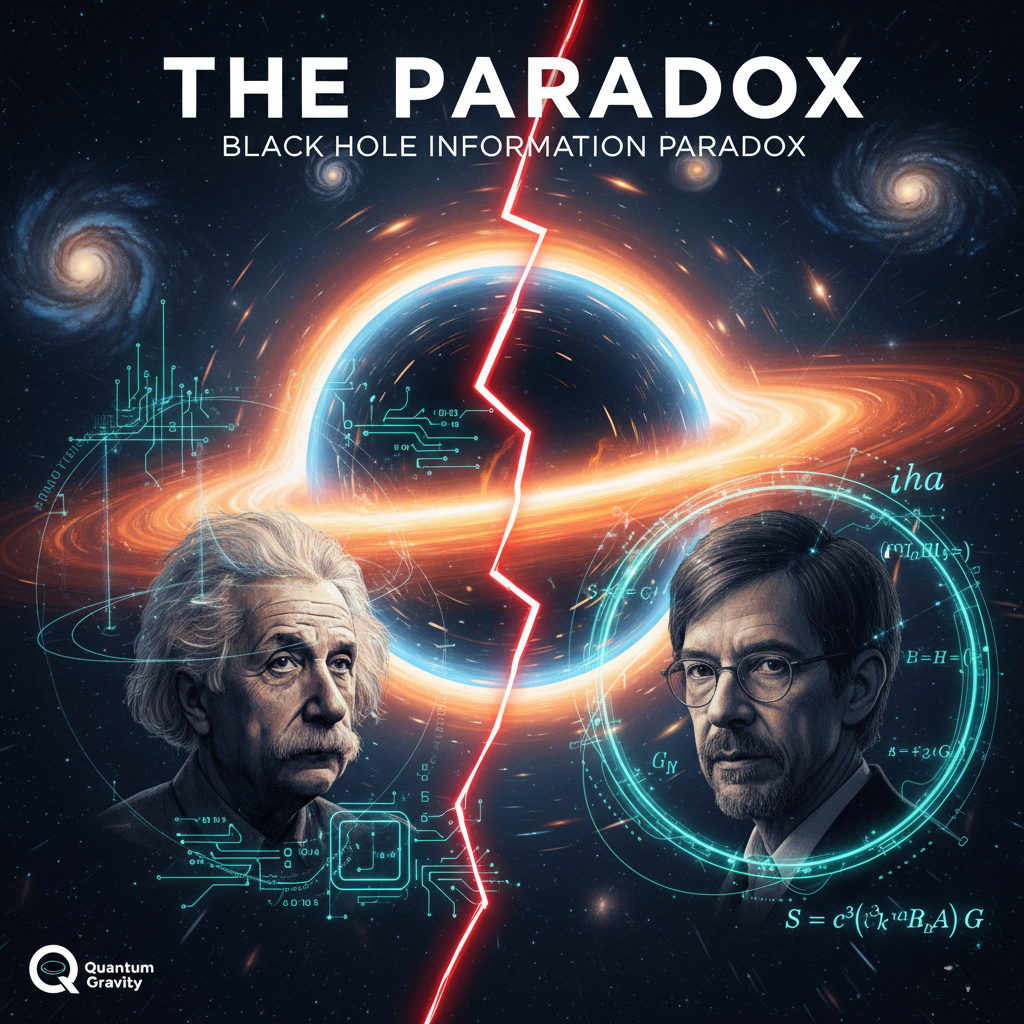
Dive into the regions of spacetime where gravity is so intense that nothing—not even light—can escape. We analyze the mechanics of Event Horizons, the mystery of Singularities, and the groundbreaking research into Hawking Radiation. This section focuses on the ultimate gravity wells that challenge our understanding of the laws of nature.
For a century, physics has been torn between two “Competitors”—Gravity and Quantum Mechanics. The resolution to their conflict suggests that the universe you see is just a user interface.
Reality is a lie?
For over a century, theoretical physics has been defined by a quiet but brutal conflict between its two deepest laws. On one side sits General Relativity, Albert Einstein’s masterpiece, which describes a universe of smooth, curving spacetime where gravity determines the motion of stars and galaxies. On the other side sits Quantum Mechanics, the rulebook for the subatomic world, describing a reality that is pixelated, probabilistic, and jittery.
Separately, these theories are incredibly successful. General Relativity guides our GPS satellites; Quantum Mechanics gave us the transistor and the laser. But when you try to combine them—to describe the center of a black hole or the moment of the Big Bang—the mathematics collapses. They are fundamentally incompatible. One demands a smooth geometry; the other demands a violent quantum foam.
However, a radical consensus is emerging among high-energy physicists: the war is over. The resolution, though, is not a peace treaty where one side wins. It is a revelation that the battlefield itself—spacetime—may not be fundamental. This is the Holographic Principle, the suggestion that the three-dimensional universe we experience is merely a projection of a lower-dimensional reality, much like a 2D hologram projects a 3D image.
The Problem of Information
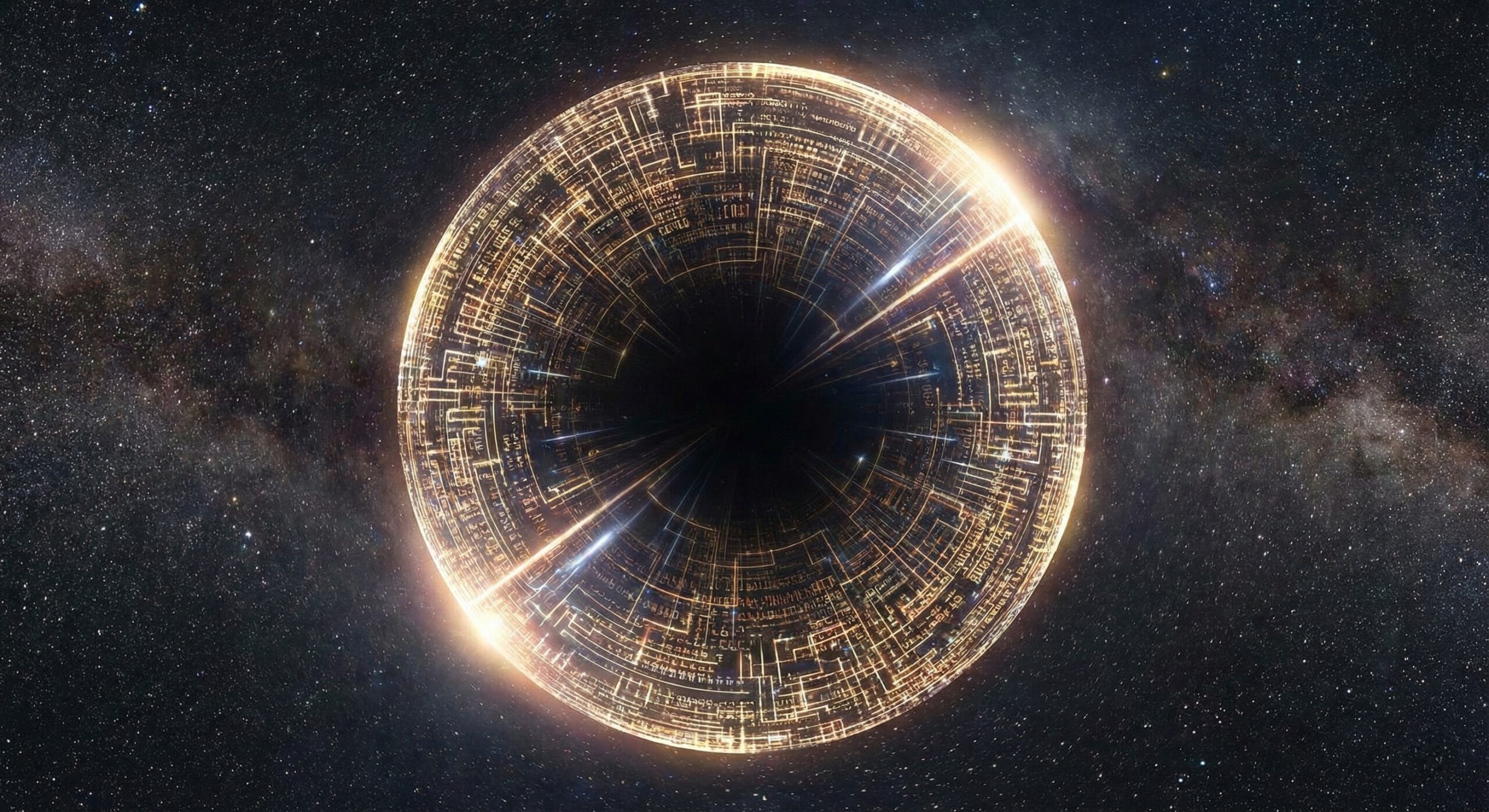
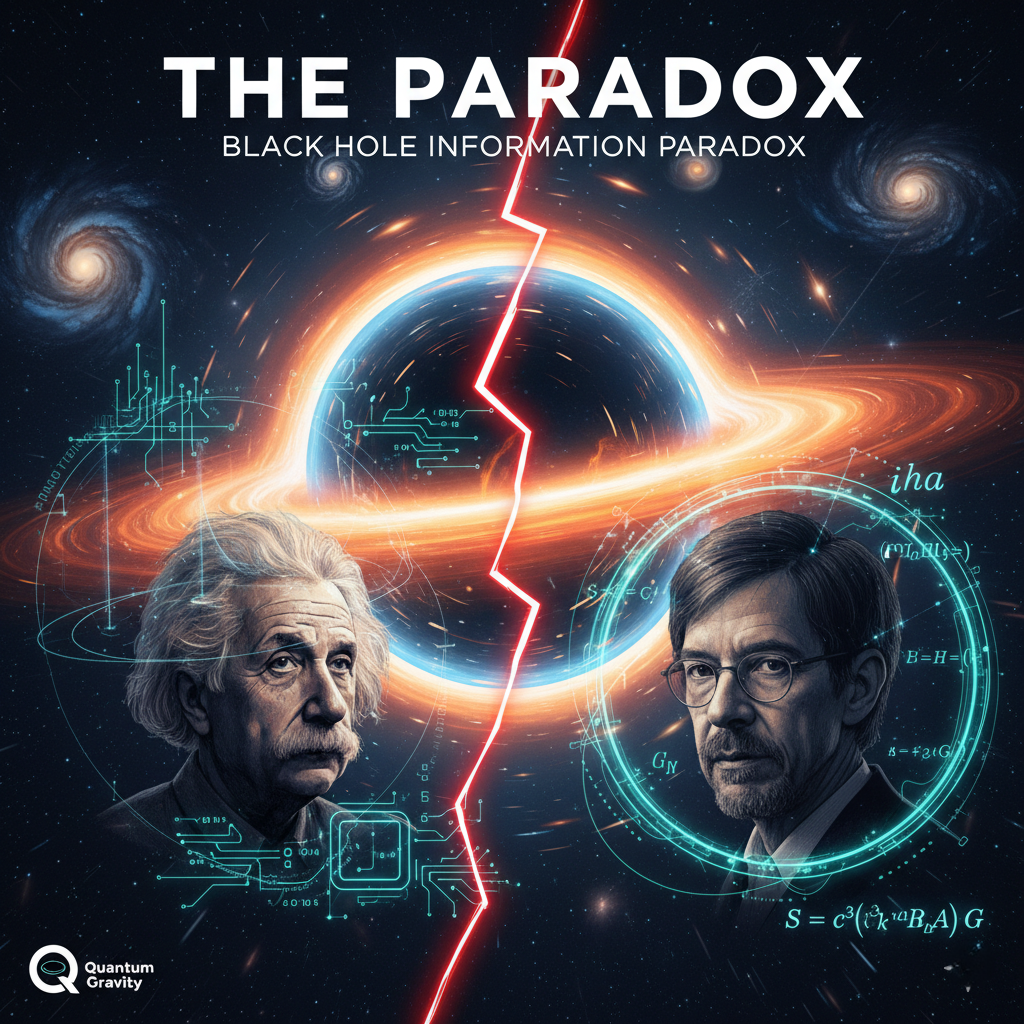
This image represents a black hole where the information is stored on its surface event horizon
The first crack in the facade of classical spacetime appeared with black holes. According to General Relativity, black holes are simple objects defined only by mass, charge, and spin. If you throw a dictionary into a black hole, the information inside it seems to vanish. But Quantum Mechanics relies on a principle called “unitarity,” which dictates that information is never destroyed, only scrambled.
In the 1970s, Jacob Bekenstein and Stephen Hawking discovered something profound: the amount of information (entropy) a black hole can hold is not proportional to its volume, as common sense would suggest, but to its surface area. This was the first hint that the “inside” of the universe might be redundant. If the maximum information of a 3D object can be fully encoded on its 2D surface, then the third dimension—depth—might be an illusion.
The Soup Can Universe: AdS/CFT
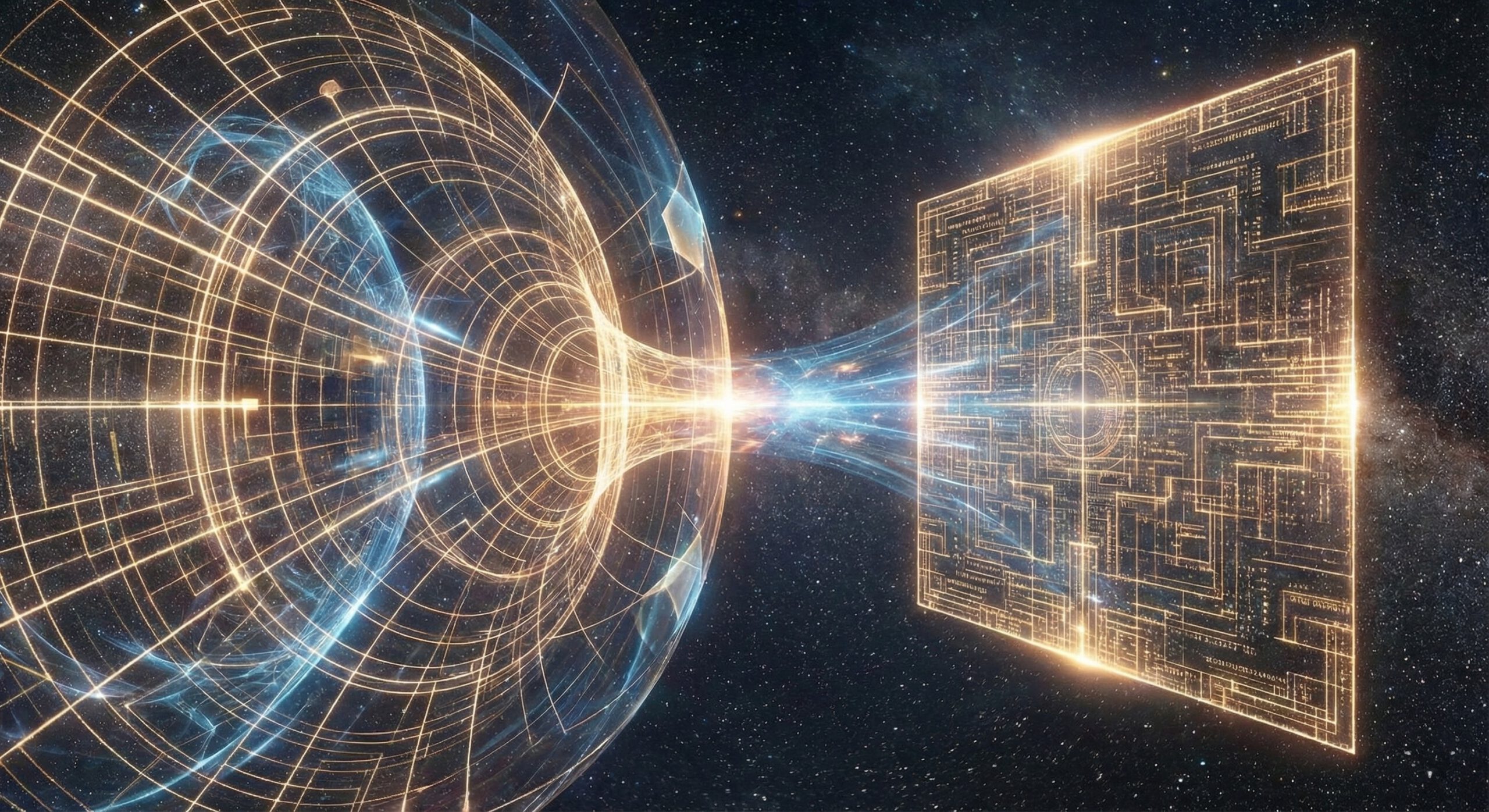
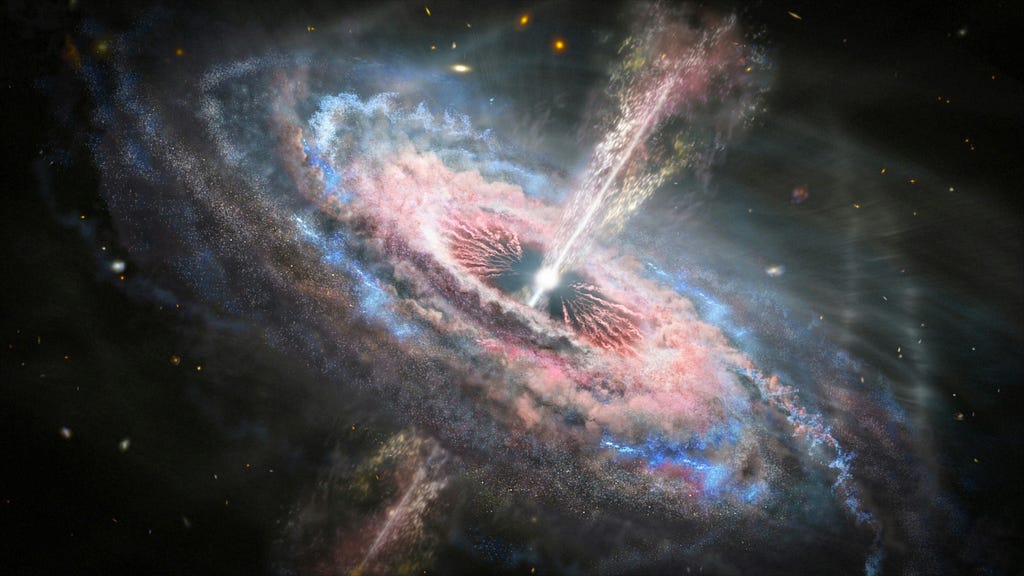
This image illustrates the AdS/CFT correspondence, showing the projection of a higher-dimensional, volumetric space
In 1997, physicist Juan Maldacena formalized this idea with the AdS/CFT Correspondence, often called the “Soup Can” analogy.
Imagine a universe contained entirely inside a tin can.
The Bulk (The Soup): The interior of the can represents Anti-de Sitter (AdS) space. This is a world with gravity, volume, and three dimensions.
The Boundary (The Label): The surface of the can represents a Conformal Field Theory (CFT). This is a quantum world with no gravity, living on a flat, two-dimensional surface.
Maldacena proved that these are not two different universes. They are the same universe described in two different languages. A black hole forming in the “soup” is mathematically identical to a hot, chaotic cloud of particles on the “label.” This duality saved quantum mechanics: information falling into a black hole isn’t lost; it is simply smeared out across the boundary of the universe.
Spacetime is “Made” of Entanglement
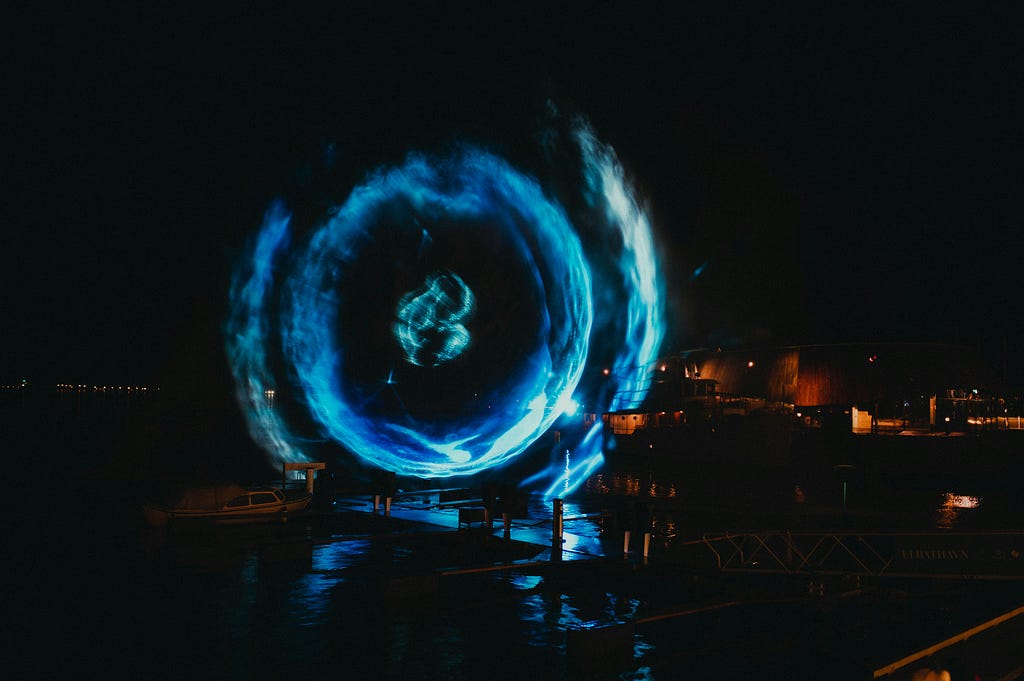
This visualization shows quantum entanglement, represented by a web of glowing connections
If the 3D world is a projection, what is the mechanism of the projector? How do flat, quantum correlations on a boundary turn into the voluminous fabric of space we walk through? The answer appears to be Quantum Entanglement.
For decades, entanglement was viewed as a “spooky” phenomenon happening inside space. New research suggests entanglement is what constructs space.
This relationship is encapsulated in the Ryu-Takayanagi Formula. It calculates the “entanglement entropy” of a region on the boundary and finds it is directly proportional to the area of a surface dipping into the bulk. In simple terms: the amount of quantum entanglement on the surface determines the amount of physical geometry inside.
Theoretical calculations have shown that if you were to “turn off” the entanglement between two regions of the boundary, the space inside would physically tear apart. Spacetime is a web of quantum correlations. This has led to the slogan “It from Qubit”—the idea that the physical “it” (geometry) emerges from the “qubit” (quantum information).
This connection is further strengthened by the ER=EPR conjecture, proposed by Maldacena and Leonard Susskind. It suggests that a pair of entangled particles (EPR) is connected by a microscopic wormhole (Einstein-Rosen bridge). In this view, quantum entanglement is literally the thread stitching the fabric of spacetime together.
The Glitch: We Don’t Live in a Soup Can
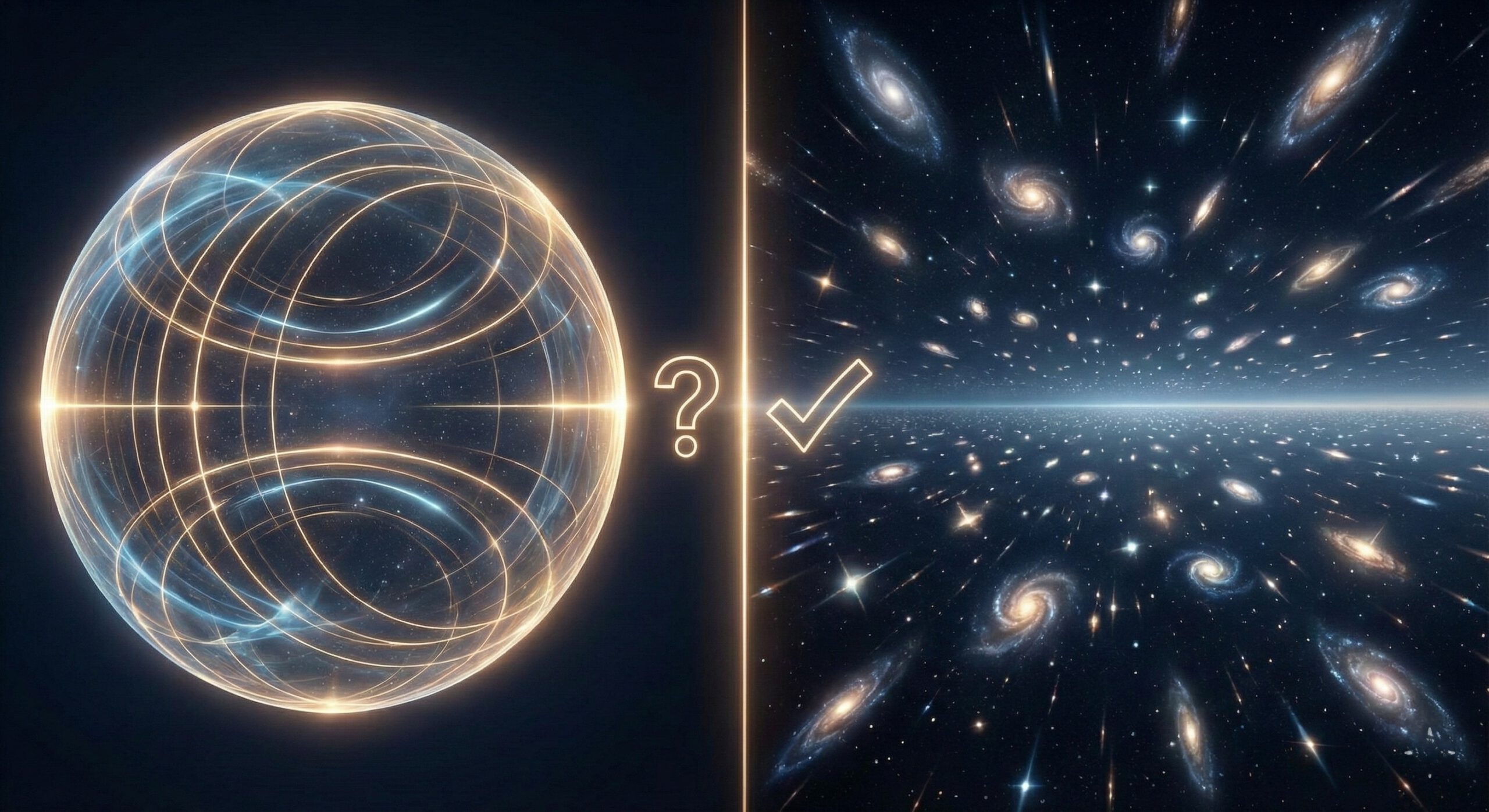
This image contrasts the theoretical, curved AdS universe (left) with our actual expanding universe (right)
While the AdS/CFT correspondence is a mathematical triumph, it faces a severe reality check: We do not live in Anti-de Sitter (AdS) space.
AdS space acts like a box with a reflective wall at the edge, which makes the mathematics of holography work nicely. Our universe, however, is expanding and accelerating due to Dark Energy. We live in de Sitter (dS) space. Unlike the soup can, our universe is like an expanding bubble with no clear spatial boundary.
This discrepancy has led to the “Swampland” Program. String theorists have found it incredibly difficult to construct a stable, accelerating universe like ours within their equations. Some conjectures suggest that universes like ours might belong to the “Swampland”—a set of theories that look consistent at low energies but are actually impossible in a full theory of quantum gravity.
Celestial Holography: A Hologram on the Sky
Because our universe lacks the convenient “walls” of AdS space, physicists are developing a new framework called Celestial Holography.
Instead of projecting reality from a boundary at the edge of the universe, Celestial Holography treats the “Celestial Sphere”—the night sky itself—as the hologram. It proposes that the four-dimensional scattering of particles in our spacetime is mathematically dual to a two-dimensional theory living on the sphere where light rays eventually end up. Recent progress has focused on relating this flat-space holography to the better-understood AdS models, attempting to “flatten” the soup can to describe the real world.
Reality as Quantum Error Correction
One of the most compelling modern interpretations is that spacetime acts like a Quantum Error-Correcting Code.
In quantum computing, information is incredibly fragile. To protect a single bit of data (a logical qubit), engineers smear it across many physical qubits so that if one is corrupted, the information remains intact.
Calculations suggest the holographic universe works the same way. The “Bulk” (our perceptible reality) is the protected, logical information. The “Boundary” is the noisy physical hardware. Space, time, and gravity may simply be the efficient coding scheme the universe uses to protect its quantum data from decoherence. In this view, the reason you can walk across a room without disintegrating is that the universe is constantly running error-correction algorithms to maintain the continuity of spacetime.
Conclusion
We are left with a view of the cosmos that is radically different from our intuition. The distinction between “geometry” and “matter,” or “container” and “content,” appears to be false. Gravity is the hydrodynamics of entanglement; space is the visualization of quantum correlations. We are not merely inhabitants of a 3D stage; we are likely the holographic projections of a deeper, 2D reality playing out at the edge of time.
Further Reading
Foundational Papers & Concepts
Maldacena, J. (1998). “The Large N limit of superconformal field theories and supergravity.” International Journal of Theoretical Physics. (The original paper proposing the AdS/CFT correspondence).
‘t Hooft, G. (1993). “Dimensional Reduction in Quantum Gravity.” arXiv:gr-qc/9310026. (The first proposal of the Holographic Principle).
Susskind, L. (1995). “The World as a Hologram.” Journal of Mathematical Physics. (Formalizing the principle in String Theory).
Ryu, S., & Takayanagi, T. (2006). “Holographic Derivation of Entanglement Entropy from AdS/CFT.” Physical Review Letters. (The geometric formula connecting entanglement to spacetime area).
Emergent Gravity & Entanglement
Maldacena, J., & Susskind, L. (2013). “Cool horizons for entangled black holes.” Fortschritte der Physik. (The paper introducing the ER=EPR conjecture).
Van Raamsdonk, M. (2010). “Building up spacetime with quantum entanglement.” General Relativity and Gravitation. (A thought experiment on tearing spacetime by removing entanglement).
Almheiri, A., Dong, X., & Harlow, D. (2015). “Bulk Locality and Quantum Error Correction in AdS/CFT.” Journal of High Energy Physics. (The proposal that spacetime is a quantum error-correcting code).
Swampland & de Sitter Space
Obied, G., Ooguri, H., Speltiin, L., & Vafa, C. (2018). “De Sitter Space and the Swampland.” arXiv:1806.08362. (Conjecturing that stable de Sitter universes cannot exist in String Theory).
Strominger, A. (2001). “The dS/CFT Correspondence.” Journal of High Energy Physics. (Early attempts to apply holography to de Sitter space).
Celestial Holography
Pasterski, S., Shao, S. H., & Strominger, A. (2017). “Flat Space Amplitudes and Conformal Symmetry of the Celestial Sphere.” Physical Review D. (Laying the groundwork for Celestial Holography).
Raclariu, A. M. (2021). “Lectures on Celestial Holography.” arXiv:2107.02075. (A comprehensive review of the field).
Observational & Experimental Prospects
Verlinde, E. P., & Zurek, K. M. (2019). “Observational Signatures of Quantum Gravity in Interferometers.” arXiv:1902.08207. (Proposing ways to detect holographic noise).
Abedi, J., Dykaar, H., & Afshordi, N. (2017). “Echoes from the Abyss: Tentative evidence for Planck-scale structure at black hole horizons.” Physical Review D. (Investigating gravitational wave echoes).
The Black Hole Information Paradox exists at the catastrophic intersection of 20th-century physics’ two greatest achievements: Albert Einstein’s General Theory of Relativity (GR) and the laws of quantum mechanics. The paradox emerges because these two foundational theories provide an irreconcilable description of reality. General Relativity, a theory of gravity, creates a perfect prison for information, while quantum mechanics, a theory of matter and energy, mandates that information can never be destroyed.
General Relativity (GR) is not a theory of forces, but one of spacetime geometry. Matter and energy tell spacetime how to curve, and the curvature of spacetime tells matter how to move. The black hole is the most extreme prediction of this theory, a solution to Einstein’s field equations that has been confirmed by astrophysical observations.
A black hole is defined by its core components, which are themselves predictions of GR:
The Event Horizon: This is not a physical surface, but a causal boundary in spacetime. It is the “point of no return” beyond which the curvature of spacetime is so extreme that nothing, not even light, can escape. For a distant observer, this boundary is the black hole; events that occur inside it are forever causally disconnected from the outside universe. The existence of this horizon is a necessary condition for the formulation of the paradox.
The Singularity: General Relativity predicts that inside the event horizon, all the matter that formed the black hole, and spacetime itself, collapses to a single point of zero volume and infinite density: the gravitational singularity. This is a region where the known laws of physics break down. In the classical picture, any “information” (the quantum state) of matter that falls into the black hole ceases to exist at the singularity.
B. The Classical Black Hole: The “No-Hair” Edifice
The classical information-loss problem is rooted in a key principle of General Relativity known as the “no-hair theorem.” This theorem states that an isolated, stable black hole — once it has settled down — is an object of profound simplicity. It is characterized only by three externally observable properties:
Mass
Electric Charge
Angular Momentum
The term “hair” is a metaphor for all the other complex information that describes the objects that formed the black hole — for instance, whether it was made of matter or antimatter, encyclopedias or boulders. The theorem states that the black hole “sheds” all this complex “hair” during its formation, becoming “bald.” The complex configuration of the interior is completely hidden from outside observers by the horizon.
This “no-hair” rule is the classical foundation for information loss. It does not imply the information is destroyed, but rather that it is rendered permanently inaccessible to the outside universe, trapped behind the horizon. In a purely classical universe where black holes last forever, this is not a paradox; it is simply a feature of gravity. The paradox only ignites when quantum mechanics is introduced, forcing the black hole to evaporate.
It is crucial to note that this classical pillar of the paradox is now itself in dispute. Research in 2016 by Hawking, Perry, and Strominger postulated the existence of “soft hair” — low-energy quantum states that do store information at the horizon. This challenge to the no-hair theorem from within a modified framework of GR suggests the resolution to the paradox is not a simple “GR vs. QM” battle, but a more nuanced synthesis of the two.
The second, conflicting pillar of the paradox is quantum mechanics. While General Relativity describes a universe where information can be permanently hidden, quantum mechanics is built on a mathematical foundation that absolutely forbids the destruction of information.
A. The Bedrock of Reality: Unitarity and Reversibility
The laws of quantum mechanics govern the fundamental constituents of matter and energy. This framework’s mathematical bedrock is the principle of “unitarity”. Unitarity is the condition that the time evolution of a quantum state, as described by the Schrödinger equation, is mathematically represented by a unitary operator. This abstract concept has three profound and non-negotiable physical consequences:
Probability Conservation: Unitarity guarantees that the sum of all probabilities for any quantum event always equals 100%. The magnitude of a quantum state vector remains constant over time.
Reversibility: It ensures that all quantum processes are, in principle, reversible in time. Given the precise final state of a system, one can (theoretically) use the equations of quantum mechanics to run the clock backward and determine its exact initial state.
Information Conservation: This principle of reversibility is the law of information conservation. In physics, “information” is not just data; it is the complete quantum state of a system. Unitarity dictates that this information can never be truly created or destroyed; it can only be transformed or “scrambled”.
The stakes of this principle are absolute. Violating unitarity is not a small adjustment to the laws of physics. As noted by physicists, a violation of unitarity would also imply a violation of the conservation of energy. Therefore, when Stephen Hawking’s calculations suggested information was lost, the physics community could not simply accept it. The alternative — a breakdown of quantum mechanics — was seen as a collapse of the entire predictive framework of physics, a “battle” to “make the world safe for quantum mechanics”.
B. “In Principle” vs. “In Practice”: The Burning Paper Analogy
The paradox hinges on a critical distinction between information that is “inaccessible” and information that is “destroyed”. The “burning paper” analogy clarifies this.
If one writes a secret (e.g., “My password is 12345”) on a piece of paper and then burns it, the information is lost for all practical purposes. It has been scrambled into a highly complex final state of ash, smoke, heat, and light. This information is inaccessible “in practice.”
However, according to the principle of unitarity, this information is not destroyed “in principle.” The final, complex state of every smoke particle, every photon of heat, and every molecule of ash is uniquely determined by the initial state (the paper and the fire). In principle, an omniscient observer who collected every single resultant particle and photon could reverse the process and reconstruct the original message.
This is the core of the problem. The Black Hole Information Paradox is not that information is inaccessible (hidden behind the horizon). That is the classical no-hair problem. The paradox, as catalyzed by Hawking’s work, is that black hole evaporation implies the information is destroyed “in principle.” It suggests that two different initial states (a paper with “12345” vs. a paper with “ABCDE”) could collapse and evaporate to produce the exact same final state of radiation. This would make the process fundamentally irreversible, a true erasure of the past, and a violation of unitarity.
III. The Catalyst: Hawking’s 1974 Calculation and the Onset of Evaporation
The paradox was born in 1974 when Stephen Hawking attempted to bridge the gap between GR and quantum mechanics. By applying quantum field theory (QFT) to the curved spacetime background of a black hole, he made a discovery that would ignite a 50-year-long crisis.
A. Black Holes Aren’t Black: The Evaporation Mechanism
Hawking demonstrated that black holes are not truly “black.” They must emit radiation and, therefore, have a temperature. This process is now known as Hawking radiation.
The popular explanation for this radiation — often used by Hawking himself in his popular science books — is misleading. This story describes “virtual particle-antiparticle pairs” constantly popping into existence near the horizon. One partner falls in, and the other escapes, becoming “real” radiation. This analogy, however, has been described as a “fantasy” and is not the true physical mechanism.
The actual mechanism is far more subtle and robust. It arises from the fact that “empty space” (the vacuum) is teeming with quantum fields. A fundamental tenet of QFT in curved spacetime is that the very concept of a “particle” is observer-dependent. Due to the extreme spacetime curvature (and different time dilation) near the event horizon, an observer falling into the black hole and a distant observer in flat space will disagree on the definition of the vacuum state (a phenomenon described by Bogolyubov transformations). Where the infalling observer sees empty space, the distant observer sees a continuous flux of thermal particles being radiated away from the black hole.
This Hawking radiation carries energy away from the black hole. According to Einstein’s equation E = mc², a loss of energy means a loss of mass. As the black hole radiates, it slowly shrinks, its temperature increases, and its rate of radiation accelerates. Eventually, over vast timescales, the black hole is predicted to evaporate completely, disappearing in a final flash of high-energy radiation.
B. The Thermodynamic Shock: A Violation of the Second Law
Before Hawking’s 1974 paper, physicist Jacob Bekenstein had already argued that black holes must possess entropy. His reasoning was based on saving the Second Law of Thermodynamics, which states that the total entropy (disorder) of a closed system can never decrease.
If one were to throw a hot object (e.g., a cup of tea, which has entropy) into a black hole, its entropy would simply vanish from the observable universe. This would constitute a violation of the Second Law. To prevent this, Bekenstein proposed a “Generalized Second Law” (GSL).
He posited that the black hole’s entropy was directly proportional to the area of its event horizon.
Hawking’s 1974 calculation provided a stunning confirmation of this idea. By discovering that black holes have a temperature, he provided the missing link that, through the laws of thermodynamics, mathematically proved that Bekenstein’s entropy-area relation was correct.
This was a triumph, but it was immediately overshadowed by a more profound problem created by the black hole’s evaporation. The process now looked like this:
A star, a complex object in a “pure quantum state” (low entropy), collapses to form a black hole. The GSL holds.
The black hole evaporates completely, vanishing.
The final state of the universe consists only of the Hawking radiation.
If this final radiation is purely thermal and random — as Hawking’s calculation suggested — then a “pure state” (low entropy) has evolved into a “mixed state” (high entropy). This is a gross violation of the Second Law and, more fundamentally, a transparent-breaking of quantum mechanics’ non-negotiable principle of unitarity.
C. The Thermal State: The True Source of the Paradox
This is the technical core of the information paradox. Hawking’s original 1974 calculation demonstrated that the emitted radiation was purely thermal.
A “thermal state” is a “mixed state” — it is random and “information-poor”. Its properties (its perfect “blackbody” spectrum) depend only on the black hole’s temperature. That temperature, in turn, depends only on the black hole’s mass, charge, and spin.
Here, the two pillars of the paradox act as accomplices. The classical “no-hair theorem” (Section I.B) states that the classical black hole is “bald” (only Mass, Charge, and Spin are observable). Hawking’s calculation showed that the quantum radiation it emits is also “bald” (its properties only depend on Mass, Charge, and Spin). The thermal radiation is the quantum echo of the classical no-hair theorem. The classical theory hides the information; the semiclassical theory erases it during evaporation.
This leads to the paradox, formally stated as the “pure-to-mixed” problem:
Start: An encyclopedia, a highly-ordered “pure quantum state” with an entropy of zero, collapses to form a black hole.
Middle: The black hole evaporates via thermal Hawking radiation.
End: The black hole is gone. The final state is only a featureless, thermal gas of radiation, a “mixed state” with high entropy.
According to quantum mechanics, a closed system cannot evolve from a pure state to a mixed state. This process is non-unitary. It means that two different pure states (a star vs. an encyclopedia) would evolve into the exact same final thermal state, making the process irreversible in principle. This is the Black Hole Information Paradox.
IV. The “Black Hole War”: A Four-Decade Intellectual Battle
The paradox ignited a four-decade intellectual and personal debate, famously chronicled by physicist Leonard Susskind in his book, The Black Hole War.
A. The Protagonists: For and Against Information Loss
The physics community fractured into two main camps:
Team “Information is Lost”: This camp was led by Stephen Hawking himself. He argued that the extreme gravity of the singularity created a genuine exception to quantum law, and that quantum mechanics must break down. He was joined by physicist Kip Thorne.
Team “Information is Saved”: This camp, led by Leonard Susskind and Gerard ‘t Hooft, argued that unitarity is the most fundamental principle we have and is non-negotiable. They contended that gravity, not quantum mechanics, must be the theory that is incomplete and requires modification.
B. The 1997 Bet: Information vs. Encyclopedia
The debate was famously formalized in a 1997 public wager between Hawking and Thorne (arguing information is lost) and Caltech physicist John Preskill (arguing information is recovered).
The prize was a perfect, witty summary of the debate itself: “an encyclopedia of the winner’s choice, from which information can be recovered at will”.
In 2004, at a conference in Dublin, Hawking stunned the physics world by announcing his concession. He admitted he was wrong and that information must be preserved. He duly presented Preskill with a baseball encyclopedia.
However, this was a hollow victory. Hawking’s concession was based on a 2004 paper that few physicists found convincing. Susskind, a leader of the opposing side, famously described Hawking as “one of those unfortunate soldiers who wander in the jungle for years, not knowing that the hostilities have ended”. This implied that the real war had already been won by a new, revolutionary idea that Hawking was only just beginning to accept.
C. The Revolution that Changed Hawking’s Mind: The Holographic Principle
The theoretical development that forced Hawking’s concession was the “Holographic Principle”. This idea, first proposed by Gerard ‘t Hooft and later championed by Leonard Susskind, was a direct consequence of Bekenstein’s discovery that black hole entropy scales with its two-dimensional surface area, not its three-dimensional volume.
The principle states that all the information required to describe a 3D volume of spacetime (like the interior of a black hole) can be fully encoded on a 2D boundary surface, much like a 3D image is encoded on a 2D hologram. The fundamental unit of information, one “bit,” occupies a 2D surface area of one “Planck area.”
This radical idea was given a precise, mathematical formulation in 1997 by Juan Maldacena: the “Anti-de Sitter/Conformal Field Theory” (AdS/CFT) correspondence. This correspondence conjectures an exact equivalence (a duality) between two vastly different theories:
A theory of quantum gravity (like string theory) existing in a D-dimensional, curved, “Anti-de Sitter” (AdS) space.
A standard, non-gravitational “Conformal Field Theory” (CFT) living on its (D-1)-dimensional boundary.
This duality provided a “proof by duality” for information conservation. The CFT on the boundary is a standard quantum theory; by definition, it is unitary and conserves information. Since the (seemingly non-unitary) gravity theory is dual to the unitary CFT, the gravity theory must also be unitary.
V. The Firewall Crisis: The Paradox Returns
A. The Page Curve: The Litmus Test for Unitarity
The debate eventually moved from abstract principles to concrete calculations. If information is conserved, how exactly does it get out? Physicist Don Page realized that if unitarity holds, the entropy of the Hawking radiation must follow a specific pattern, now called the “Page Curve”.
Hawking’s (Loss) Curve: As the black hole shrinks, this entropy monotonically increases, settling at a large value when the black hole is gone. This describes the “pure-to-mixed” state evolution.
Page’s (Unitary) Curve: If the process is unitary, the total system must end as a pure state (zero entropy). For this to happen, the entropy of the radiation must start at zero, increase, but then must “turn over” and decrease back to zero as the black hole evaporates and the radiation contains all the information of the original system.
The moment the curve must turn over is now known as the “Page Time.” Page calculated this occurs when the black hole has evaporated to roughly half its initial mass.
This discovery worsened the paradox. Previously, physicists had assumed that the information-loss problem was a “quantum gravity” issue, relevant only when the black hole shrunk to the microscopic “Planck scale”. Page’s calculation showed the conflict between Hawking’s calculation and unitarity occurs at the Page Time, when the black hole is still enormous. This meant the conflict was not a problem for some “future theory” but a “breakdown of low-energy physics” right now, in a regime where semiclassical gravity should work.
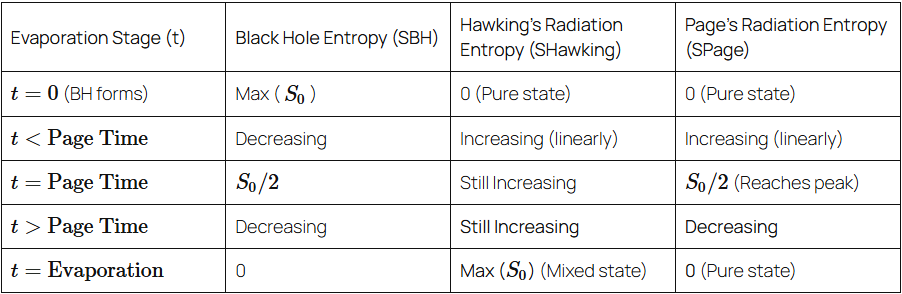
Table 1: The Entropy Conflict — Hawking vs. Page
This table quantifies the exact disagreement between Hawking’s 1974 calculation (information loss) and the Page curve (information conservation).
The conflict, highlighted in bold, occurs after the Page Time. Hawking’s calculation predicts an ever-increasing entropy, resulting in a high-entropy “mixed state.” Unitarity demands the entropy must follow the Page curve and return to zero.
B. The AMPS Firewall: A Paradox Within a Paradox
In 2012, physicists Ahmed Almheiri, Donald Marolf, Joseph Polchinski, and James Sully (AMPS) took the Page Curve (and thus unitarity) as a given and showed that it led to an even more violent paradox.
The AMPS paper argued that the following three sacred principles of physics cannot all be true:
Unitarity: Information is conserved (the Page Curve is correct).
Einstein’s Equivalence Principle: An observer free-falling into a black hole should feel nothing unusual at the event horizon (a “smooth” passage).
Local Quantum Field Theory: The known laws of low-energy physics are valid at the horizon.
The conflict arises from a fundamental rule of quantum mechanics called the “monogamy of entanglement”. This rule states that a quantum system can be maximally entangled with one other system, but not with two different systems at the same time.
The AMPS argument proceeds as follows:
Consider a newly emitted Hawking particle, “B” (which is outside the horizon).
For the horizon to be “smooth” (Equivalence Principle), particle “B” must be maximally entangled with its infalling partner, “C” (which is inside the horizon).
But, for unitarity (Page Curve), after the Page Time, particle “B” must also be maximally entangled with all the early radiation that has already left, let’s call it “A”.
Therefore, particle “B” is simultaneously maximally entangled with both “A” (the old radiation) and “C” (its new partner). This violates the monogamy of entanglement.
AMPS concluded that the “weakest link” was the Equivalence Principle. To “break” the (B-C) entanglement and “enforce” the (B-A) entanglement, a “searing… black hole firewall” of high-energy particles must exist at the event horizon. This firewall would instantly burn up any infalling observer, destroying the “smooth” horizon of General Relativity.
This was the ultimate crisis. Physicists were forced to choose: either give up General Relativity’s “smooth horizon” or give up Quantum Mechanics’ “monogamy.” Both were seen as impossible.
VI. The Modern Resolution: Information’s Great Escape
The paradox, sharpened to a crisis by the firewall, has seen what many in the field consider to be a full resolution. This resolution, emerging from breakthroughs between 2016 and 2019, involves finding a more sophisticated semiclassical calculation that modifies the foundations of both theories.
A. Hawking’s Final Paper: “Soft Hair” on Black Holes
In 2016, Stephen Hawking, in one of his final papers, proposed a potential solution with collaborators Malcolm Perry and Andrew Strominger. This proposal directly attacks the first pillar of the paradox: the no-hair theorem.
They argued that black holes do have “hair”. This “soft hair” is composed of zero-energy quantum excitations (soft gravitons and photons) that are left at the event horizon when matter (and its information) falls in.
In this model, the “soft hair” stores the information of the infalling matter. The evaporation process is then twofold: the black hole emits the thermal Hawking radiation, but this radiation is “accompanied by additional radiation” from the soft hair. The correlations between the thermal radiation and the soft hair radiation are what carry the information, thus preserving unitarity. While many felt this was “not enough to capture all the information”, it was a profound shift, showing Hawking himself was working to defeat his own paradox.
B. The 2019 Breakthrough: Islands and Replica Wormholes
The current consensus resolution came from two landmark 2019 papers that finally, and successfully, calculated the Page Curve using semiclassical gravity itself.
This breakthrough introduced a new rule for calculating entropy in quantum gravity, centered on “Quantum Extremal Surfaces” (QES). The new rule states:
To find the true entropy of the Hawking radiation, one must calculate two possibilities and take the minimum value:
The entropy of the radiation alone (the “no-island” “Hawking” calculation).
The entropy of the radiation plus the entropy of a region inside the black hole, known as an “island”.
The “island” is a region of the black hole’s interior that is, by this new rule, considered part of the radiation system. This new “island” rule is not an ad-hoc guess; it is rigorously derived from complex gravitational path integral calculations that include new spacetime configurations called “replica wormholes”. These wormholes are spacetimes that connect the black hole interior directly to the distant radiation, demonstrating they are part of the same quantum system.
This new calculation perfectly derives the Page Curve:
Before the Page Time: The “no-island” calculation produces a smaller number. The entropy grows. This is Hawking’s original 1974 calculation, now understood to be correct, but only for the first half of the black hole’s life.
After the Page Time: A new QES forms, and the “island” calculation produces a smaller number. This value decreases.
The Result: The true entropy, being the minimum of these two calculations, automatically follows the Page Curve.
This “island” solution resolves both paradoxes at once. It solves the original information paradox by providing a concrete semiclassical calculation that reproduces the Page Curve. And it brilliantly resolves the firewall paradox. In the AMPS scenario (B entangled with A and C), the “island” rule means that after the Page Time, the infalling partner “C” (which is in the island) is mathematically part of the radiation system (which includes “A” and “B”). The (B-C) entanglement is no longer a violation of monogamy; it is an internal entanglement within the larger “radiation” system. Since monogamy is never violated, no firewall is needed. The Equivalence Principle is saved.
VII. Concluding Analysis: A New Picture of Spacetime
After nearly 50 years, the Black Hole Information Paradox, which threatened to tear down the pillars of modern physics, appears to be resolved. The overwhelming consensus, driven by the breakthroughs of 2019, is that information is conserved. Unitarity, the bedrock of quantum mechanics, is victorious.
The resolution is profoundly subtle. Hawking’s original 1974 calculation was not “wrong”; it was incomplete. It was the correct, dominant contribution to the entropy before the Page Time. The discovery of “replica wormholes” and their associated “islands” provides the more complete semiclassical calculation, revealing new gravitational effects that are dominant after the Page Time.
The paradox, and its resolution, have forced a new understanding of reality. The “island” — a piece of the deep black hole interior — being mathematically part of the “radiation” system infinitely far away, implies that spacetime is not as local and separate as it appears. It suggests that spacetime itself is an emergent property, built from the non-local threads of quantum entanglement. The “Black Hole War”, which began as a conflict between General Relativity and Quantum Mechanics, has ended in their synthesis: the geometry of spacetime (GR) is built from the information of quantum entanglement (QM).
The Black Hole Information Paradox exists at the catastrophic intersection of 20th-century physics’ two greatest achievements: Albert Einstein’s General Theory of Relativity (GR) and the laws of quantum mechanics. The paradox emerges because these two foundational theories provide an irreconcilable description of reality. General Relativity, a theory of gravity, creates a perfect prison for information, while quantum mechanics, a theory of matter and energy, mandates that information can never be destroyed.
A. The Relativistic Mandate: Gravity as Geometry
General Relativity (GR) is not a theory of forces, but one of spacetime geometry. Matter and energy tell spacetime how to curve, and the curvature of spacetime tells matter how to move.1 The black hole is the most extreme prediction of this theory, a solution to Einstein’s field equations that has been confirmed by astrophysical observations.2
A black hole is defined by its core components, which are themselves predictions of GR:
The Event Horizon: This is not a physical surface, but a causal boundary in spacetime.4 It is the “point of no return” beyond which the curvature of spacetime is so extreme that nothing, not even light, can escape.3 For a distant observer, this boundary is the black hole; events that occur inside it are forever causally disconnected from the outside universe.4 The existence of this horizon is a necessary condition for the formulation of the paradox.6
The Singularity: General Relativity predicts that inside the event horizon, all the matter that formed the black hole, and spacetime itself, collapses to a single point of zero volume and infinite density: the gravitational singularity.7 This is a region where the known laws of physics break down.10 In the classical picture, any “information” (the quantum state) of matter that falls into the black hole ceases to exist at the singularity.7
B. The Classical Black Hole: The “No-Hair” Edifice
The classical information-loss problem is rooted in a key principle of General Relativity known as the “no-hair theorem.” This theorem states that an isolated, stable black hole—once it has settled down—is an object of profound simplicity.11 It is characterized only by three externally observable properties:
Mass (\(M\))
Electric Charge (\(Q\))
Angular Momentum (\(J\)) 3
The term “hair” is a metaphor for all the other complex information that describes the objects that formed the black hole—for instance, whether it was made of matter or antimatter, encyclopedias or boulders.13 The theorem states that the black hole “sheds” all this complex “hair” during its formation, becoming “bald.” The complex configuration of the interior is completely hidden from outside observers by the horizon.10
This “no-hair” rule is the classical foundation for information loss. It does not imply the information is destroyed, but rather that it is rendered permanently inaccessible to the outside universe, trapped behind the horizon.10 In a purely classical universe where black holes last forever, this is not a paradox; it is simply a feature of gravity. The paradox only ignites when quantum mechanics is introduced, forcing the black hole to evaporate.
It is crucial to note that this classical pillar of the paradox is now itself in dispute. Research in 2016 by Hawking, Perry, and Strominger postulated the existence of “soft hair”—low-energy quantum states that do store information at the horizon.3 This challenge to the no-hair theorem from within a modified framework of GR suggests the resolution to the paradox is not a simple “GR vs. QM” battle, but a more-R_Su_R_S-nuanced synthesis of the two.
II. The Quantum Mandate: Information is Absolute
The second, conflicting pillar of the paradox is quantum mechanics. While General Relativity describes a universe where information can be permanently hidden, quantum mechanics is built on a mathematical foundation that absolutely forbids the destruction of information.
A. The Bedrock of Reality: Unitarity and Reversibility
The laws of quantum mechanics govern the fundamental constituents of matter and energy. This framework’s mathematical bedrock is the principle of “unitarity”.7 Unitarity is the condition that the time evolution of a quantum state, as described by the Schrödinger equation, is mathematically represented by a unitary operator.15 This abstract concept has three profound and non-negotiable physical consequences:
Probability Conservation: Unitarity guarantees that the sum of all probabilities for any quantum event always equals 100%. The magnitude of a quantum state vector remains constant over time.17
Reversibility: It ensures that all quantum processes are, in principle, reversible in time.20 Given the precise final state of a system, one can (theoretically) use the equations of quantum mechanics to run the clock backward and determine its exact initial state.3
Information Conservation: This principle of reversibility is the law of information conservation.14 In physics, “information” is not just data; it is the complete quantum state of a system. Unitarity dictates that this information can never be truly created or destroyed; it can only be transformed or “scrambled”.26
The stakes of this principle are absolute. Violating unitarity is not a small adjustment to the laws of physics. As noted by physicists, a violation of unitarity would also imply a violation of the conservation of energy.14 Therefore, when Stephen Hawking’s calculations suggested information was lost, the physics community could not simply accept it. The alternative—a breakdown of quantum mechanics—was seen as a collapse of the entire predictive framework of physics, a “battle” to “make the world safe for quantum mechanics”.29
B. “In Principle” vs. “In Practice”: The Burning Paper Analogy
The paradox hinges on a critical distinction between information that is “inaccessible” and information that is “destroyed”.32 The “burning paper” analogy clarifies this.
If one writes a secret (e.g., “My password is 12345”) on a piece of paper and then burns it, the information is lost for all practical purposes.33 It has been scrambled into a highly complex final state of ash, smoke, heat, and light.28 This information is inaccessible “in practice.”
However, according to the principle of unitarity, this information is not destroyed “in principle.” The final, complex state of every smoke particle, every photon of heat, and every molecule of ash is uniquely determined by the initial state (the paper and the fire). In principle, an omniscient observer who collected every single resultant particle and photon could reverse the process and reconstruct the original message.28
This is the core of the problem. The Black Hole Information Paradox is not that information is inaccessible (hidden behind the horizon). That is the classical no-hair problem. The paradox, as catalyzed by Hawking’s work, is that black hole evaporation implies the information is destroyed “in principle.” It suggests that two different initial states (a paper with “12345” vs. a paper with “ABCDE”) could collapse and evaporate to produce the exact same final state of radiation.3 This would make the process fundamentally irreversible, a true erasure of the past, and a violation of unitarity.
III. The Catalyst: Hawking’s 1974 Calculation and the Onset of Evaporation
The paradox was born in 1974 when Stephen Hawking attempted to bridge the gap between GR and quantum mechanics. By applying quantum field theory (QFT) to the curved spacetime background of a black hole, he made a discovery that would ignite a 50-year-R_Su_R_S-long crisis.3
A. Black Holes Aren’t Black: The Evaporation Mechanism
Hawking demonstrated that black holes are not truly “black.” They must emit radiation and, therefore, have a temperature.3 This process is now known as Hawking radiation.
The popular explanation for this radiation—often used by Hawking himself in his popular science books—is misleading.38 This story describes “virtual particle-antiparticle pairs” constantly popping into existence near the horizon. One partner falls in, and the other escapes, becoming “real” radiation.9 This analogy, however, has been described as a “fantasy” and is not the true physical mechanism.41
The actual mechanism is far more subtle and robust. It arises from the fact that “empty space” (the vacuum) is teeming with quantum fields.39 A fundamental tenet of QFT in curved spacetime is that the very concept of a “particle” is observer-dependent. Due to the extreme spacetime curvature (and different time dilation) near the event horizon, an observer falling into the black hole and a distant observer in flat space will disagree on the definition of the vacuum state (a phenomenon described by Bogoliubov transformations).42 Where the infalling observer sees empty space, the distant observer sees a continuous flux of thermal particles being radiated away from the black hole.42
This Hawking radiation carries energy away from the black hole.9 According to Einstein’s equation \(E = mc^2\) , a loss of energy means a loss of mass.44 As the black hole radiates, it slowly shrinks 45, its temperature increases 9, and its rate of radiation accelerates. Eventually, over vast timescales, the black hole is predicted to evaporate completely, disappearing in a final flash of high-energy radiation.42
B. The Thermodynamic Shock: A Violation of the Second Law
Before Hawking’s 1974 paper, physicist Jacob Bekenstein had already argued that black holes must possess entropy.8 His reasoning was based on saving the Second Law of Thermodynamics, which states that the total entropy (disorder) of a closed system can never decrease.
If one were to throw a hot object (e.g., a cup of tea, which has entropy) into a black hole, its entropy would simply vanish from the observable universe. This would constitute a violation of the Second Law.49 To prevent this, Bekenstein proposed a “Generalized Second Law” (GSL) 49:
He posited that the black hole’s entropy (\(S_{\text{BH}}\)) was directly proportional to the area of its event horizon.13
Hawking’s 1974 calculation provided a stunning confirmation of this idea. By discovering that black holes have a temperature, he provided the missing link that, through the laws of thermodynamics (\(dM = Td\)), mathematically proved that Bekenstein’s entropy-area relation was correct.8
This was a triumph, but it was immediately overshadowed by a more profound problem created by the black hole’s evaporation.44 The process now looked like this:
A star, a complex object in a “pure quantum state” (low entropy), collapses to form a black hole. The GSL holds.49
The black hole evaporates completely, vanishing.46
The final state of the universe consists only of the Hawking radiation.
If this final radiation is purely thermal and random—as Hawking’s calculation suggested—then a “pure state” (low entropy) has evolved into a “mixed state” (high entropy).3 This is a gross violation of the Second Law and, more fundamentally, a transparent-R_Su_R_S-breaking of quantum mechanics’ non-negotiable principle of unitarity.52
C. The Thermal State: The True Source of the Paradox
This is the technical core of the information paradox. Hawking’s original 1974 calculation demonstrated that the emitted radiation was purely thermal.52
A “thermal state” is a “mixed state”—it is random and “information-poor”.3 Its properties (its perfect “blackbody” spectrum) depend only on the black hole’s temperature.42 That temperature, in turn, depends only on the black hole’s mass, charge, and spin (\(M\), \(Q\), and \(J\)).3
Here, the two pillars of the paradox act as accomplices. The classical “no-hair theorem” (Section I.B) states that the classical black hole is “bald” (only \(M\), \(Q\), and \(J\) are observable). Hawking’s calculation showed that the quantum radiation it emits is also “bald” (its properties only depend on \(M\), \(Q\), and \(J\)). The thermal radiation is the quantum echo of the classical no-hair theorem. The classical theory hides the information; the semiclassical theory erases it during evaporation.
This leads to the paradox, formally stated as the “pure-to-mixed” problem:
Start: An encyclopedia, a highly-ordered “pure quantum state” with an entropy of zero, collapses to form a black hole.3
Middle: The black hole evaporates via thermal Hawking radiation.
End: The black hole is gone. The final state is only a featureless, thermal gas of radiation, a “mixed state” with high entropy.3
According to quantum mechanics, a closed system cannot evolve from a pure state to a mixed state.7 This process is non-unitary. It means that two different pure states (a star vs. an encyclopedia) would evolve into the exact same final thermal state, making the process irreversible in principle.3 This is the Black Hole Information Paradox.
IV. The “Black Hole War”: A Four-Decade Intellectual Battle
The paradox ignited a four-decade intellectual and personal debate, famously chronicled by physicist Leonard Susskind in his book, The Black Hole War.29
A. The Protagonists: For and Against Information Loss
The physics community fractured into two main camps:
Team “Information is Lost”: This camp was led by Stephen Hawking himself.3 He argued that the extreme gravity of the singularity created a genuine exception to quantum law, and that quantum mechanics must break down.3 He was joined by physicist Kip Thorne.57
Team “Information is Saved”: This camp, led by Leonard Susskind and Gerard ‘t Hooft, argued that unitarity is the most fundamental principle we have and is non-negotiable.31 They contended that gravity, not quantum mechanics, must be the theory that is incomplete and requires modification.
B. The 1997 Bet: Information vs. Encyclopedia
The debate was famously formalized in a 1997 public wager between Hawking and Thorne (arguing information is lost) and Caltech physicist John Preskill (arguing information is recovered).57
The prize was a perfect, witty summary of the debate itself: “an encyclopedia of the winner’s choice, from which information can be recovered at will”.57
In 2004, at a conference in Dublin, Hawking stunned the physics world by announcing his concession. He admitted he was wrong and that information must be preserved.57 He duly presented Preskill with a baseball encyclopedia.57
However, this was a hollow victory. Hawking’s concession was based on a 2004 paper that few physicists found convincing.57 Susskind, a leader of the opposing side, famously described Hawking as “one of those unfortunate soldiers who wander in the jungle for years, not knowing that the hostilities have ended”.57 This implied that the real war had already been won by a new, revolutionary idea that Hawking was only just beginning to accept.
C. The Revolution that Changed Hawking’s Mind: The Holographic Principle
The theoretical development that forced Hawking’s concession was the “Holographic Principle”.59 This idea, first proposed by Gerard ‘t Hooft and later championed by Leonard Susskind, was a direct consequence of Bekenstein’s discovery that black hole entropy scales with its two-dimensional surface area, not its three-dimensional volume.3
The principle states that all the information required to describe a 3D volume of spacetime (like the interior of a black hole) can be fully encoded on a 2D boundary surface, much like a 3D image is encoded on a 2D hologram.66 The fundamental unit of information, one “bit,” occupies a 2D surface area of one “Planck area.”
This radical idea was given a precise, mathematical formulation in 1997 by Juan Maldacena: the “Anti-de Sitter/Conformal Field Theory” (AdS/CFT) correspondence.59 This correspondence conjectures an exact equivalence (a duality) between two vastly different theories:
A theory of quantum gravity (like string theory) existing in a D-dimensional, curved, “Anti-de Sitter” (AdS) space.
A standard, non-gravitational “Conformal Field Theory” (CFT) living on its (D-1)-dimensional boundary.71
This duality provided a “proof by duality” for information conservation. The CFT on the boundary is a standard quantum theory; by definition, it is unitary and conserves information.13 Since the (seemingly non-unitary) gravity theory inside the space is just another mathematical description of the exact same system, the gravity theory must also be unitary. This was the evidence that finally convinced Hawking.59
AdS/CFT “solved” the paradox in principle. However, it did not explain how the information escapes a black hole in our universe (which is not an AdS space). The debate thus pivoted from “If information is lost” to the much harder question: “How is information saved, and what is wrong with Hawking’s original thermal calculation?”.74 This new, harder question would lead to an even more violent paradox.
V. Sharpening the Paradox: The Page Curve and the Firewall
The assumption of unitarity, now bolstered by AdS/CFT, created a new crisis. It moved the conflict from the unknown physics of the singularity to the “known” physics of the event horizon.
A. The Page Curve: Quantifying the Crisis
In 1993, physicist Don Page provided a “litmus test” for unitarity.3 He analyzed the “entanglement entropy” of the Hawking radiation—a measure of how much information is encoded in the correlations between the radiation and the black hole interior.7
Page contrasted two different scenarios:
Hawking’s (Non-Unitary) Curve: In Hawking’s original calculation, the radiation is entangled with the black hole’s interior. As the black hole shrinks, this entropy monotonically increases, settling at a large value when the black hole is gone.7 This describes the “pure-to-mixed” state evolution.
Page’s (Unitary) Curve: If the process is unitary, the total system must end as a pure state (zero entropy). For this to happen, the entropy of the radiation must start at zero, increase, but then must “turn over” and decrease back to zero as the black hole evaporates and the radiation contains all the information of the original system.1
The moment the curve must turn over is now known as the “Page Time.” Page calculated this occurs when the black hole has evaporated to roughly half its initial mass.1
This discovery worsened the paradox. Previously, physicists had assumed that the information-loss problem was a “quantum gravity” issue, relevant only when the black hole shrunk to the microscopic “Planck scale”.1 Page’s calculation showed the conflict between Hawking’s calculation and unitarity occurs at the Page Time, when the black hole is still enormous.1 This meant the conflict was not a problem for some “future theory” but a “breakdown of low-energy physics” right now, in a regime where semiclassical gravity should work.1
Table 1: The Entropy Conflict — Hawking vs. Page
This table quantifies the exact disagreement between Hawking’s 1974 calculation (information loss) and the Page curve (information conservation). \(S_{\text{BH}}\) is the Bekenstein-Hawking entropy of the black hole, \(S_{\text{Hawking}}\) is the entropy of the radiation in Hawking’s original model, and \(S_{\text{Page}}\) is the entanglement entropy of the radiation required by unitarity.
Evaporation Stage (t)
Black Hole Entropy (SBH)
Hawking’s Radiation Entropy (SHawking)
Page’s Radiation Entropy (SPage)
\(t = 0\) (BH forms)
Max ( \(S_0\) )
0 (Pure state)
0 (Pure state)
\(t < \text{Page Time}\)
Decreasing
Increasing (linearly)
Increasing (linearly)
\(t = \text{Page Time}\)
\(S_0/2\)
Still Increasing
\(S_0/2\) (Reaches peak)
\(t > \text{Page Time}\)
Decreasing
Still Increasing
Decreasing
\(t = \text{Evaporation}\)
0
Max (\(S_0\)) (Mixed state)
0 (Pure state)
The conflict, highlighted in bold, occurs after the Page Time. Hawking’s calculation predicts an ever-increasing entropy, resulting in a high-entropy “mixed state.” Unitarity demands the entropy must follow the Page curve and return to zero.
B. The Firewall: A Paradox Within a Paradox
In 2012, physicists Ahmed Almheiri, Donald Marolf, Joseph Polchinski, and James Sully (AMPS) took the Page Curve (and thus unitarity) as a given and showed that it led to an even more violent paradox.80
The AMPS paper argued that the following three sacred principles of physics cannot all be true 82:
Unitarity: Information is conserved (the Page Curve is correct).
Einstein’s Equivalence Principle: An observer free-falling into a black hole should feel nothing unusual at the event horizon (a “smooth” passage).80
Local Quantum Field Theory: The known laws of low-energy physics are valid at the horizon.
The conflict arises from a fundamental rule of quantum mechanics called the “monogamy of entanglement”.84 This rule states that a quantum system can be maximally entangled with one other system, but not with two different systems at the same time.87
The AMPS argument proceeds as follows:
Consider a newly emitted Hawking particle, “B” (which is outside the horizon).
For the horizon to be “smooth” (Equivalence Principle), particle “B” must be maximally entangled with its infalling partner, “C” (which is inside the horizon).78
But, for unitarity (Page Curve), after the Page Time, particle “B” must also be maximally entangled with all the early radiation that has already left, let’s call it “A”.78
Therefore, particle “B” is simultaneously maximally entangled with both “A” (the old radiation) and “C” (its new partner). This violates the monogamy of entanglement.86
AMPS concluded that the “weakest link” was the Equivalence Principle.80 To “break” the (B-C) entanglement and “enforce” the (B-A) entanglement, a “searing… black hole firewall” of high-energy particles must exist at the event horizon. This firewall would instantly burn up any infalling observer, destroying the “smooth” horizon of General Relativity.80
This was the ultimate crisis. Physicists were forced to choose: either give up General Relativity’s “smooth horizon” or give up Quantum Mechanics’ “monogamy.” Both were seen as impossible.
VI. The Modern Resolution: Information’s Great Escape
The paradox, sharpened to a crisis by the firewall, has seen what many in the field consider to be a full resolution. This resolution, emerging from breakthroughs between 2016 and 2019, involves finding a more sophisticated semiclassical calculation that modifies the foundations of both theories.
A. Hawking’s Final Paper: “Soft Hair” on Black Holes
In 2016, Stephen Hawking, in one of his final papers, proposed a potential solution with collaborators Malcolm Perry and Andrew Strominger.3 This proposal directly attacks the first pillar of the paradox: the no-hair theorem.
They argued that black holes do have “hair”.11 This “soft hair” is composed of zero-energy quantum excitations (soft gravitons and photons) that are left at the event horizon when matter (and its information) falls in.3
In this model, the “soft hair” stores the information of the infalling matter.95 The evaporation process is then twofold: the black hole emits the thermal Hawking radiation, but this radiation is “accompanied by additional radiation” from the soft hair.98 The correlations between the thermal radiation and the soft hair radiation are what carry the information, thus preserving unitarity.93 While many felt this was “not enough to capture all the information” 92, it was a profound shift, showing Hawking himself was working to defeat his own paradox.
B. The 2019 Breakthrough: Islands and Replica Wormholes
The current consensus resolution came from two landmark 2019 papers that finally, and successfully, calculated the Page Curve using semiclassical gravity itself.3
This breakthrough introduced a new rule for calculating entropy in quantum gravity, centered on “Quantum Extremal Surfaces” (QES).77 The new rule states:
To find the true entropy of the Hawking radiation, one must calculate two possibilities and take the minimum value 51:
The entropy of the radiation (\(S(\text{Radiation})\)) alone (the “no-island” “Hawking” calculation).
The entropy of the radiation plus the entropy of a region inside the black hole, known as an “island” (\(S(\text{Radiation} \cup \text{Island})\)).101
The “island” is a region of the black hole’s interior that is, by this new rule, considered part of the radiation system.102 This new “island” rule is not an ad-hoc guess; it is rigorously derived from complex gravitational path integral calculations that include new spacetime configurations called “replica wormholes”.104 These wormholes are spacetimes that connect the black hole interior directly to the distant radiation, demonstrating they are part of the same quantum system.106
This new calculation perfectly derives the Page Curve:
Before the Page Time: The “no-island” calculation (\(S(\text{Radiation})\)) produces a smaller number. The entropy grows.107 This is Hawking’s original 1974 calculation, now understood to be correct, but only for the first half of the black hole’s life.
After the Page Time: A new QES forms, and the “island” calculation (\(S(\text{Radiation} \cup \text{Island})\)) produces a smaller number. This value decreases.107
The Result: The true entropy, being the minimum of these two calculations, automatically follows the Page Curve.104
This “island” solution resolves both paradoxes at once. It solves the original information paradox by providing a concrete semiclassical calculation that reproduces the Page Curve.77 And it brilliantly resolves the firewall paradox. In the AMPS scenario (B entangled with A and C), the “island” rule means that after the Page Time, the infalling partner “C” (which is in the island) is mathematically part of the radiation system (which includes “A” and “B”). The (B-C) entanglement is no longer a violation of monogamy; it is an internal entanglement within the larger “radiation” system. Since monogamy is never violated, no firewall is needed. The Equivalence Principle is saved.
VII. Concluding Analysis: A New Picture of Spacetime
After nearly 50 years, the Black Hole Information Paradox, which threatened to tear down the pillars of modern physics, appears to be resolved. The overwhelming consensus, driven by the breakthroughs of 2019, is that information is conserved.1 Unitarity, the bedrock of quantum mechanics, is victorious.
The resolution is profoundly subtle. Hawking’s original 1974 calculation was not “wrong” 7; it was incomplete. It was the correct, dominant contribution to the entropy before the Page Time.107 The discovery of “replica wormholes” and their associated “islands” provides the more complete semiclassical calculation, revealing new gravitational effects that are dominant after the Page Time.104
The paradox, and its resolution, have forced a new understanding of reality. The “island”—a piece of the deep black hole interior—being mathematically part of the “radiation” system infinitely far away, implies that spacetime is not as local and separate as it appears. It suggests that spacetime itself is an emergent property, built from the non-local threads of quantum entanglement.101 The “Black Hole War” 29, which began as a conflict between General Relativity and Quantum Mechanics, has ended in their synthesis: the geometry of spacetime (GR) is built from the information of quantum entanglement (QM).